
Why two people in the same room can see different messages
Each CicadaChat room is centred on the person reading it, and each message reaches only as far as its sender chose. Real examples, and a checklist for when a message doesn't arrive.
"My friend can see a message I can't, and we're both in the 1 km room." It's the most common surprise in CicadaChat, and it isn't a fault. Two people in the same room can see different messages because each of them sits at the centre of their own room. This article explains the rule behind it with real examples, and ends with a checklist for when a message doesn't reach someone you expected it to.
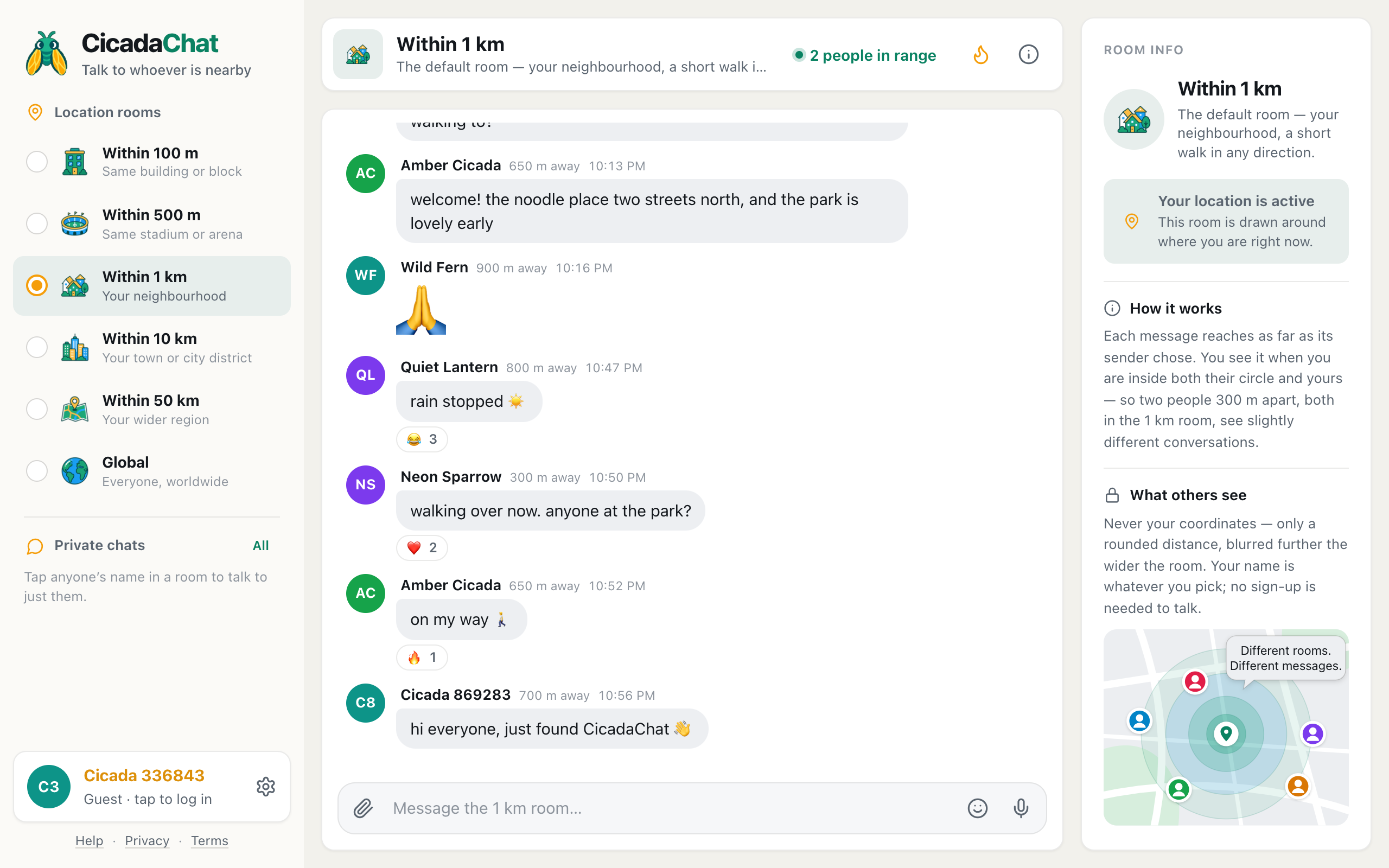
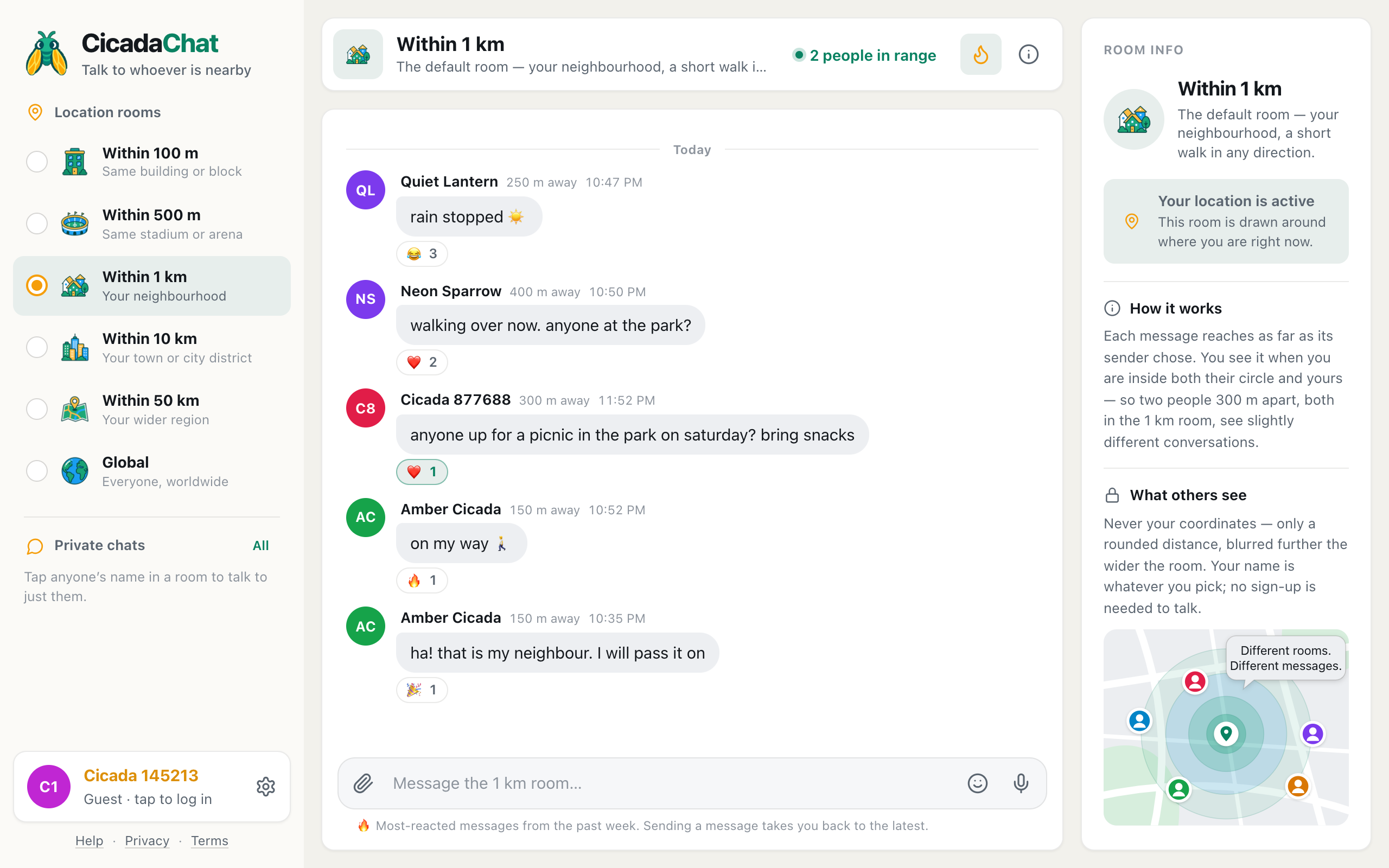
A screenshot of reader B's 1 km room, 700 m east of the park. Compare the distances with reader A's view below.
Why two people in the same room can see different messages
A CicadaChat room is a circle drawn around the person looking at it. When you and a friend both pick Within 1 km, you each get a circle 1 km wide, but centred on two different spots. The circles overlap, and the overlap is shared, but each of you also sees a strip of neighbourhood the other doesn't.
On top of that, every message has a reach of its own: the size of the room its sender was in. So whether a message appears on your screen depends on three things:
- Where it was sent from. Every message keeps the point it was sent from, and distances are measured from there.
- How far its sender let it reach. A message sent from the 500 m room reaches 500 m, and no further.
- How big your own room is. You see messages sent within your room's radius of you, and no further.
Put together, the rule is: you see a message when the distance between you and the point it was sent from is no more than the smaller of the two radiuses, the sender's room and yours. Room info puts it in one sentence: You see it when you are inside both their circle and yours.
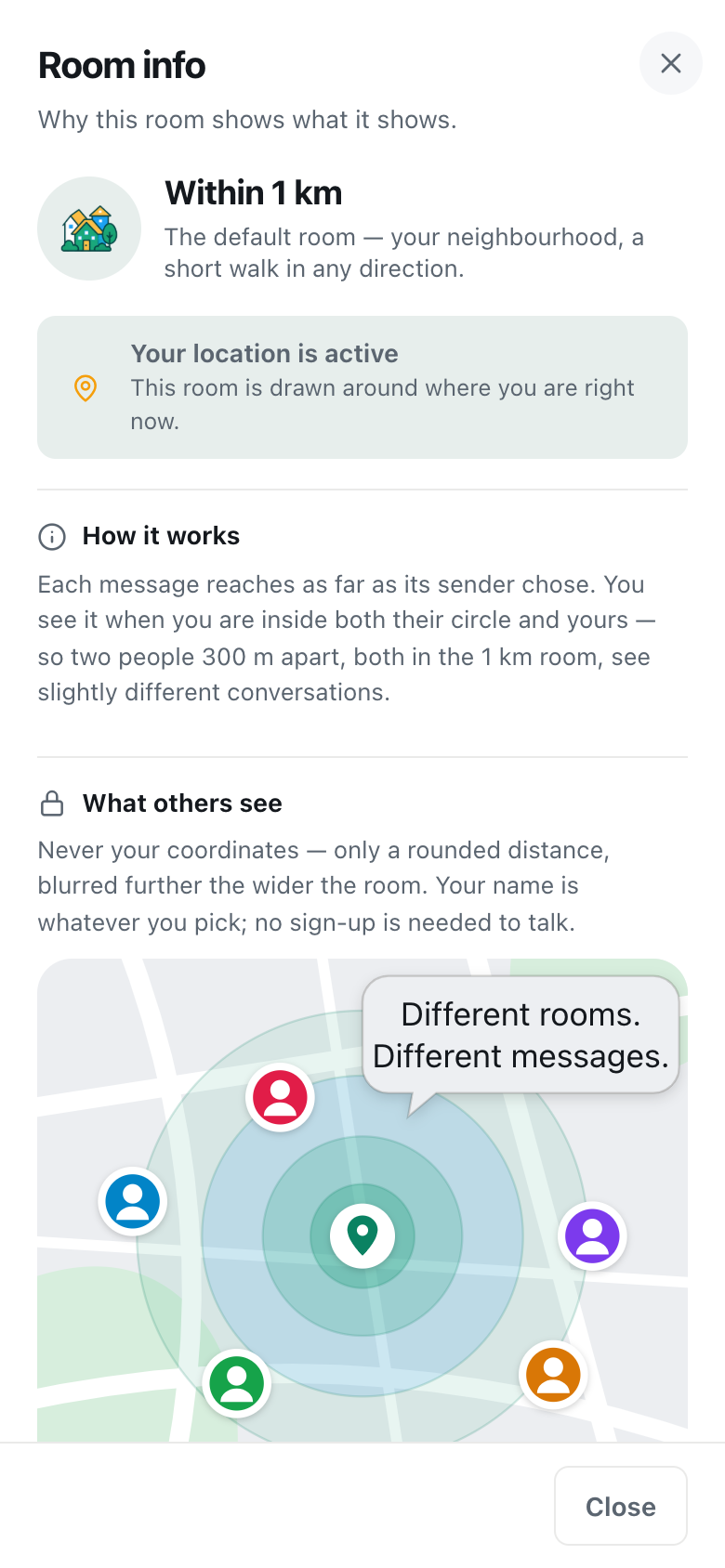
A screenshot of Room info on a phone. The picture at the bottom shows why different rooms mean different messages.
Example 1: two readers 700 m apart, both in the 1 km room
Here's one neighbourhood conversation seen by two people at the same moment. Reader A is standing by the park. Reader B is 700 m east of them. Both are in Within 1 km.
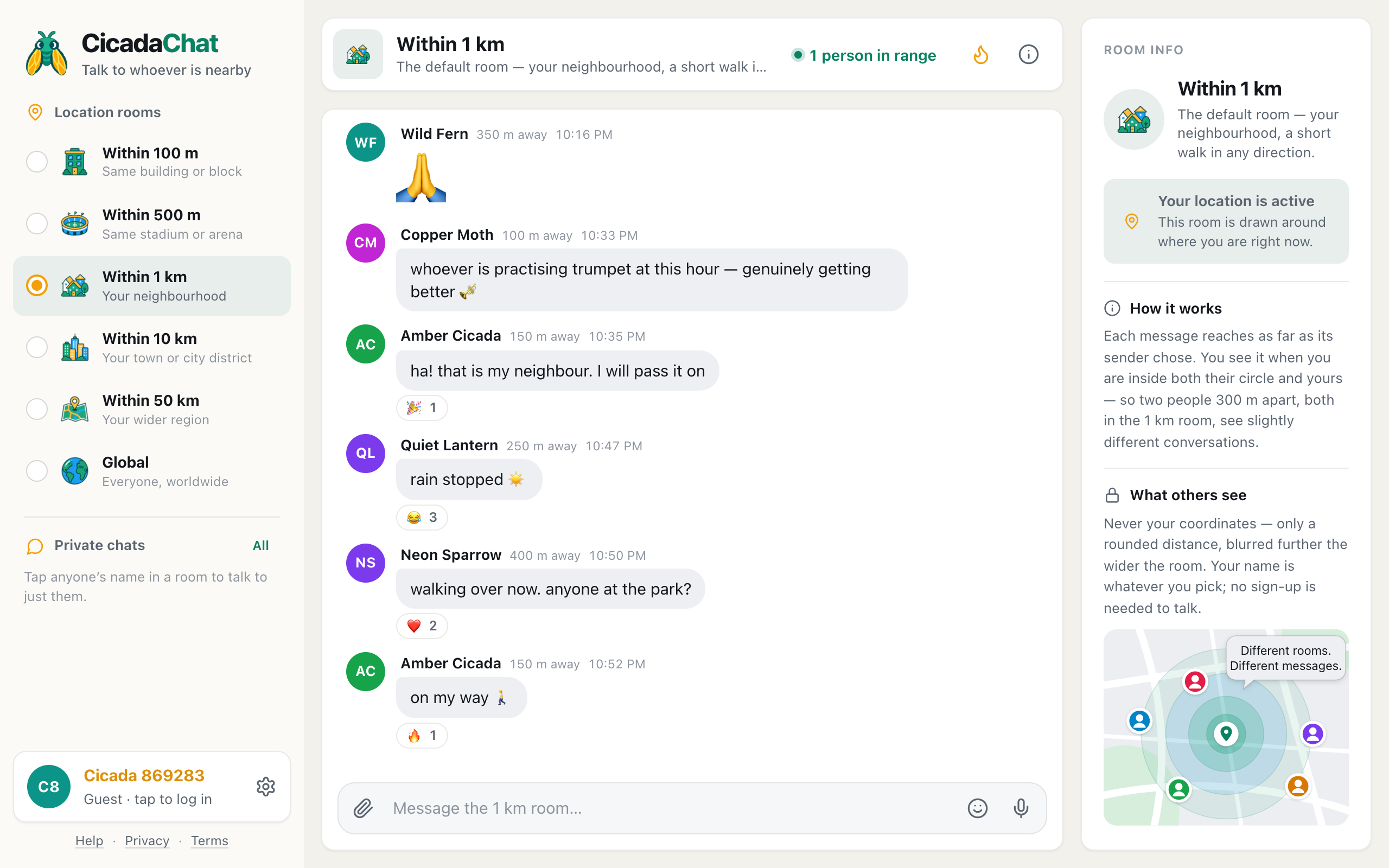
A screenshot of reader A's 1 km room at the park. The trumpet message and Amber Cicada's reply appear here but not for reader B.
Compare this with the picture at the top of the article, which is what reader B sees. Some messages are the same, but the distances are different, and some messages appear on only one screen:
| Message | Sent to | Reader A sees it | Reader B sees it |
|---|---|---|---|
| Neon Sparrow: "walking over now. anyone at the park?" | 1 km room | Yes, 400 m away | Yes, 300 m away |
| Quiet Lantern: "rain stopped ☀️" | 1 km room | Yes, 250 m away | Yes, 800 m away |
| Copper Moth: "whoever is practising trumpet at this hour…" | 500 m room | Yes, 100 m away | No: about 600 m away, beyond its 500 m reach |
| Amber Cicada: "ha! that is my neighbour…" | 500 m room | Yes, 150 m away | No: 650 m away, beyond its 500 m reach |
The first two messages were sent to the 1 km room, and both readers are within 1 km of where they were sent, so both see them, each with their own distance. The last two were sent to the 500 m room. Reader A is close enough. Reader B is in a room big enough to hold them, but they were never allowed to travel 600 m. Neither reader is doing anything wrong, and neither is missing a setting. They're simply standing in different places.
Example 2: the same reader, a smaller room
Now reader A switches from Within 1 km to Within 100 m. Their conversation shrinks to two messages: the trumpet message, sent from 100 m away, and a hello sent from right next to them. Quiet Lantern's "rain stopped", sent from 250 m away, disappears, even though it was sent to the 1 km room and reader A is well inside its reach.
That's the second half of the rule. Your own room is a limit too, so a smaller room is a quieter room. It shows only what was said very close to you, whatever reach the sender chose.
Example 3: two people who can't hear each other at all
This one catches people out. Say Lan is in the 100 m room and her neighbour Minh, 300 m away, is in the 10 km room.
- Lan writes "anyone else's power out?" It reaches 100 m. Minh is 300 m away, so he doesn't see it, even though his room is huge.
- Minh replies to the whole district from the 10 km room. His message reaches 10 km, easily far enough for Lan, but Lan's own room only shows messages sent within 100 m of her. She doesn't see it either.
Neither of them sees the other, because each message fails one half of the rule. For two people to talk in a location room, both need to be in rooms at least as big as the distance between them. If they're 300 m apart, 500 m rooms or wider on both sides will do.
In practice, when you reply to someone, look at the distance next to their message. If it says 300 m away, a reply from the 100 m room will never reach them. Reply from the 500 m room or wider instead. If you already know each other, a private chat avoids the question entirely.
Example 4: the conversation changes as you move
A room's history isn't fixed. It's worked out from where you are when you open the room. While the app is open, your position also updates in the background whenever you move about 25 m or more, and from then on new messages reach you according to where you are now.
The messages already on your screen stay as they were until the room loads again, which happens when you switch rooms or reopen the app. So after a 500 m walk east, the new conversation follows you straight away, but the history catches up the next time the room loads: some messages from the west side drop out, older messages from the east side appear, and each distance is measured again from your new spot.
So if a friend says "scroll up, it's just there" and you can't find it, check where you both are. Your friend may be reading from a spot that the message reaches, while you're just outside it.
Example 5: Global and local rooms never mix
If one of you is in Global and the other is in a local room, you'll never see each other's room messages, however close you're standing. Global messages have no sending point and no reach. They're shown only in Global, and local messages are never shown there. That's by design: local rooms stay local, and Global stays a single room for everyone.
What "people in range" counts
The same rule decides the people in range count in the header. It counts the people online right now whose own room would show a message if you sent one. A neighbour 300 m away who is reading the 100 m room isn't counted in your 1 km room, because your message wouldn't appear in their room. That's why two friends standing together can see different counts, too.
My friend can't see my message: a checklist
- Check you're both in local rooms. If one of you is in Global, you're in separate conversations.
- Check which room you sent it from. The message reaches only as far as that room. The message box names the room before you send: Message the 100 m room….
- Check your friend's room. It must be at least as big as the distance between you. If you're 700 m apart, your friend needs the 1 km room or wider.
- Check how far apart you really are. Distances are rounded, more roughly in wider rooms, so someone shown as right here in the 10 km room may be over 100 m away.
- Check that both of you are sharing a location. Without one, the local rooms are greyed out and you're in Global. The gear next to your name opens Settings, which shows the location status.
- If one of you has moved, reload by switching rooms and back. The history on screen isn't reloaded as you move, but switching rooms works it out again from where you are now.
If you simply want to be sure one person gets your message, send it privately: tap their name in the room. Private chats have no distance at all, so they keep working however far apart you move.
Why CicadaChat works this way
It would be simpler to give everyone one shared room per area, but it would be worse in the ways that matter. With fixed areas, two people across the street from each other could land in different rooms, while someone at the far edge of the same area would count as "local". With circles, everyone is always at the centre, and "nearby" means the same thing for everyone: the people really around you.
The rule also keeps things fair. Nobody can shout into a room tighter than the one they're speaking in, and nobody can listen in on the 100 m room of a building from across the city. You decide how far your voice carries, and each reader decides how far they want to listen.
No comments yet. Start the conversation.