
Quiet questions in the library and the study hall: the 100 m room on campus
Ask about opening hours, free sockets and lost bottles without breaking the silence. How to use the 100 m room in the library and study hall, and the etiquette that keeps it quiet.
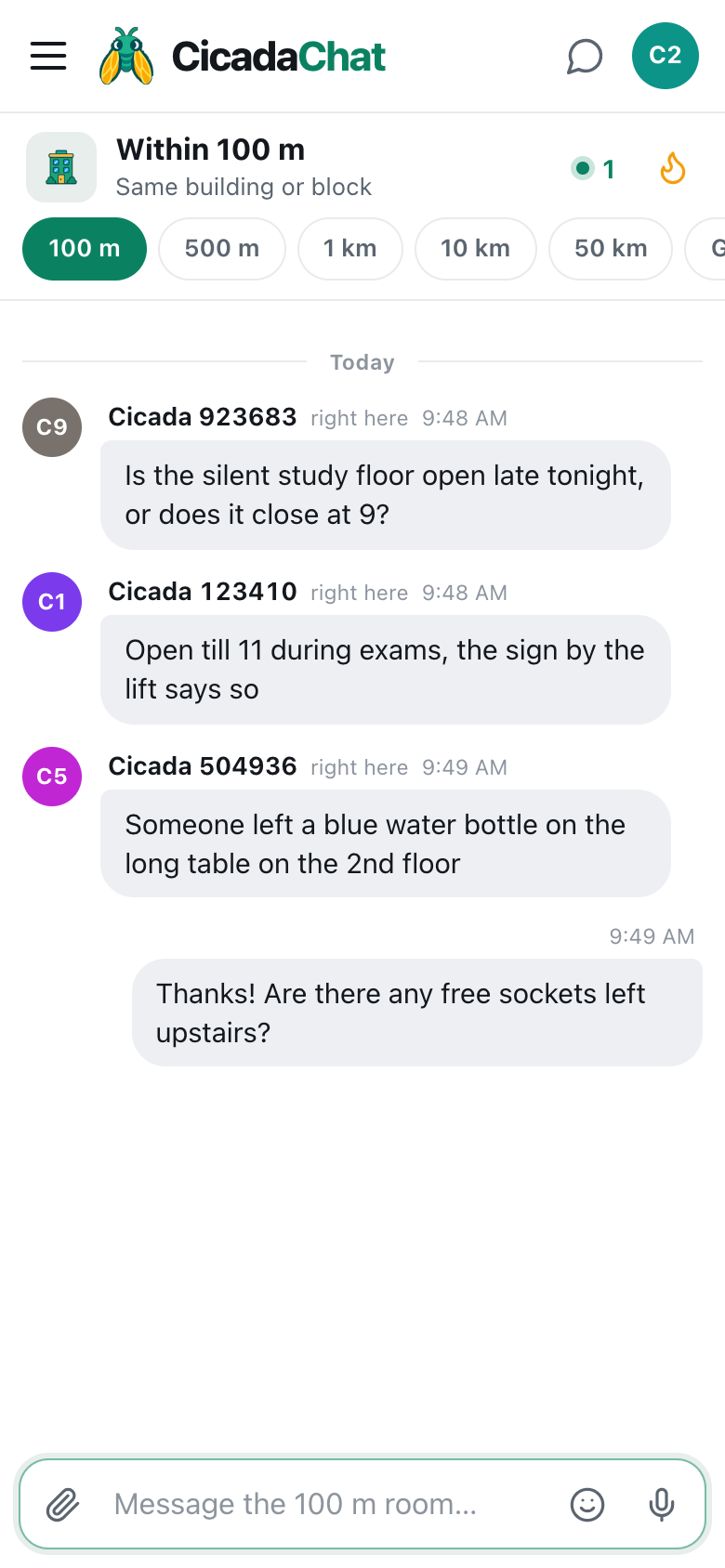
In a library you can't shout "is anyone using this socket?" across the room, and walking up to strangers mid-revision feels worse. Yet libraries, study halls and reading rooms are full of small questions: when does this floor close, is that seat taken, who left their bottle on the long table. CicadaChat's 100 m room is made for quiet questions like these. It reaches the people in the same building, silently, and nobody needs to know your name. This article covers using the 100 m room in the library and the study hall on campus: what it's good for, how it differs from the wider campus rooms, and the etiquette that keeps it pleasant.
Why the 100 m room fits a library
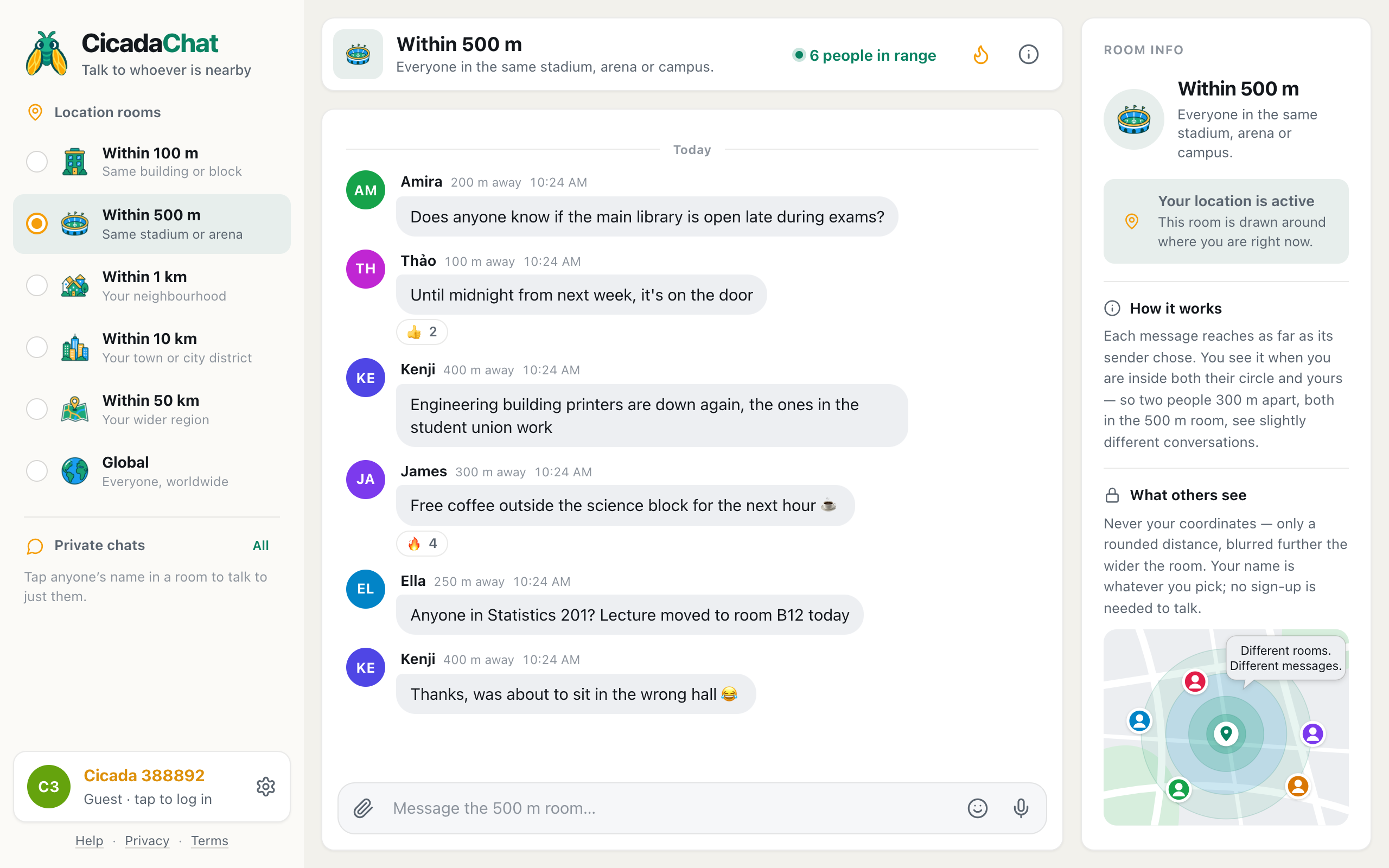
A campus is big. The whole of one usually fits in CicadaChat's 500 m room, whose label is Same stadium or arena, and that room is the right place for campus-wide chatter. But a question about the library is only useful to the people in the library. Ask it in the 500 m room and it lands in front of people at the sports hall and the student bar.
The 100 m room is a circle with a 100 m radius around wherever you're sitting. In a library, that's the building, perhaps the one next door, and not much more. Your message reaches everyone within 100 m of you who has a local room open, and you see what they say. It's the room that matches the building you're in.
And it's silent. Typing is quieter than whispering, and nobody has to leave their desk.
A screenshot of the 100 m room in a library. Everyone nearby shows as right here, which tells nobody which desk is whose.
Quiet questions that work well
Opening hours and rules
"Is the silent study floor open late tonight, or does it close at 9?" Someone has always read the sign by the lift. During exams, when hours change, this is one of the most useful things the room does.
Seats, sockets and rooms
- "Are there any free sockets left upstairs?"
- "Group study room B is free if anyone needs it, we've just left."
- "Is the window seat by the stairs taken? There's a bag but nobody's been there for an hour."
Lost and found
"Someone left a blue water bottle on the long table on the 2nd floor." Post it from where you found it, so it reaches the people who were sitting there. For anything valuable, hand it to the library desk and say so in the room.
Study questions
"Does anyone know which shelf the statistics textbooks are on?" "Is anyone else revising for the organic chemistry exam? Want to test each other at the café later?" Some of the best study partners are people you'd never have spoken to.
Etiquette for a quiet room
A library chat works because it keeps the library quiet. A few habits keep it that way:
- Put your phone on silent before you open the room. A chat that makes your neighbour's phone buzz defeats the point.
- Keep it short. One question, one answer. Long conversations can move to the café or to a private chat.
- React instead of replying. A 👍 or 🙏 from the row of quick reactions says "thanks" without another message.
- Skip voice notes. CicadaChat can send voice notes, but they're the one thing that doesn't belong in a silent room.
- Dim your screen at night. In a quiet reading room late in the evening, a bright white screen catches everyone's eye. Choose Dark in CicadaChat's Settings, or System to follow your device.
- Don't comment on people. "The guy in the red jumper is loud" is unkind and easy to recognise. "Could we keep the second floor quiet? It's a silent zone" makes the same point.
Staying anonymous
In a library, you're surrounded by people you'll see again: classmates, tutors, people from your halls. That makes privacy matter more, not less.
- Your coordinates are never shared. Others see a rounded distance: right here for anyone under 50 m, then 50 m away or 100 m away. In a library, almost everyone is "right here", which tells nobody which desk is yours.
- Your name is up to you. As a guest, you're Cicada plus a number. With an account, you choose. If you'd rather ask a question without the whole reading room knowing it was you, stay a guest or use a first name.
- Be careful with details. "I'm the one by the window with the green laptop" makes you easy to spot. Share it only when you want to be found, and preferably in a private chat.
For more on what others can see, read privacy in the smallest room: what the people within 100 m can and can't see.
Meeting study partners
When you get talking to someone in the room and want to keep in touch, tap their name on one of their messages to start a private chat. Private chats are just the two of you, and they don't depend on distance, so they keep working after you've both left the library.
For a study group, a private room is better still. It's an invite-only group chat for registered accounts. Everyone adds each other as friends, then one person creates the room and adds the others. It works from anywhere, so the group can keep planning over the holidays.
Campus rooms: which one to use
A campus usually spans several rungs of CicadaChat's room ladder. A rough guide:
- Within 100 m: the library, a lecture building, your hall of residence. Questions about this building.
- Within 500 m: the whole campus. Events, clubs, "anyone going to the talk tonight?".
- Within 1 km: the campus and the streets around it, where many students live.
Remember that what you hear includes messages sent to wider rooms. If someone within 100 m of you posts in the 500 m room, you'll see it in the 100 m room too, because they're inside your circle and you're inside theirs. The help article choosing a room: 100 m, 500 m, 1 km, 10 km, 50 km or Global explains every rung.
In halls of residence
Halls are one of the places where the 100 m room shines. A block of student rooms is almost exactly the size of the room, and the questions are the same every term:
- "Is the laundry room on the ground floor free, or is there a queue?"
- "Does anyone have a tin opener I could borrow?"
- "The fire alarm test is at 10 tomorrow, according to the notice."
- "Anyone want to split a pizza order?"
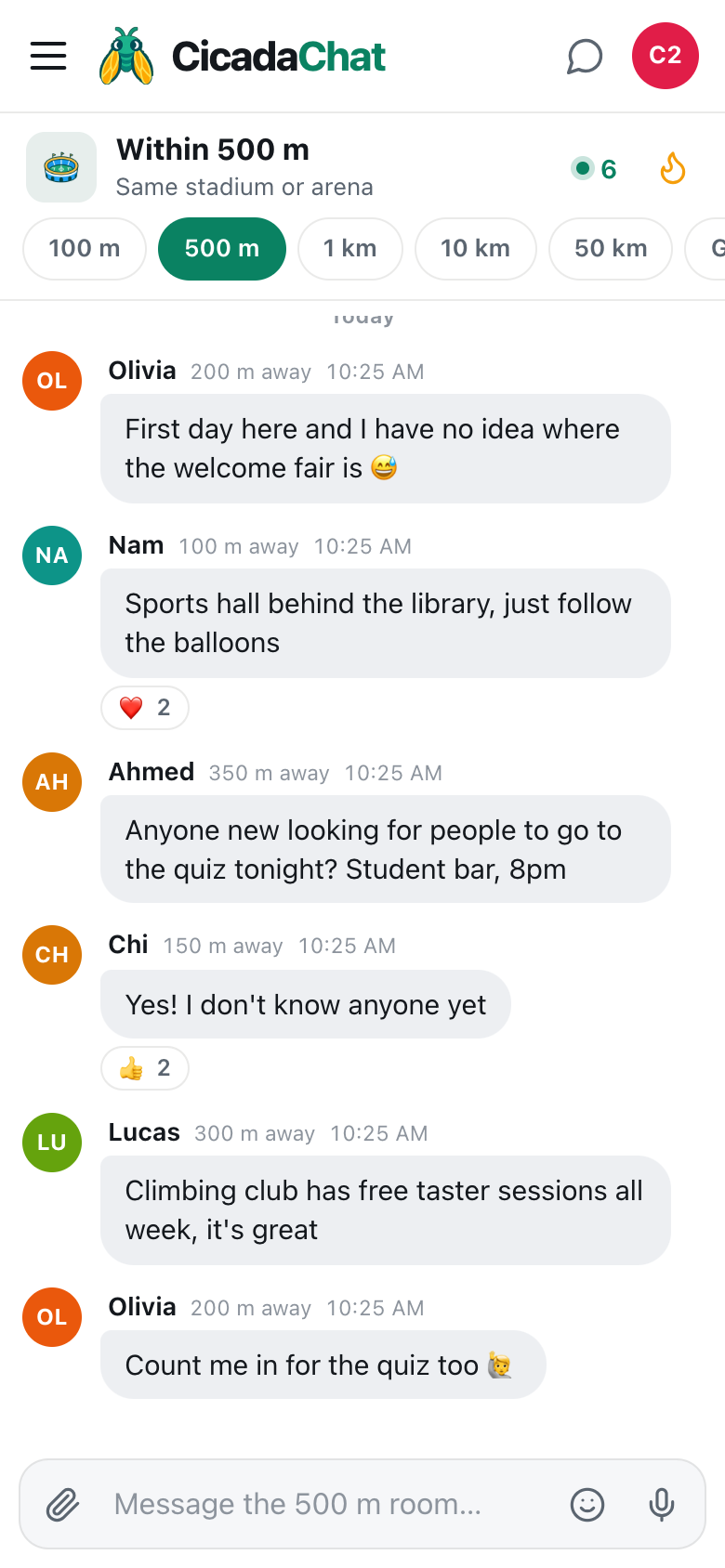
At the start of the year, when nobody knows anyone yet, a message like "First years on the third floor, anyone want to walk to the welcome fair together?" is an easy way to meet people. Nobody has to be added to a group, and nobody has to give out a phone number to take part.
The same privacy habits apply as in the library, perhaps more so: the people in your 100 m room are the people you share a kitchen with. Leave room numbers out of public messages, and move anything personal to a private chat.
In exam season
Exam season is when the library room gets busiest, and when a few habits help most:
- Check Hot first. Before asking whether the library's opening hours have changed, tap the flame in the header. Hot shows the most-reacted messages of the past week, and useful notices like "open till 11 during exams" tend to collect reactions.
- React to useful notices for the same reason: a 👍 on the opening-hours message keeps it near the top of Hot for the next person.
- Keep the room calm. Stress is catching. Questions and answers help everyone; long complaints about the exam timetable don't.
When the library is quiet in the app too
If you open the 100 m room and nothing has been said, you'll see Nobody has said anything yet and Be the first. Anyone within 100 m will see it. Libraries are full of people with their heads down, so give a question time. It stays at the spot where you sent it, and anyone who opens a local room within 100 m of that spot later will see it.
A few tips for a quiet library room:
- Ask something with a clear answer: hours, sockets, rooms.
- Post at busy times, such as mid-afternoon in exam season.
- If a friend is in the library too, mention the room to them.
A note on location indoors
Libraries are often big, thick-walled buildings, and phones are least accurate indoors. If your location is off by a few dozen metres, the edge of your 100 m circle moves too. You may see a message from the building next door, or miss one from the far end of your floor. A seat by a window usually gives a better location fix.
The same approach works in any shared building where people keep to themselves: offices and co-working spaces have their own version, covered in the 100 m room at the office or co-working space.
No comments yet. Start the conversation.