
Small towns, suburbs and villages: when the 10 km room is your local room
Outside the city, the 1 km room can be quiet. Why the 10 km room fits small towns, suburbs and villages, what people talk about there, and how to get a quiet room going.
In a big city, a kilometre in any direction holds thousands of people. In a small town, a suburb of detached houses or a village surrounded by fields, it might hold a few hundred, and on a given evening none of them may be on CicadaChat. That's when the 10 km room becomes your local room. This article is about using CicadaChat in small towns, suburbs and villages: why the 10 km room fits them, what people talk about there, how to get a quiet room going, and what's different about privacy when the town is small.
Why the neighbourhood room can be quiet outside the city
Every CicadaChat room is a circle drawn around you. The 1 km room, where the app starts, is sized for a city neighbourhood: the streets you can walk to in ten minutes. In a city, that circle is full of people. Outside one, it can be a handful of streets, a main road and some fields.
You can tell how busy a room is at a glance. The green dot and number beside the room name are the people in range: how many people are online now and would hear you, you included. If it says 1, it's just you. Tap it and the list will say Nobody else is in range right now. Try a wider room. That's CicadaChat's own advice, and outside the city, the next room worth trying is usually 10 km. The help article who's around? Using the People in range list explains what the list counts.
Why the 10 km room fits small towns and villages
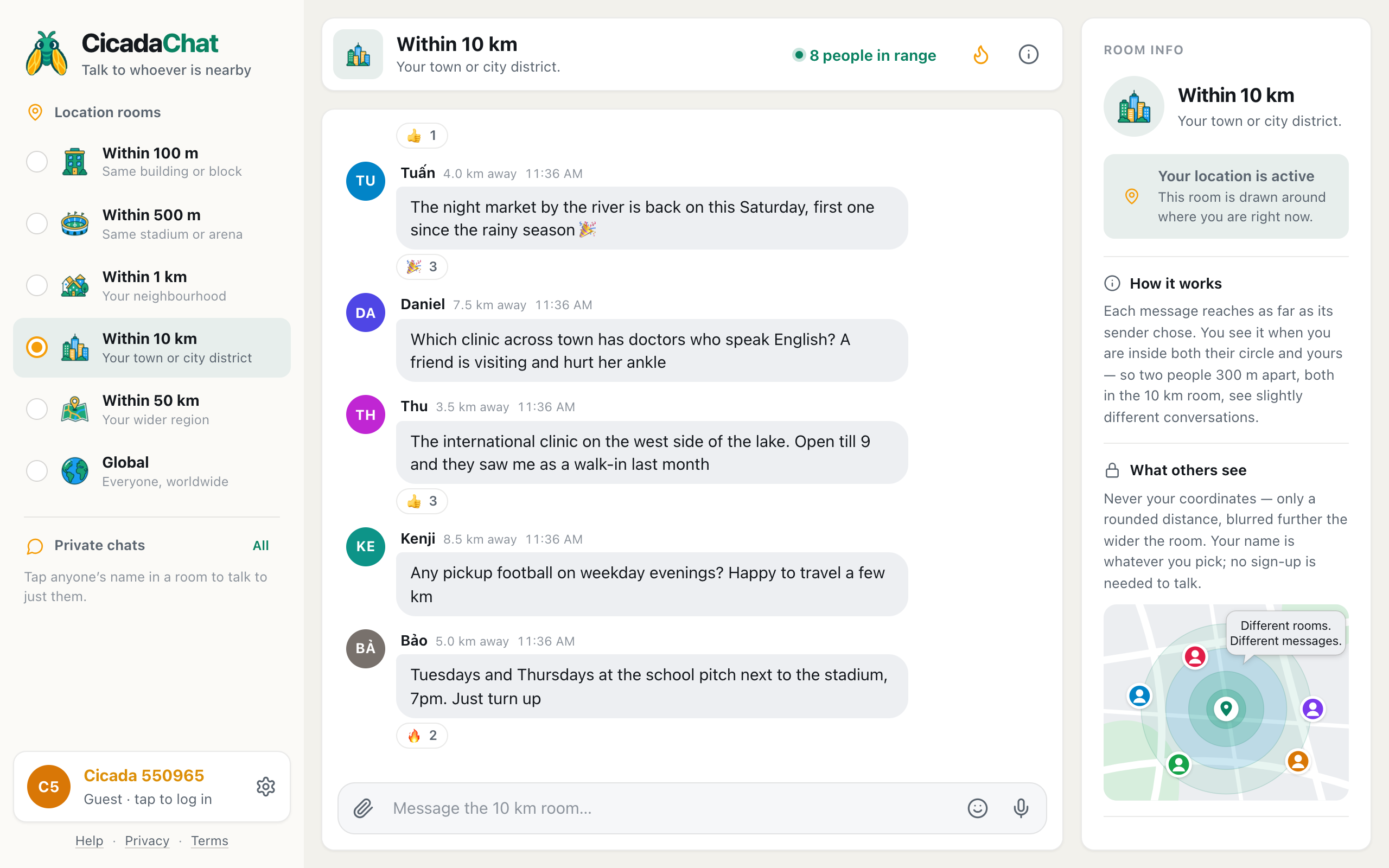
The 10 km room is labelled Within 10 km, with Your town or city district underneath. Twenty kilometres across, it covers most small towns completely, with room to spare for the villages and farms around them. It's the area people share a life in: the same market, the same secondary school, the same clinic, the same bus into the city, the same weather.
That shared life is what makes a room work. A question about the Sunday market or the bus timetable means something to everyone in a 10 km circle around a market town. The same question in the 10 km room of a big city would reach people in five different districts, most of whom don't use that market or that bus. In the countryside, the 10 km room is as local as the 1 km room is in the city.
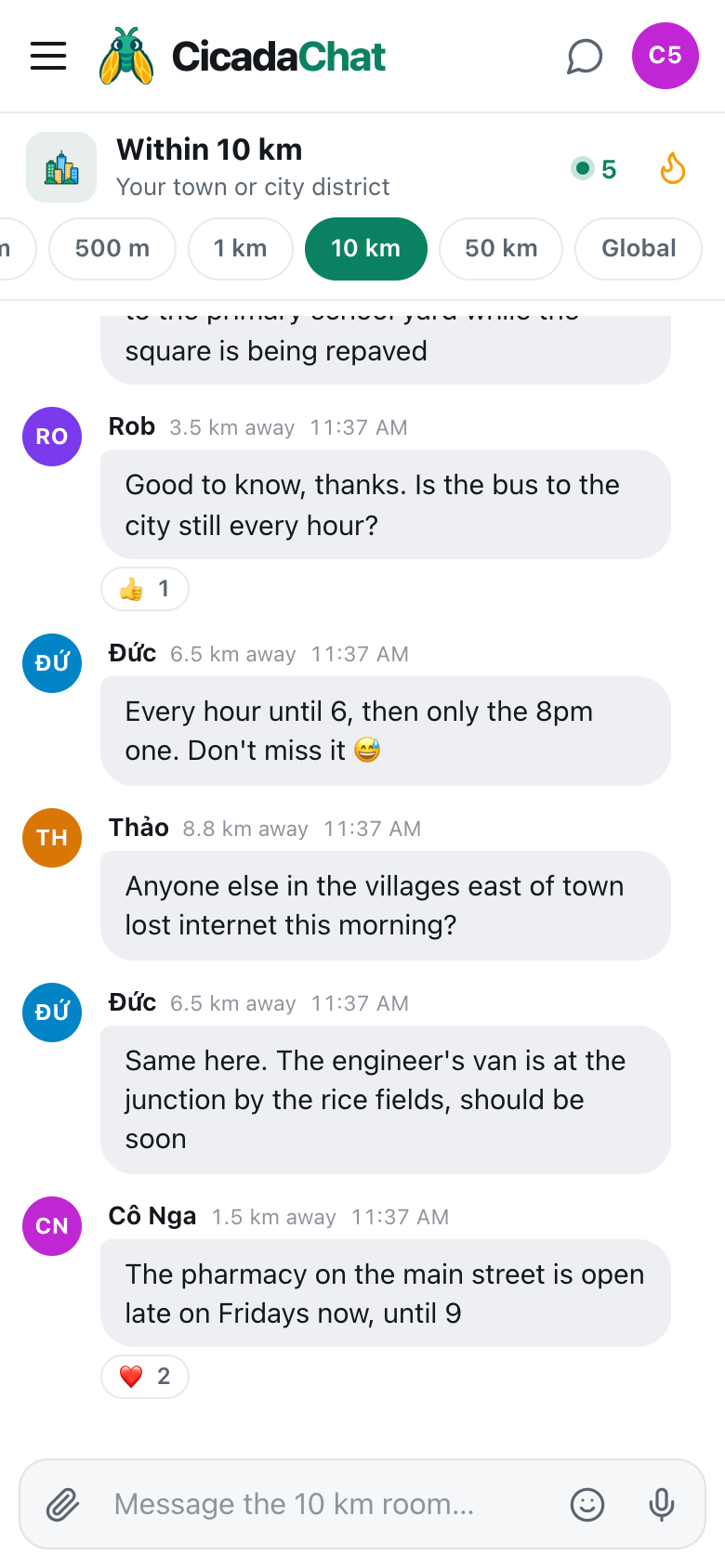
A screenshot of the 10 km room around a small town. Five people in range are talking about the farmers' market moving, the last bus to the city, an internet outage in the villages and the pharmacy's new hours.
What people talk about in a small-town room
The things that change
The market moves to the school yard while the square is repaved. The pharmacy stays open late on Fridays now. The swimming pool closes for a week. In a small town, news like this travels by word of mouth, and the 10 km room is word of mouth for people who've just moved in, work odd hours or don't know the right people to ask.
Getting to the city
Bus times, the last train, whether the main road is flooded, who's driving into the city on Thursday and has a spare seat. For people outside a city, getting in and out is a big part of life, and the 10 km room is full of people making the same trip.
Outages and weather
When the internet or the power goes in one village, the first question is whether it's just you. In a small-town room, someone three villages over can answer in a minute, and someone else has usually spotted the engineer's van. The same goes for storms, floods and roads blocked by fallen trees.
Buying, selling and swapping
Eggs, vegetables from the garden, firewood, a second-hand bicycle, a trailer to borrow for an afternoon. With a 10 km radius, the room reaches enough people for something to find a new home, and they're still close enough to collect it.
Services
Who fixes tractors, who tutors maths, which vet does home visits, whether anyone knows a reliable electrician. In a small place, a recommendation from someone who has used them is worth more than any listing.
Market days and seasons
Small towns run on a calendar: market day, harvest, the school holidays, the festival that fills the hotels once a year. The room follows the same rhythm. It's busiest on market mornings and in the evenings before a holiday, and it's where you'll hear that the festival parade has changed its route or that the ferry has a winter timetable from next week.
Suburbs: between the town and the city
Suburbs are a special case. Houses are spread out, so the 1 km room can be quiet, but the city is close, so the 10 km room around a suburb usually reaches into it. That can be a good thing: you hear about the city you commute into as well as the suburb you live in. If the city talk drowns out the local talk, try both rooms side by side, the 1 km room for your street and the 10 km room for everything else, and switch between them with the tabs under the header.
How to get a quiet room going
A room is only as lively as the people who talk in it. In a small town you might be one of the first people there, and the room grows because you used it. Some things that work:
- Ask a real question. "Does anyone know if the Sunday market is on this week?" gets an answer. "Hello, anyone here?" usually doesn't.
- Answer when you can. A room with answered questions is a room people come back to. If you know the bus times, say so.
- React. A 👍 or ❤️ on a useful message tells the next person it's a good one, and puts it into the room's Hot view, the most-reacted messages of the past week. In a slow room, Hot becomes a noticeboard of the things worth knowing.
- Come back at busy times. Mornings before work and evenings after dinner are when most people open the app. A question asked at 7pm is seen by more people than one asked at 3pm on a weekday.
- Tell people about it. The room gets better with every neighbour who opens it. It needs no sign-up, so someone can join the conversation seconds after hearing about it.
The 100 m room has the same problem at a smaller scale, and why the 100 m room is quiet sometimes, and how to start a conversation there has more ideas that work just as well in a town.
When even 10 km is quiet: the 50 km room
In remote areas, a 10 km circle might hold a few villages and nothing else. The next rung, Within 50 km or Your wider region, is a hundred kilometres across and usually reaches the nearest city. It's good for regional things: the weather coming in, the state of the main roads, a festival in the county town. For local things, the 10 km room is still the better place to ask, even if you have to wait a little longer for the answer.
Remember how reach works: a message is seen when the distance is no more than the smaller of the sender's room and the reader's. A question you ask in the 50 km room reaches people 40 km away only if they're listening in the 50 km room too. If you want to be heard by the town, ask in the town's room.
Privacy when the town is small
CicadaChat's privacy rules are the same everywhere: nobody sees your coordinates, only a distance rounded to the nearest 250 m in the 10 km room, and photos are re-encoded on your device, which strips the location data cameras hide in them. But in a small town, fewer people means each detail says more.
- Think about your name. In a city, "Linh" is one of thousands. In a village, it might be the only Linh. Use a name you're happy for the town to recognise.
- Be careful with distances from home. If there are only three houses about 1.5 km from the market, a message sent from home narrows things down. Posting from somewhere public, or not minding who knows, are both fine choices. Just make it a choice.
- Share places, not people. "The road past the rice fields is flooded" helps. A comment about a neighbour, in a room where everyone knows everyone, rarely does.
- Keep details for private chats. Tap someone's name to talk to just them. That's the place to arrange collecting the eggs or borrowing the trailer.
From a quiet room to a community
Small-town rooms often end up with a group of regulars who know each other. Once you do, a free registered account lets you add them as friends and create a private room, an invite-only chat that works wherever each of you happens to be, for the allotment group, the village football team or the parents at the primary school. The town room stays open for everyone else, including the newcomer who arrived last week and has a question about the bins.
If you're still deciding which room to use, 1 km or 10 km? How to tell when it's time to go wider goes through the choice with a worked example.
No comments yet. Start the conversation.