
Lost a cat, found a key: using the 100 m room for lost and found on your block
Lost things rarely travel far. How to post lost and found messages in the 100 m room that reach the right people, what to include and leave out, and how to hand things back safely.
A set of keys on the wall by the gate. A cat on the wrong windowsill. A glove on the railing, a parcel on the wrong doormat. Lost things rarely travel far, and the people most likely to find them are the ones who live, work or walk within a hundred metres. That makes CicadaChat's 100 m room a natural lost and found for your block: whoever reads it is close enough to have seen what you lost, or to walk over and collect what you found. This article covers how to post a lost or found message that works, what to include and leave out, and how to hand things back safely.
Why the 100 m room works for lost and found
A lost and found board only works if the right people see it. A citywide group is too big: your message scrolls away among hundreds of others, and most readers are nowhere near. A notice taped to a lamp post is too small: it reaches only the people who happen to walk past it.
The 100 m room sits in between. Your message reaches everyone within 100 m of the spot you send it from, whichever local room they're reading. And because messages stay where they were sent, someone who opens CicadaChat nearby tomorrow morning still sees it. It's a notice board that exists exactly where the thing was lost.
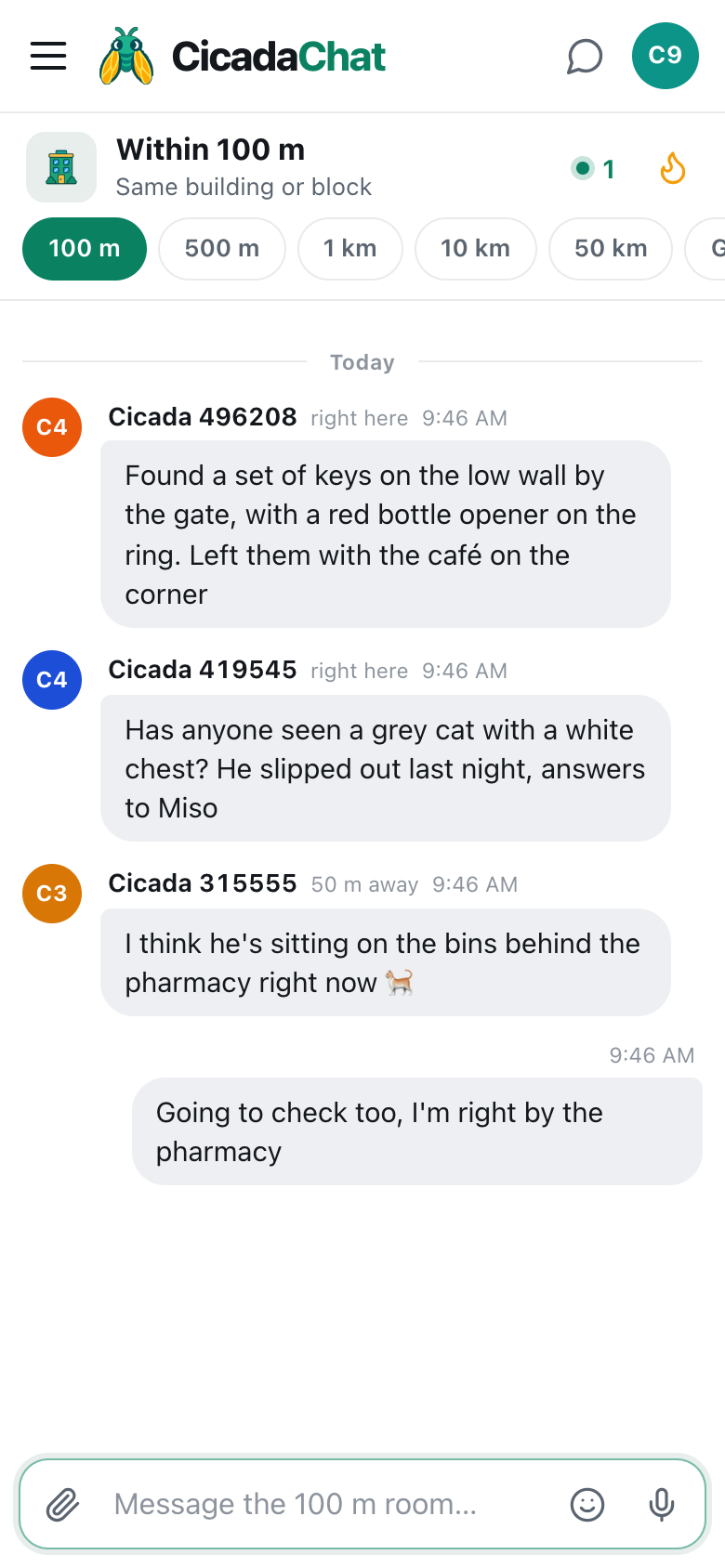
A screenshot of the 100 m room on a phone, working as the block's lost and found. The found keys are described, but one detail is kept back.
Posting a "found" message
If you've found something, the aim is to describe it well enough for the owner to recognise it, but not so well that anyone could claim it.
- Stand near where you found it, or where you're keeping it, and open the 100 m room.
- Say what it is and roughly where you found it: "Found a set of keys on the low wall by the gate."
- Add one detail that helps the owner recognise it, and keep one back: "red bottle opener on the ring". Ask the person who claims them what else is on the ring.
- Say where it is now: "Left them with the café on the corner" or "I have them, message me."
Leaving an item with a shop, a café or the building's front desk is often easiest. The owner can pick it up without having to meet you, and you don't have to be home at the right time.
Should you add a photo?
A photo helps with things that are hard to describe, like a child's toy or a scarf. Tap the paperclip, choose Photo, and add a caption. CicadaChat resizes photos on your device and strips the hidden GPS data phone cameras add, so the file doesn't carry where it was taken.
For keys, cards and anything valuable, skip the photo or crop it tightly. A clear picture of a key can be copied, and a photo of a wallet shows the owner's details to everyone nearby. Describe it instead and let the owner prove it's theirs. The help article how to send photos and documents in a chat explains photo sizes and what else you can attach.
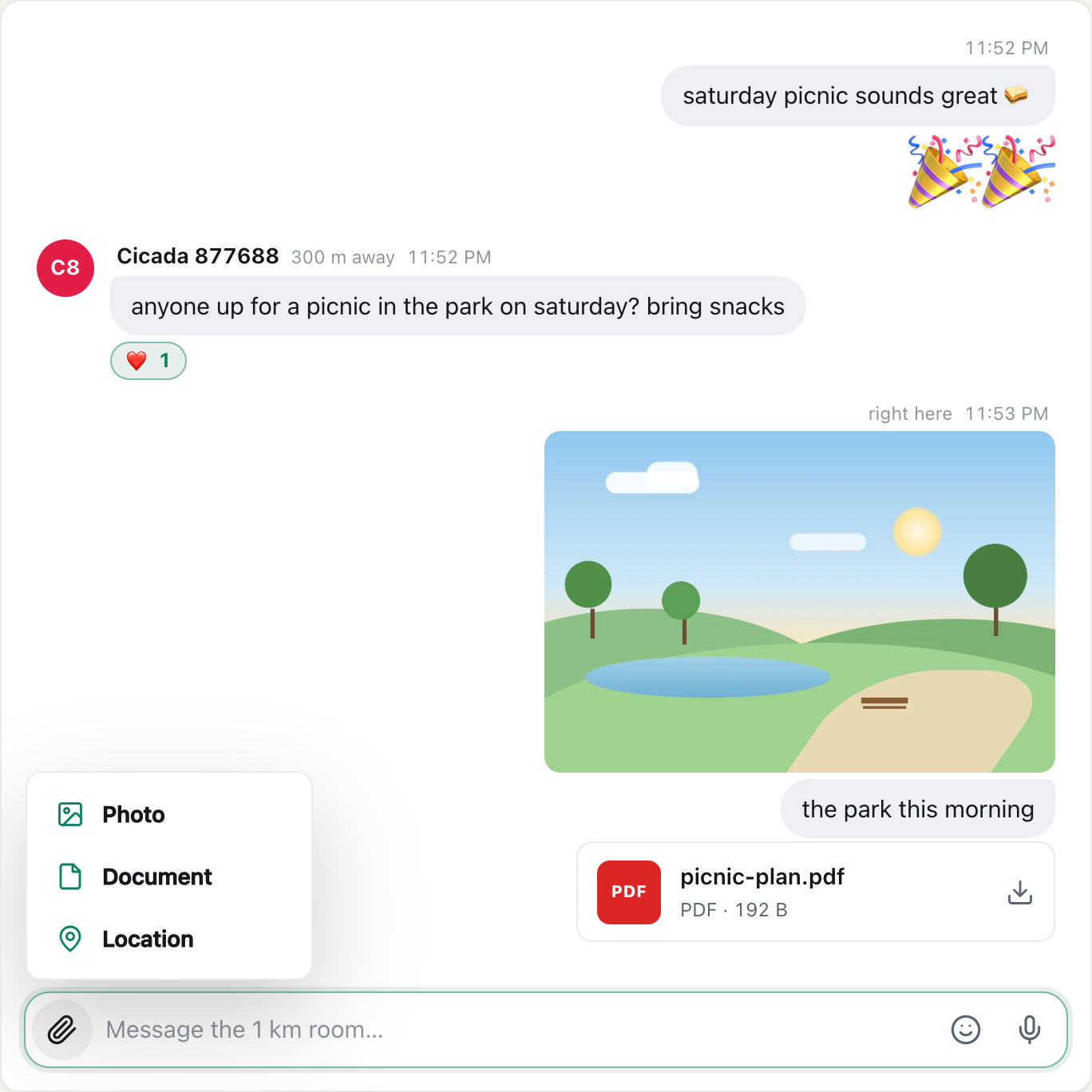
A screenshot of the attach menu. Choose Photo for a picture of what you found, or Location to pin where it is right now.
Posting a "lost" message
When you've lost something, where you post from matters. The 100 m room is centred on you, so a message sent from your flat reaches people within 100 m of your flat. If you lost your glove at the bus stop two streets away, walk back to the bus stop and post from there, so the message reaches the people who'll pass it.
- Describe it plainly: "Has anyone seen a grey cat with a white chest?"
- Say when: "He slipped out last night" tells people how far he might be.
- Give a name if it helps: a pet that answers to its name is easier to coax out.
- Say how to reach you: "Reply here or message me" is enough. Don't post your phone number or your flat number.
Lost pets
Pets are where the 100 m room shines. A cat that's slipped out is usually hiding within a few buildings, which is exactly the room's reach. Ask people to check sheds, bike stores and under parked cars. When someone replies "I think he's on the bins behind the pharmacy", go and look straight away, and keep the room posted.
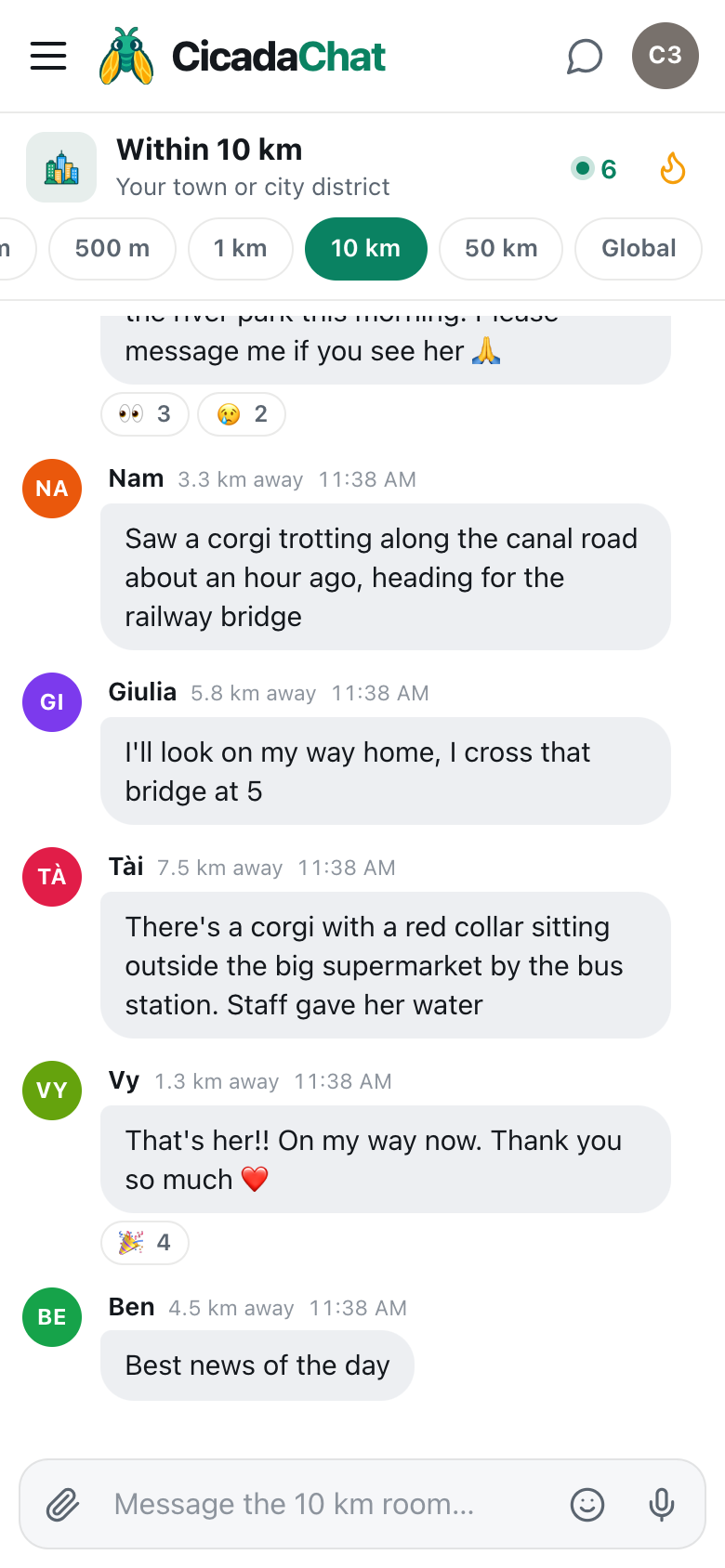
If the 100 m room is quiet, post the same message in the 500 m room as well. It still covers your block, and it reaches a wider area. A dog that's run off can cover more than 100 m in a minute, so for dogs, start wider.
Sharing a location, carefully
Sometimes "behind the pharmacy" isn't precise enough. You can attach an exact pin: the paperclip, then Location. CicadaChat shows a map preview and a warning in orange: Everyone within 100 m will see this exact spot.
That's the right tool for "the cat is under this car, right now". It's the wrong tool from inside your own home. Pin the place where the thing is, not where you live./p>
Handing things back safely
Most returns are simple: the owner picks the keys up from the café, says thank you, done. When you do meet, a few habits help:
- Move to a private chat to arrange it. Tap the other person's name to talk one to one. Details like "I'll be in the lobby at six" don't need to be seen by the whole block.
- Ask for the detail you kept back. "What else is on the key ring?" is a fair question. A real owner knows.
- Meet somewhere public: the lobby, the shop, the front of the building.
- Close the loop in the room. "Keys found their owner, thanks all" stops people from looking and keeps the room tidy.
When nobody answers
A quiet room doesn't mean nobody will see your message. It means nobody is online right now. The message stays at the spot you sent it from, and anyone who opens a local room within 100 m of that spot will see it. Try these:
- Post again at a busier time, such as the early evening when people are home.
- Post from another spot. If you lost something on a walk, post from two or three points along the route. Each message covers its own 100 m circle.
- Go one rung wider, to the 500 m room, for things that could have travelled.
- Use a paper notice too. Mention the room on it, so the next person who finds something knows where to post.
More ideas for a quiet room are in why the 100 m room is quiet sometimes, and how to start a conversation there.
Lost and found beyond your building
The same approach works wherever a small area has lots of people passing through.
Cafés, shops and gyms
If you run a café or a shop, you probably have a box of forgotten umbrellas, scarves and chargers. A message from behind the counter reaches everyone within 100 m: "Found on a table this morning: a black umbrella and a child's blue hat. Ask at the counter." Customers who've just left are often still within range, and regulars will see it next time they open the room.
Parks and playgrounds
A lost toy in a playground is almost always still in the playground. Post from the bench you were sitting on. The parents who come later that afternoon are exactly the people who'll spot it.
On the move
If you've lost something on a route, such as a glove between home and the station, remember that each message covers its own 100 m circle around the spot you send it from. Posting once from home reaches only the first part of the route. Posting from two or three points along it covers the whole walk. Keep each message short and consistent, so people who see more than one know it's the same glove.
Things that found you
Sometimes the lost thing is a letter or a parcel delivered to the wrong door. Say what it is and the name of the street or building it's for, not the addressee's full name: "A parcel for the green building on the corner was left at ours, it's at our front desk." The owner will recognise it, and the rest of the block doesn't learn anyone's name.
What not to post
A lost and found message is read by everyone within 100 m, including people passing through. Keep it to what's needed to reunite the thing and its owner:
- No photos of ID cards, bank cards or anything with a name and address on it.
- No phone numbers or flat numbers. Private chats exist for that.
- No accusations. "My bike was taken from the rack" is useful. "Someone from number 12 took my bike" isn't.
For a found wallet, phone or ID, the safest route is usually to hand it to the police or the place where you found it, and say in the room where it went. For how far a message and a photo really travel in the smallest room, read privacy in the smallest room: what the people within 100 m can and can't see.
A small room with a long memory
The nicest thing about lost and found in the 100 m room is how it builds up over time. Once people on your block know the room is where lost keys and wandering cats get posted, they check it when they find something. One "found your gloves on the railing" is all it takes for the room to become the block's lost property office.
No comments yet. Start the conversation.