
Borrow a ladder, give away a sofa: the 1 km room as a neighbourhood noticeboard
Borrowing, lending, giving away and swapping in CicadaChat's 1 km room: how to post so things move, how to hand them over safely, and how to keep the room readable.
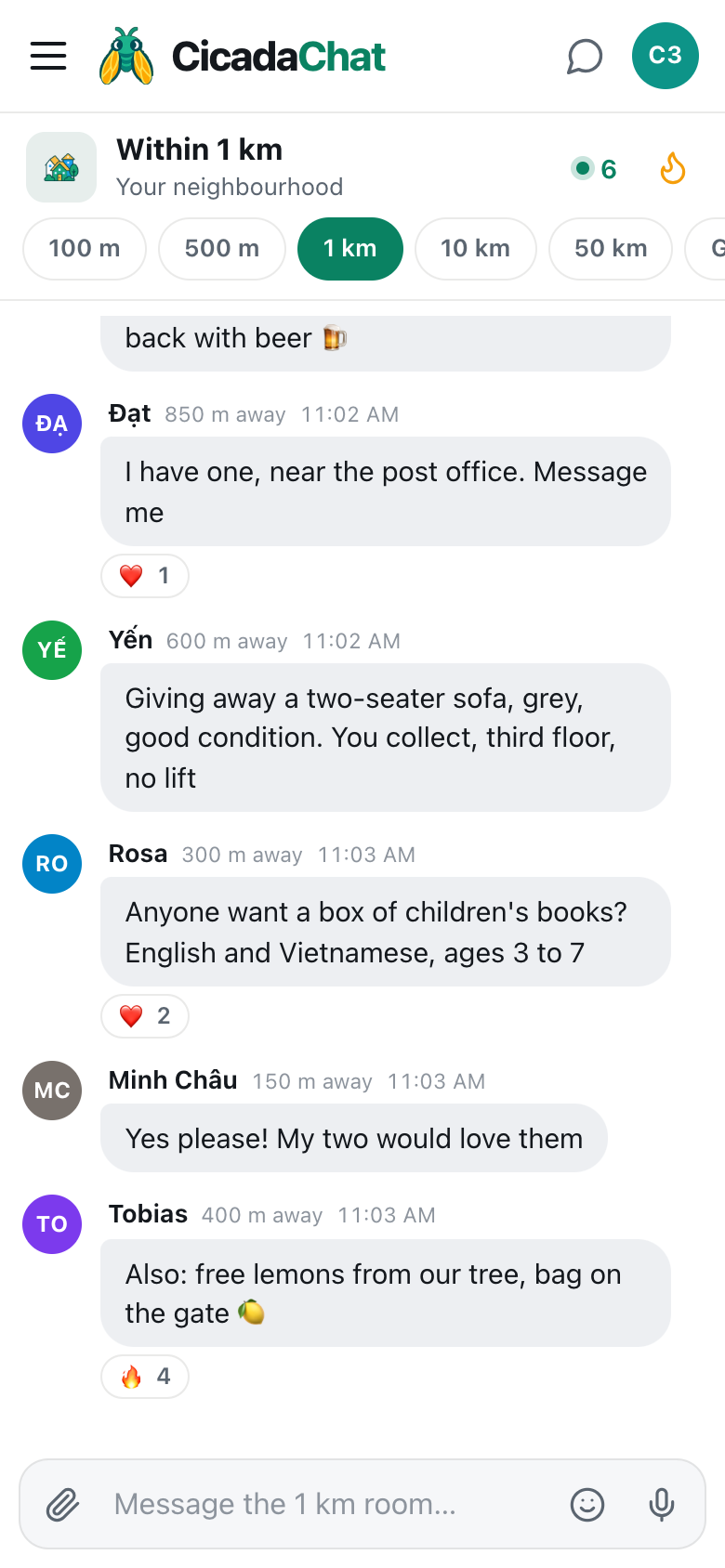
Somewhere within a kilometre of you, there's a ladder that spends 364 days a year in a cupboard. There's a sofa someone would gladly give away if only somebody would carry it downstairs. There's a box of children's books, outgrown, and a lemon tree producing far more lemons than one family can eat. Before CicadaChat, these things found new homes through a noticeboard in the corner shop, or not at all. The 1 km room works like a neighbourhood noticeboard that everyone within a short walk can read: you post what you need or what you're giving, and the neighbours who can help are close enough to come over. This article is about borrowing, lending, giving away and swapping in the 1 km room, how to post so things actually move, how to hand them over safely, and how to keep it fair.
Why a kilometre is the right size
Giving something away only works if someone can come and get it. A kilometre is a ten or fifteen minute walk: far enough to reach hundreds or thousands of households, close enough that nobody needs a van to collect a box of books. Borrowing works the same way. A ladder you can carry back in five minutes is a ladder people will lend.
CicadaChat's 1 km room is a circle drawn around you. A message you send there reaches everyone within 1 km of where you sent it, and each message shows how far away its sender was. So when someone replies "I have one, near the post office" from 850 m away, you know before you ask whether it's a stroll or a trek.
If you'd like only the people in your building, the 100 m room is the size of a block. If you're giving away something big and nobody nearby wants it, the 10 km room reaches a whole district.
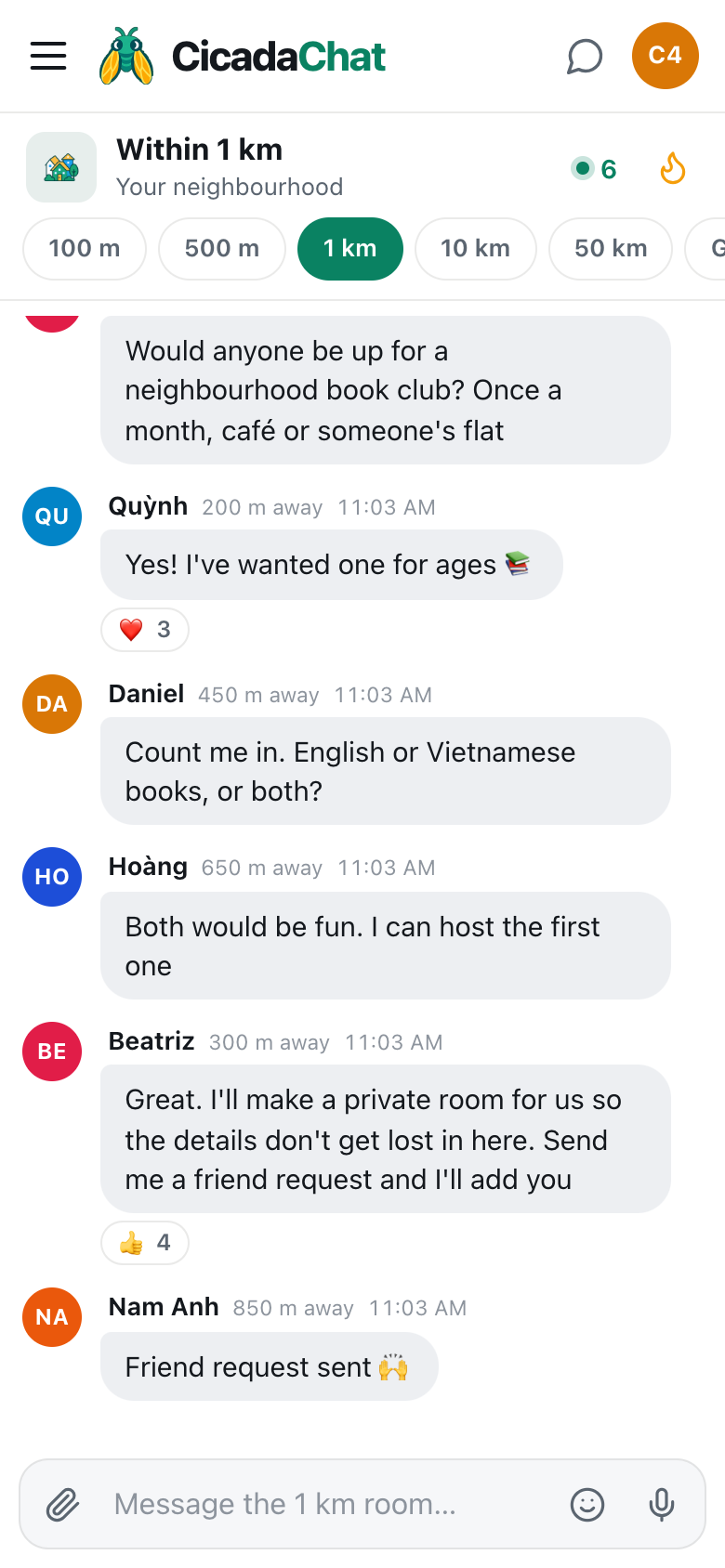
A screenshot of the 1 km room working as a noticeboard. Neighbours offer a ladder, a sofa, children's books and a bag of lemons, with the distance to each one.
Borrowing
Borrowing is where the 1 km room shines, because most things people need to borrow are things they need once: a ladder, a drill, a pasta machine, a folding table for a party, a car seat for a visiting grandchild.
A good borrowing message says what, when and for how long, and offers something back:
Could anyone lend me a ladder for an hour this afternoon? Happy to bring it back with beer 🍺
"For an hour this afternoon" tells lenders it'll come back soon. The offer of a beer is a small thing that makes people want to help. And it doesn't say where you live: that can wait for a private chat.
Lending
If you have something that's useful and rarely used, say so. "I have a ladder, near the post office. Message me" is all it takes. You can also post things before anyone asks: "I have a pressure washer if anyone needs one this weekend." Lending once often turns into a neighbour who lends you something back.
A few habits keep lending pleasant:
- Agree on when it comes back, in the private chat, before you hand it over.
- Lend what you can afford to lose. Most things come back, but not all.
- Show how it works. Two minutes explaining the drill saves a broken drill.
Giving away
Furniture you're replacing, clothes your children have outgrown, the spare kettle, plants you've divided, too many lemons. Giving things away in the neighbourhood saves them from the tip and saves someone else from buying new.
A good giveaway message includes:
- What it is, and its condition. "Two-seater sofa, grey, good condition."
- What collecting involves. "You collect, third floor, no lift." People need to know whether to bring a friend.
- A photo. Tap the paperclip, choose Photo, and add a caption. A picture answers most questions before they're asked. CicadaChat resizes and re-encodes photos on your device, which removes the hidden location data many phones add. Check what's in the background, though: a photo of a sofa in front of your window can show your street. The help article how to send photos and documents in a chat has the details.
- How long it's available. "Needs to go by Sunday" saves you from answering messages next month.
For small things, "bag on the gate" is the easiest giveaway there is. "Free lemons from our tree, bag on the gate 🍋" doesn't even need a reply. People can just walk past and take one. It's one of the few times it's fine to say where your gate is, because you've decided to, and a gate isn't a flat number.
Swapping
Swaps work well for things that come in sizes or stages: children's clothes, shoes, school uniforms, books, toys, baby equipment. "Anyone want a box of children's books? English and Vietnamese, ages 3 to 7" might get "Yes please! My two would love them", and next month that family might have outgrown something you need.
Seasonal swaps are popular too: plant cuttings in spring, school books at the start of term, fancy dress before a festival.
Handing things over
Once someone says yes, move the details out of the public room. Tap their name, on their message or in the People in range list, to open a private chat with just them. There, you can arrange a time and a place. A private chat shows no distance, and keeps working wherever you both are. The help article private chats: how to message someone one to one explains how.
A few sensible habits for the handover:
- Meet somewhere public for small things. The café on the corner, the gate of the park, the entrance to the market. For books, lemons and ladders, there's no need for anyone to come to your door.
- For big things, bring someone. If someone's collecting a sofa from your flat, have a friend or housemate around. It helps with the carrying, too.
- Share your exact location only if you need to. The paperclip's Location option sends a map of exactly where you are. In a private chat, only the other person sees it. In the 1 km room, CicadaChat warns you first: Everyone within 1 km will see this exact spot. For a handover, share it in the private chat, not the room.
- Say when it's gone. Post "Sofa's gone, thank you!" in the room so nobody else sets out for it. There's no way to edit or delete the original message, so a follow-up is the only way to update it.
Making it a habit: a neighbourhood lending group
After a few months, you'll notice the same names lending and borrowing: the person with the ladder, the family with the pasta machine, the neighbour who always has a spare drill bit. That's the start of a lending group, and CicadaChat can give it a home of its own.
With registered accounts, you can add each other as friends and create a private room, an invite-only chat that only its members can read. It's a good place for a list of who has what, for the ongoing "can I borrow…?" messages that would otherwise fill the 1 km room, and for arranging handovers without posting times and places in public. Private rooms work from anywhere, so the group keeps going when someone's away. Only friends can be added, so nobody is pulled in by a stranger.
Keep posting the occasional "anyone need a ladder?" in the 1 km room, though. That's how new neighbours find the group.
What not to post
- Things that aren't safe to pass on: medicines, car seats that have been in an accident, broken electrical goods, food that's past its date.
- Things that aren't yours to give: the landlord's furniture, the building's bike rack.
- Sales dressed up as giveaways. "Free sofa, you just pay for delivery" isn't free. If you're selling, say so. It's a neighbourhood room, not a marketplace, so keep sales occasional and honest.
- Anything illegal or unkind. The people reading are your neighbours.
Keeping the noticeboard readable
A room where every other message is "anyone want…?" stops being a conversation. A few courtesies help:
- One message per item, or one message for a small bundle. Ten messages for ten things buries everyone else's news.
- Don't repost every hour. Once a day at most. If nobody wants it in the 1 km room after a couple of days, try the 10 km room.
- React instead of replying "me too". A ❤️ or 👍 on a message shows interest without cluttering the room. Reactions are counted, not named, so if you actually want the item, send a message or open a private chat.
- Give first to whoever asked first. It's the fairest rule, and the room notices when it's broken.
Found something? Lost something?
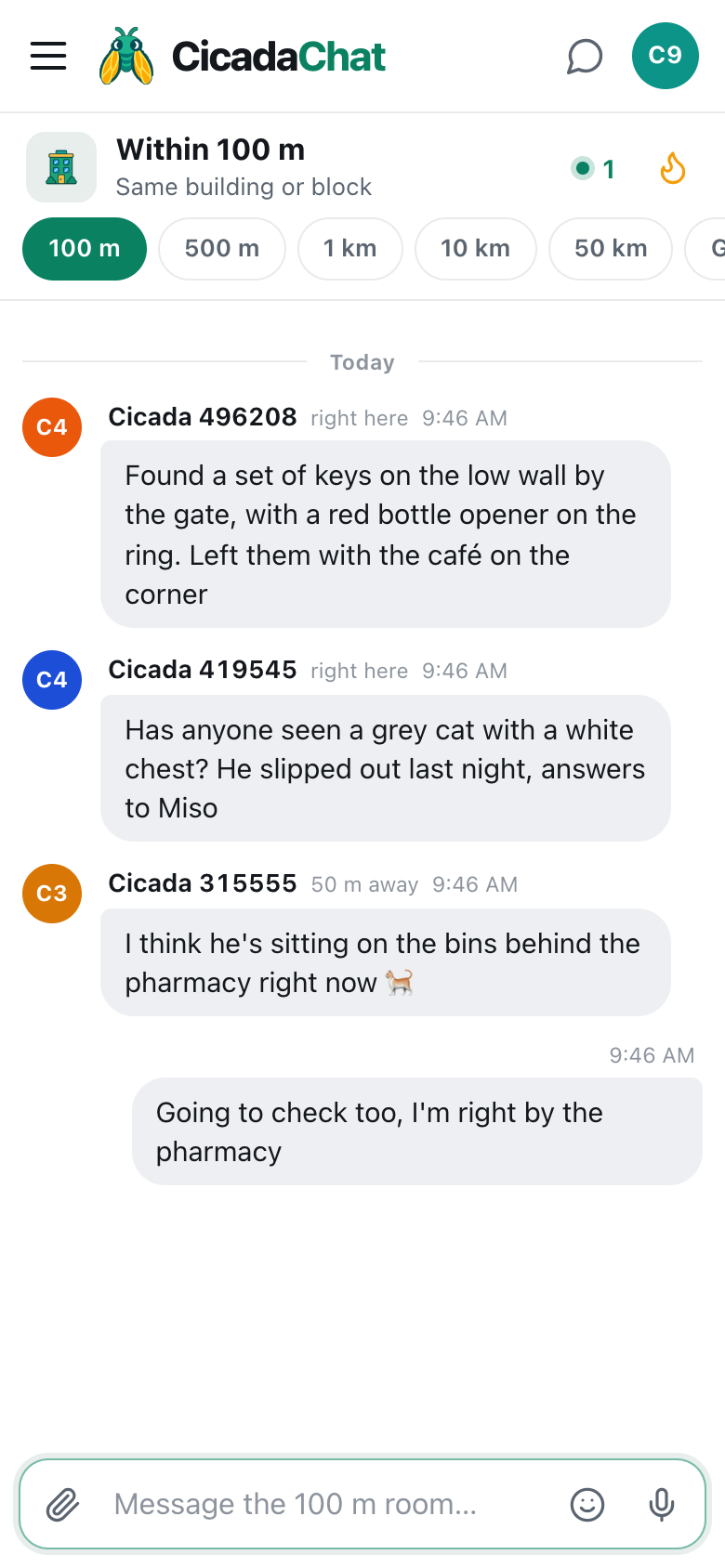
Lost and found is the noticeboard's other half. A key on the pavement, a scarf on a bench, a cat that's got out again. In a busy building, the 100 m room is often best, because the owner is probably next door. There's a whole article on it: lost a cat, found a key: using the 100 m room for lost and found on your block. In the 1 km room, describe the item, not the person who might own it, and say where it is now: "Found a small blue water bottle with a dinosaur on it at the school gate, it's on the railing."
Why it's worth it
Every ladder lent is a ladder nobody had to buy. Every sofa given away is a sofa that didn't go to the tip. And every handover is two neighbours who've met, which is how a street of strangers slowly becomes a neighbourhood.
No comments yet. Start the conversation.