
Sirens, roadworks and a queue round the block: finding out what's going on nearby
Sirens, smoke, a road dug up, a queue round the block: how to use CicadaChat's 1 km room to find out what's going on nearby, report what you see and tell reports from rumours.
Sirens go past heading north. A helicopter hangs over the river for twenty minutes. There's a queue round the block outside a bakery that's usually empty. The road you take to work has been dug up overnight. The news won't cover any of it, and a search engine won't know. But someone within a kilometre of you can see it from their window. CicadaChat's 1 km room is where you find out what's going on nearby: the small, local news of a neighbourhood, from the people who are closest to it. This article covers how to ask, how to report what you see, how to tell a good report from a rumour, and how to keep it kind.
Why the 1 km room is right for local news
A kilometre is about as far as you can hear a siren, see smoke, or notice that a road is closed. It's the distance that matters for most local events: close enough to affect your evening, not so far that it's someone else's story.
CicadaChat's rooms are circles drawn around each person, so the 1 km room around you contains the people who can see what you can hear. When you ask "anyone know what's going on?", you're asking exactly the people most likely to know.
It also works the other way. A message sent in the 1 km room reaches only people within a kilometre of where it was sent. When someone posts about a fire at the warehouse by the river, it reaches the people downwind, not the whole city.
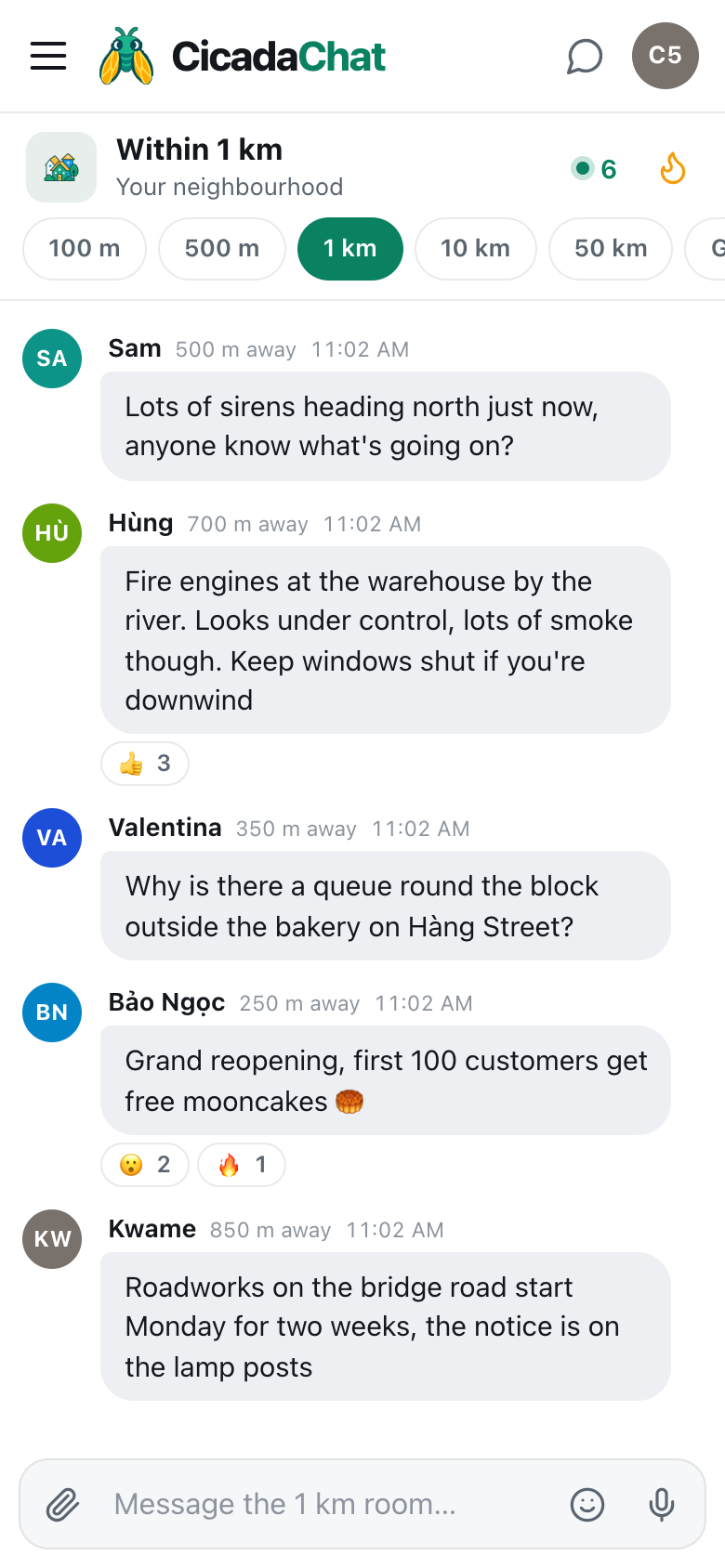
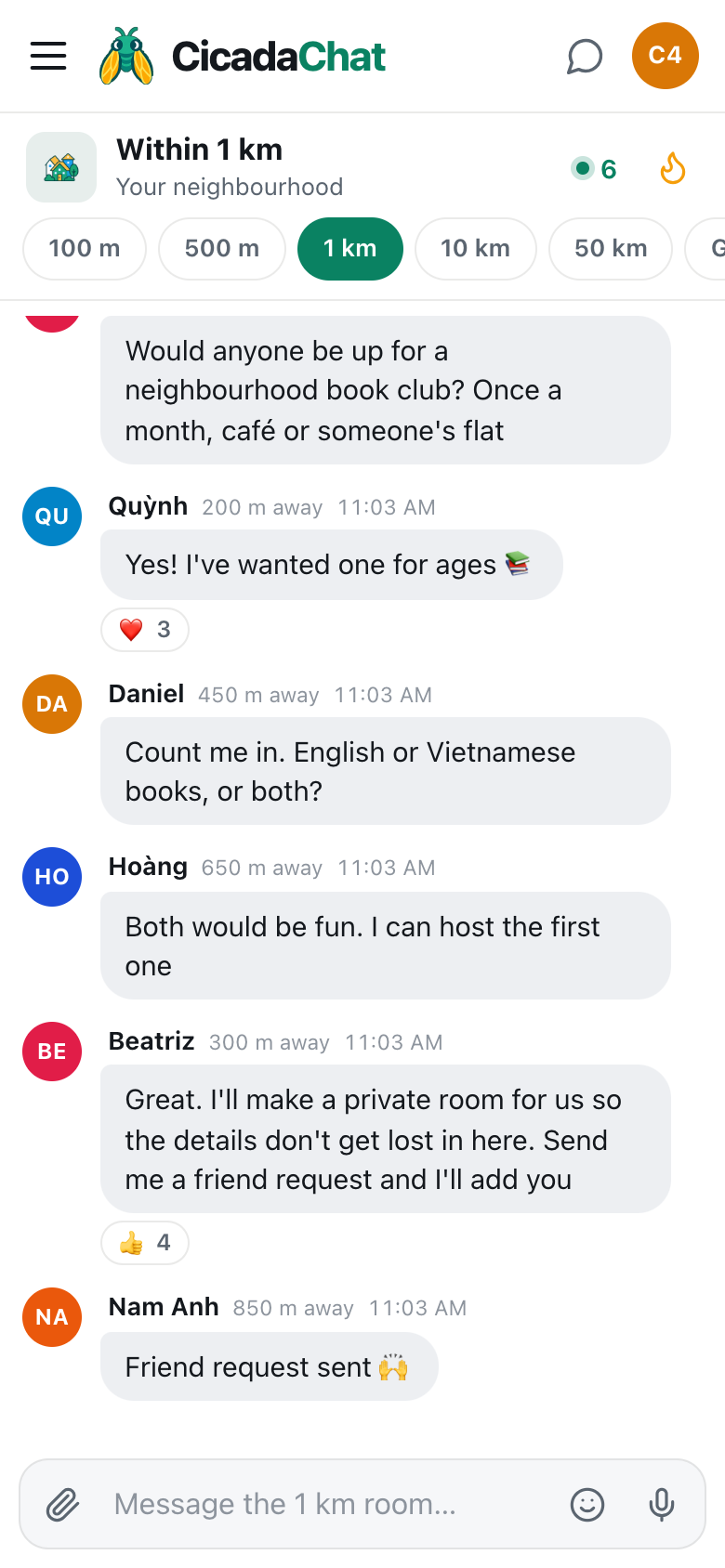
A screenshot of the 1 km room finding out what's going on. Neighbours up to 850 m away explain the sirens, the queue at the bakery and next week's roadworks.
Asking what's going on
A good question about something happening nearby has three parts: what you noticed, roughly where, and when.
- "Lots of sirens heading north just now, anyone know what's going on?"
- "Why is there a queue round the block outside the bakery on Hàng Street?"
- "Helicopter over the river for the last 20 minutes, anyone know why?"
"Just now" and "for the last 20 minutes" matter. Each message shows the time it was sent, but people reading it an hour later will want to know whether you meant "right now" or "this morning".
Your question reaches 1 km around where you sent it. If you heard the sirens heading north, and the answer is two kilometres north, the people who know may be outside your circle. If nobody answers, try the 10 km room, which reaches much further. Just remember that it also reaches many more people, so say which part of town you mean.
Reporting what you see
When you're the one who can see it, a good report is short, factual and useful:
- What: "Fire engines at the warehouse by the river."
- How serious, as far as you can tell: "Looks under control, lots of smoke though."
- What people nearby should do, if anything: "Keep windows shut if you're downwind."
That's the message in the screenshot above, and it's a good one. It tells people the thing they're worried about, how worried to be, and one sensible thing to do.
Photos
A photo can say in a second what takes a paragraph: how long the queue is, how far the roadworks go, how thick the smoke is. Tap the paperclip, choose Photo, add a caption and send. CicadaChat resizes photos and re-encodes them on your device, which removes the hidden location data many phones add, so the photo shows what you pointed it at and nothing more. The help article how to send photos and documents in a chat has the steps.
Before you send one, look at who's in it. A photo of a road closure is useful. A close-up of the people standing behind the police tape isn't, and they might be your neighbours.
Voice notes
If you're walking or your hands are full, the microphone button records a voice note of up to five minutes. For news, though, text is usually better: people can read it in a meeting, and they can scan it quickly.
Kinds of local news the 1 km room is good at
Emergencies nearby
Sirens, fire engines, smoke, a helicopter, police cordons. The 1 km room can tell you quickly whether it's something to worry about, and whether to shut the windows or avoid a road. It is not a way to call for help: in an emergency, call the emergency services first, then tell the neighbourhood.
Roadworks and closures
"Roadworks on the bridge road start Monday for two weeks, the notice is on the lamp posts." A message like that saves a lot of people a wasted journey. So does "they're relaying the pavement by the lake, the buses are going round by the school."
Queues and crowds
A queue round the block is usually good news: a bakery reopening, free mooncakes, a new shop, a popular stall. Sometimes it's a problem, like a long line at the post office before a holiday. Either way, someone in the queue can tell you in a line.
Things that just look strange
A film crew on your street, a road painted a new colour, a crane that wasn't there yesterday, a strange smell. Somebody always knows.
Outages
Water off, power out, internet down. The 1 km room is the quickest way to find out whether it's just you, your building or the whole area. There's a whole article on this: storms, floods and outages: checking on your neighbourhood in the 1 km room.
Telling a good report from a rumour
The 1 km room is fast, and fast isn't always right. A few ways to judge what you read:
- Distance. Every message shows how far away its sender was. "Fire engines at the warehouse" from someone 700 m away, near the river, is more likely to be first-hand than the same message from someone on the far side.
- First-hand or second-hand. "I can see it from my balcony" is worth more than "my friend says". Good reporters say which.
- Reactions. A 👍 from several people usually means others can see the same thing. Reactions are counted, not named, so it's an easy way for people to confirm without saying more.
- Official sources. For anything that matters, like a gas leak or an evacuation, check with the authorities. A neighbour pointing to "the notice on the lamp posts" is pointing you to a real source.
Because every room is centred on a different person, you might see a reply without the question it answers, if the question was sent more than a kilometre from you. If a message seems to come from nowhere, that's probably why. There's more about it in two neighbours, two rooms: why your 1 km room isn't the same as the one down the street.
Which room for which news
News comes in different sizes, and so do CicadaChat's rooms. Picking the right one means your message reaches the people it matters to, and no one else:
- 100 m for news about your building or block: the lift is broken, there's a leak in the stairwell, a parcel was left in the lobby.
- 1 km for news about the neighbourhood: a road closed, a fire by the river, a queue at the bakery, a street party on Saturday.
- 10 km for news that affects a whole district: a bridge closed, a big fire you can see from across town, a bus strike.
Remember that the room you're in also decides what you hear. If you're in the 100 m room, you won't see the 1 km room's report about the fire, even if it's 300 m away, because you've chosen to hear only what's said within 100 m of you. When something's happening, one room wider is often the quickest way to find out what.
Keeping up
- Scroll back. If you've been out, scroll up to see what happened. When you reach the top, press Load older messages.
- Check Hot. The flame button shows the most-reacted messages from the past week. The big local stories of the week, like the reopening with free mooncakes, tend to end up there.
- Watch the typing line. If someone is writing, the line under the messages says so, like Hùng is typing…. When something is happening, it's worth waiting a moment for the answer.
CicadaChat doesn't send notifications, so the 1 km room is somewhere you check rather than something that interrupts you. For fast-moving events, keep it open in a tab.
Being a good neighbour when something's happening
- Don't speculate about people. "Police outside number 14, I bet it's the son" is the kind of message that can't be taken back. There's no way to edit or delete a message once it's sent. Say what you see, not what you imagine.
- Don't post other people's misfortunes. A car crash, an arrest, an ambulance outside a house: the people involved are your neighbours, and some of them are reading.
- Update when it's over. "Road's open again" or "Fire's out, smoke's clearing" is as useful as the first report, and it stops people worrying.
- Keep your own location vague. "I can see it from my balcony on the river side" is fine. Your building and flat number aren't needed.
What the 1 km room isn't
It isn't an emergency service, and it isn't a news agency. It's a room full of neighbours who can see what you can't. Used that way, it's the fastest way to find out why the sirens went past, and whether you need to do anything about it.
No comments yet. Start the conversation.