
Two neighbours, two rooms: why your 1 km room isn't the same as the one down the street
Two neighbours in the 1 km room can see different conversations. A worked example from both sides of a canal shows why, and what it means for what you read and write.
Two friends live on opposite sides of a canal, about a kilometre and a half apart. Both open CicadaChat, both are in the 1 km room, and both are chatting with their neighbourhood. But when they compare screens, they're not looking at the same conversation. One sees a question about the night market on the west side. The other sees a warning that the water's off on the east side. Both see the same invitation to a street party on the bridge between them. Nothing's broken. This is how CicadaChat works, and once you see why your 1 km room isn't the same as the one down the street, the room makes a lot more sense. This article explains it with a real example and shows what it means for what you read and what you write.
A room is a circle around you, not a place
Most chat apps have rooms that are places: a channel called "West Side Neighbours" that someone created, with a member list and a boundary on a map. Everyone in it sees the same messages.
CicadaChat doesn't work like that. There's no "West Side" room and no boundary. The 1 km room is a circle with a radius of 1 km, and the centre of that circle is you. Your neighbour's 1 km room is a circle centred on them. If you live next door to each other, your circles almost completely overlap and you see almost the same conversation. If you live a kilometre and a half apart, the circles overlap only in the middle, and you each see a different neighbourhood.
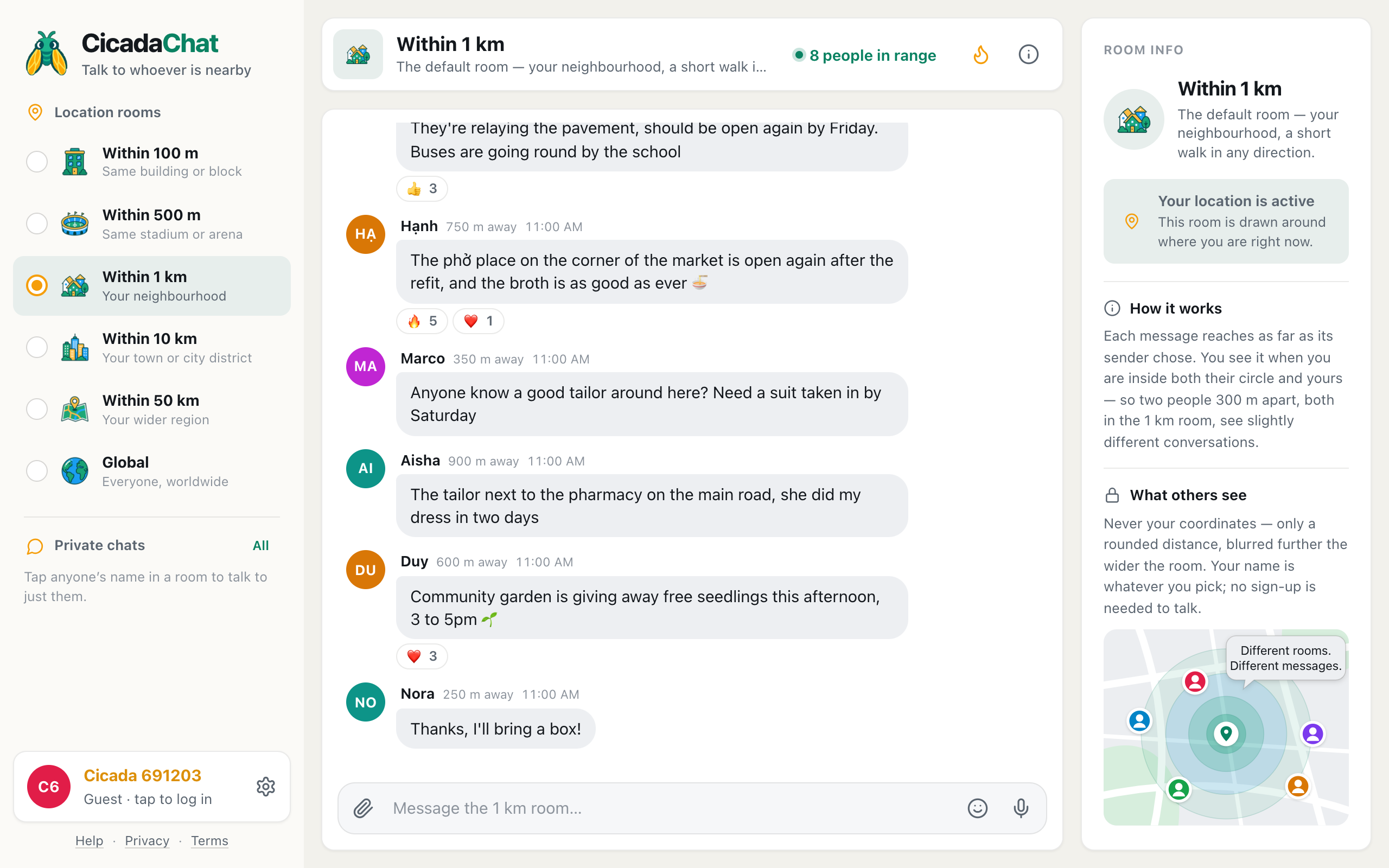
The room info panel puts it in one sentence: Each message reaches as far as its sender chose. You see it when you are inside both their circle and yours — so two people 300 m apart, both in the 1 km room, see slightly different conversations.
The rule in one line
Every message remembers two things: where it was sent from, and which room its sender was in. You see a message when the distance between you and where it was sent is no more than the smaller of the two rooms: the sender's and yours.
In the 1 km room, talking to other people in the 1 km room, that simply means: you see messages sent within 1 km of where you are now.
The canal, from both sides
Here's the example from the introduction, with the screens. Six neighbours are chatting. Three live on the west side of the canal, three on the east, and Hà My lives by the bridge in the middle. Our two viewers stand 700 m west and 700 m east of the bridge.
From the west side
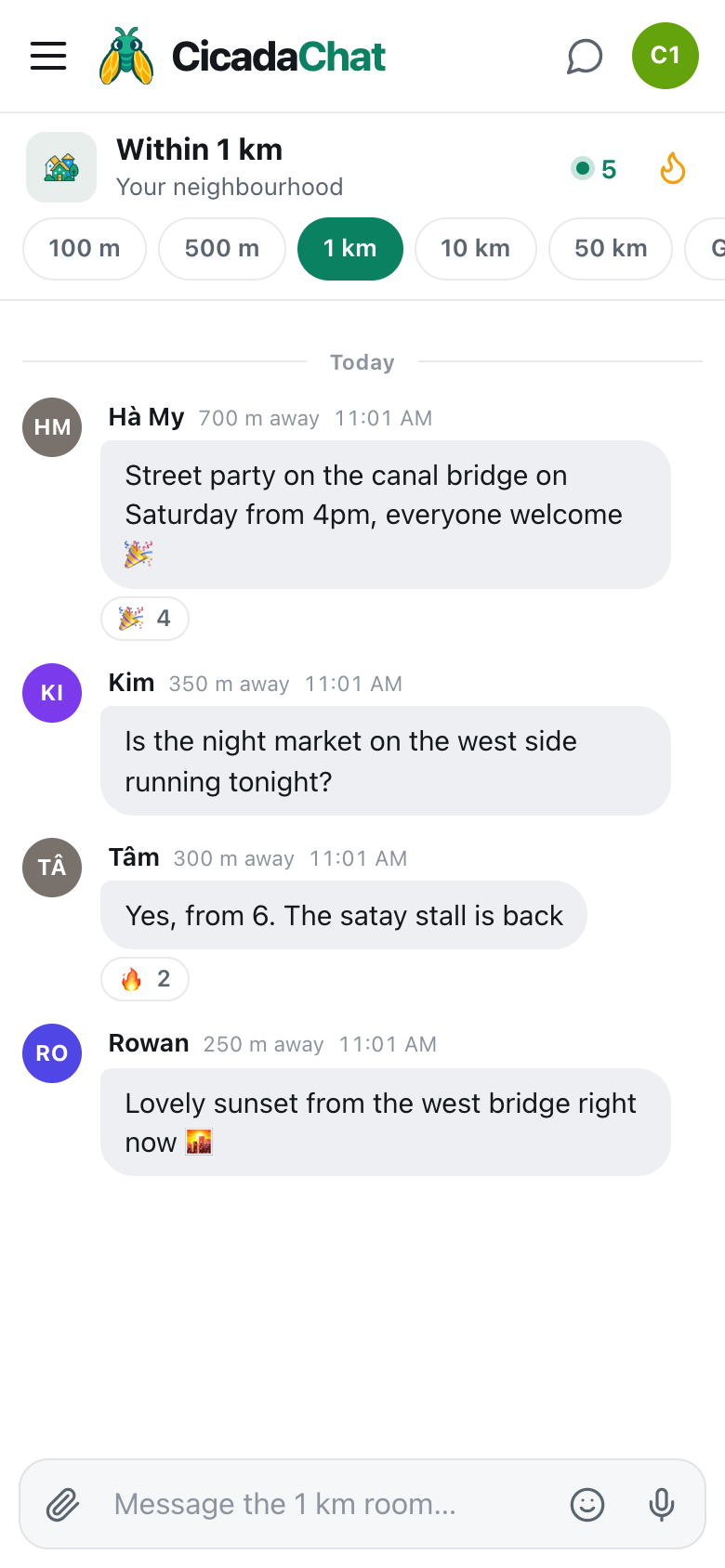
A screenshot of the 1 km room from the west side. Hà My's street party is 700 m away, and the messages about the west side's night market and sunset are close by.
From the west, the screen shows Hà My's message about the street party on the canal bridge, 700 m away. Below it are Kim asking whether the night market on the west side is on, Tâm answering, and Rowan's sunset over the west bridge, all a few hundred metres away. The east side's messages are more than a kilometre away, outside this circle, so they don't appear.
From the east side
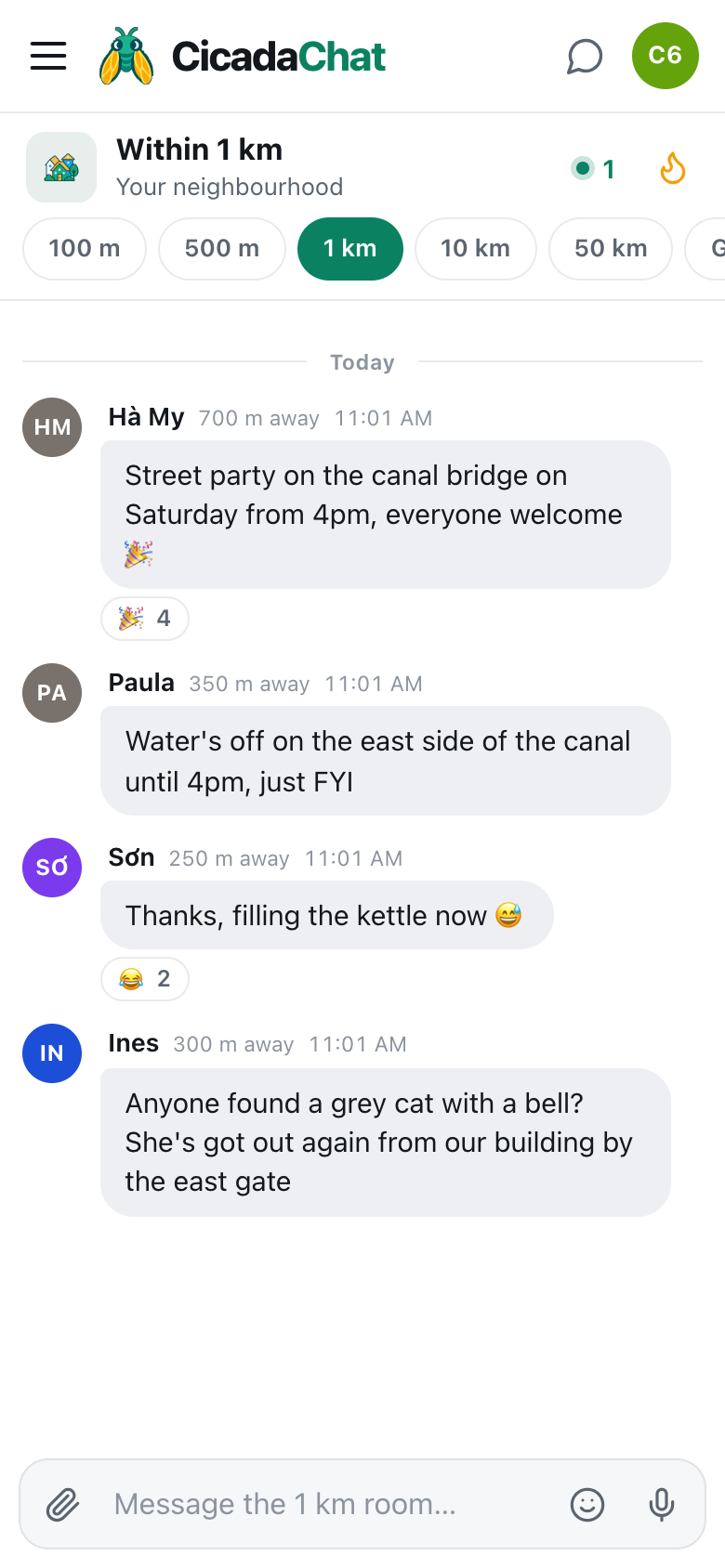
A screenshot of the 1 km room from the east side. The same street party message is at the top, but the rest of the conversation is about the east side: a water cut and a missing cat.
From the east, the same street party message is at the top, again 700 m away, because the bridge is halfway between the two viewers. But everything under it is different: Paula's warning that the water's off on the east side until 4pm, Sơn filling the kettle, and Ines looking for a grey cat that's got out by the east gate. The night market and the sunset aren't there. They're more than a kilometre away.
What this shows
- The message in the middle reached both sides. Hà My's street party was sent from the bridge, within 1 km of both viewers, so both see it.
- Each side got what's relevant to it. The west doesn't need to know the water's off in the east. The east isn't going to walk to the west side's night market for a quick dinner.
- Nobody had to decide where the boundary was. There's no argument about whether the bridge belongs to the west side or the east side. Everybody's neighbourhood is simply the kilometre around them.
What it means for what you read
Your 1 km room is yours alone. A few consequences follow:
- A reply can appear without its question. If someone 900 m east of you asks something and someone 400 m west of you answers, you might see the answer (it was sent within 1 km of you) but not the question (it wasn't). It's rare, but when a reply seems to come from nowhere, that's usually why.
- Your friend's screen isn't a copy of yours. If you mention a message and your friend can't find it, check how far apart you are.
- Reaction counts are the same for everyone. If a message shows 🔥 5, five people reacted, wherever they are. What differs is which messages you see, not what's on them.
- Hot is yours too. The flame button shows the most-reacted messages from the past week, out of the ones you can see. Two neighbours far apart can have different Hot lists.
What it means for what you write
When you send a message from the 1 km room, it reaches 1 km around the spot where you sent it, and it stays there. It doesn't follow you home. A few things follow from that:
- Where you send from matters. A question about the market sent from the market reaches the people round the market. The same question sent from your office across town reaches the people round your office.
- Sending from the edge of something reaches beyond it. If you post about a flood from one end of your street, people a kilometre in the other direction won't see it. People a kilometre on the far side of the flood might.
- Your neighbours at 1.2 km won't see you. If someone you know lives just outside your circle, you're not in each other's 1 km room. The 10 km room would reach them, as would a private chat.
The room moves when you move
Because the circle is centred on you, it follows you. Walk from the west side across the bridge to the east side, and your room slides with you. When you open the room, it loads what's been said within reach of where you are. As you walk, new messages reach you based on where you are now, and the distance on each new message is measured from where you are when it arrives. Open the room again on the far side of the bridge, and it loads the conversation around you there.
The distances shown are rounded to the nearest 50 m, with anything under 50 m shown as right here, so small movements don't change them.
Different rooms, different overlaps
The same thing happens in every local room, but the size of the room changes how much two neighbours share:
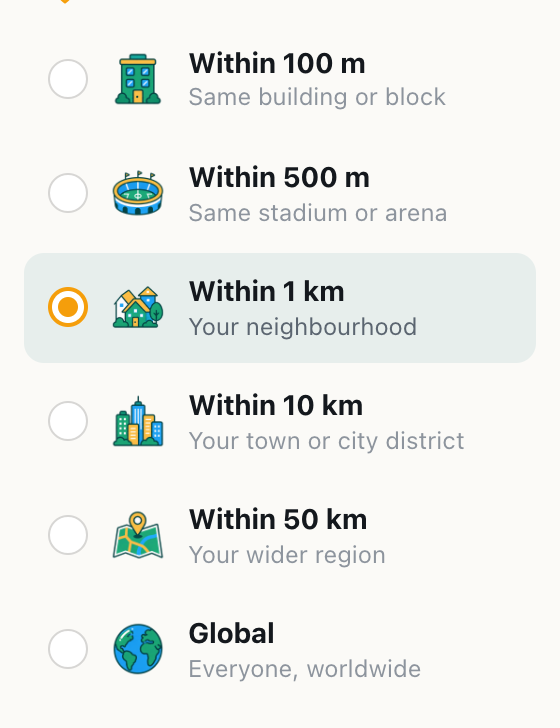
- In the 100 m room, two people 300 m apart share nothing at all. Their circles don't touch.
- In the 500 m room, they share a narrow slice in the middle.
- In the 1 km room, they share most of their neighbourhood, with a different fringe on each side.
- In the 10 km room, they see nearly identical conversations, because 300 m is small next to 10 km.
And when people are in different rooms, the smaller room wins. A neighbour 600 m away in the 500 m room won't see your 1 km message, because they've chosen to hear only what's said within 500 m. For help choosing, see 100 m, 500 m or 1 km? How to tell when the 500 m room is the right size.
Why CicadaChat is built this way
Fixed neighbourhood groups have edges, and the people who live on the edges get the worst of it. Someone at the end of the street ends up in the "wrong" group, or in two groups, or in neither. Groups also need someone to run them, admit people and decide who belongs.
A circle around each person has no edges to fall off. Everyone is in the middle of their own neighbourhood. Nobody has to be admitted, and nobody decides who belongs. And because the room is defined by distance, not by membership, a message about the flooded road reaches the people who might drive down it, not the people who happen to have joined a group.
If you'd like to go deeper, the help article why two people in the same room can see different messages has more examples across all the rooms, and the 1 km room: chatting with your neighbourhood, a short walk in any direction covers everything else the room does.
A few practical tips
- Quote the question when you answer. "The night market? Yes, from 6" makes sense even to someone who never saw the question.
- Name places, not directions. "The east side of the canal" means the same thing to everyone. "Over here" means something different on every screen.
- Want everyone in the whole area? For something that matters across a wide area, like a storm warning, the 10 km room reaches much further.
- Talking to one particular neighbour? Tap their name and open a private chat. A private chat doesn't depend on distance, so it keeps working however far apart you are.
No comments yet. Start the conversation.