
New in town: finding your feet in a new city with the 10 km room
Just moved to a new city? How to use CicadaChat's 10 km room to find somewhere to live, sort out everyday things, judge the answers, avoid scams and meet people.
Moving to a new city means a hundred small questions nobody warned you about. Which areas are nice to live in? Where do people buy the food you miss from home? Is there a doctor who speaks your language? Which bus goes to the centre, and does anyone actually use it? You can search for all of it, but the answers online are often years old or written for tourists. The people who live there now know. This article is about finding your feet in a new city with CicadaChat's 10 km room: what to ask in your first weeks, how to judge the answers, how to meet people, and when to step down to your neighbourhood room.
Why the 10 km room is the newcomer's room
When you first arrive, you don't have a neighbourhood yet. You might be in a hotel, a short-term rental or a friend's spare room, and you'll be criss-crossing the city looking at flats, sorting out paperwork and working out where things are. The 10 km room, Within 10 km, Your town or city district, is a circle twenty kilometres across drawn around wherever you are. It covers the part of the city you're getting to know, and it moves with you.
The smaller rooms are for later. The 1 km room, where CicadaChat starts you, is your neighbourhood, and it's at its best once you have one. In your first weeks, most of your questions are about the city, and the people who can answer them are spread across it.
Getting started takes seconds
There's nothing to sign up for. Open CicadaChat in your phone's browser and allow location when it asks. You get a guest account with a name like Cicada 371074 and land in the 1 km room. Tap the 10 km tab under the header, and you're in the city's room.
Later, if you want to keep the same name on every device, add friends or create private rooms, you can create a free account, and everything you said as a guest comes with you. The help article guest or registered account: what's the difference? explains the choice.
One thing to know before you move: the 10 km room is drawn around where you are, so you can't join a city's room from abroad. If you want to ask questions before you arrive, the Global room is open to everyone, wherever they are, and needs no location. Once you land, the city's own room is one tap away.
What to ask in your first weeks
Where to live
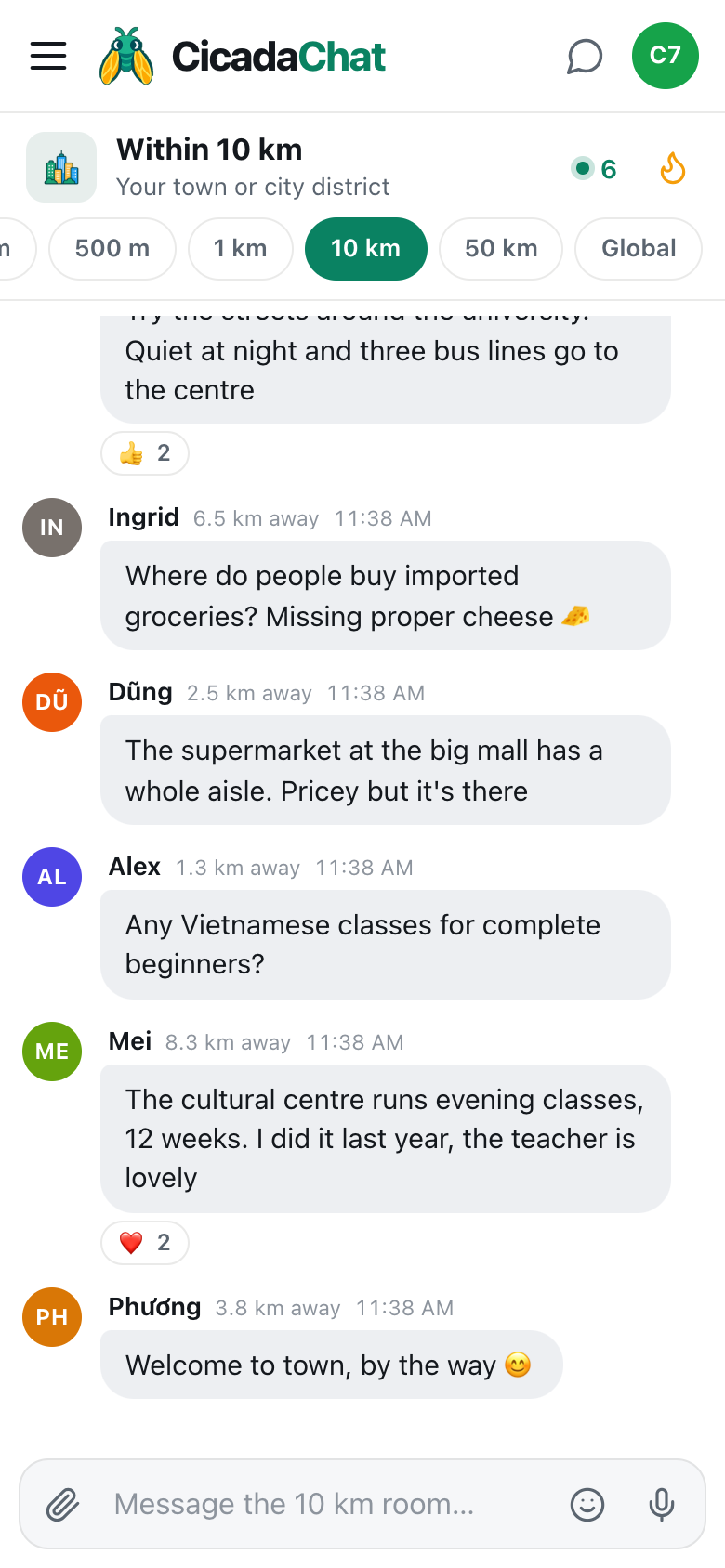
"Just moved here for work. Which areas are good to rent in? Quiet, but near a bus line." A question like this gets answers from people who live in those areas and know what the listings don't say: which street floods, which one has a night market under the windows, which one is a twenty-minute walk from the nearest bus stop.
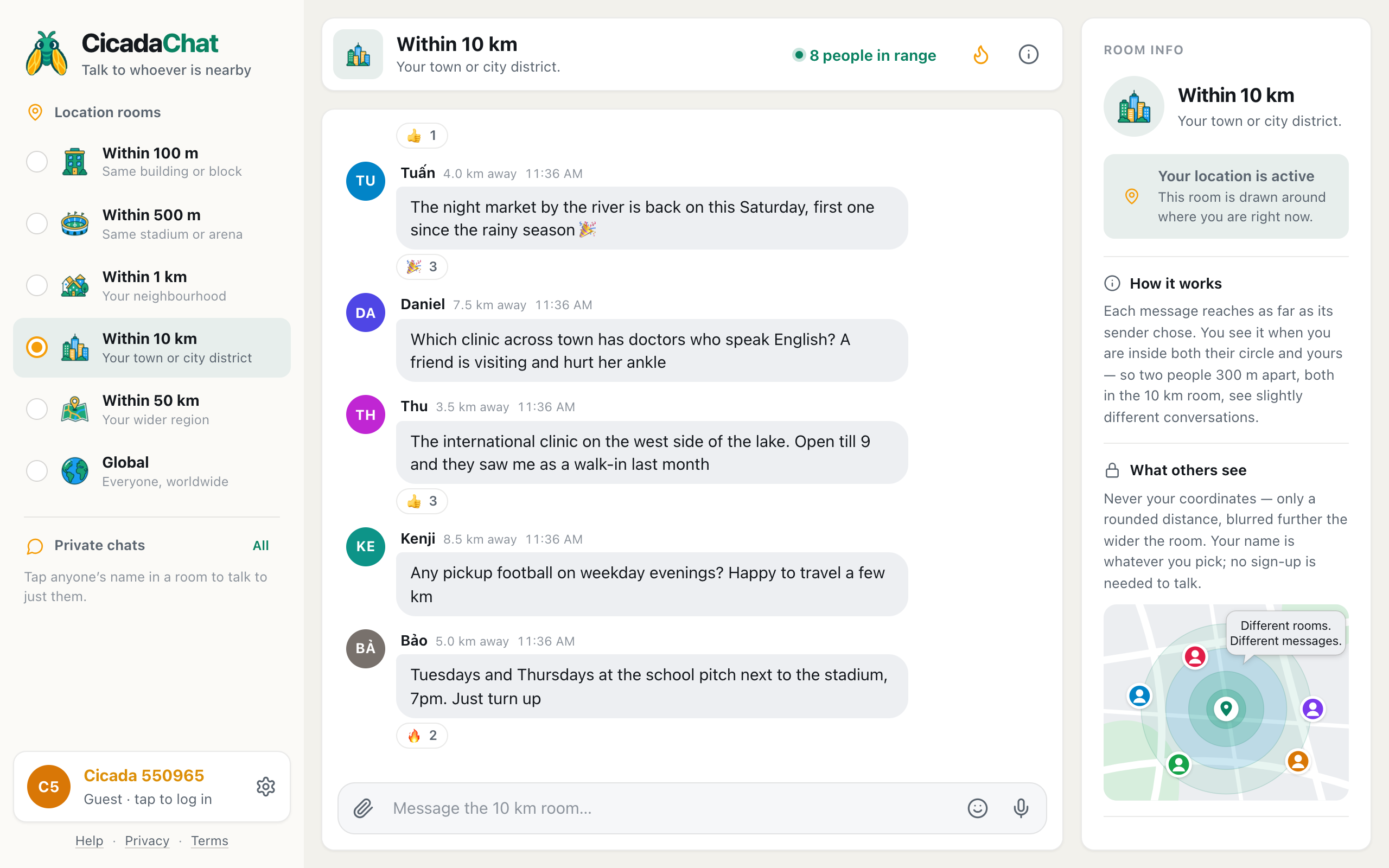
A screenshot of the 10 km room with a newcomer's questions. People 2.5 to 8.3 km away suggest where to rent, where to find imported groceries and an evening language class, and one simply says welcome to town.
The distance on each answer is a useful clue. Someone 3.8 km away recommending the streets around the university may well live there. Distances are rounded to the nearest 250 m and have no direction, so they tell you roughly how far, not where.
Everyday things
- Where to get a local SIM card without a two-hour queue.
- Which supermarket has imported groceries, and which market has the best fruit.
- How the buses work, which app people use for taxis, and whether it's safe to cycle.
- Where to get a key cut, a phone screen fixed or a suit altered.
- Which gym, pool or park is worth the trip.
Health and paperwork
"Which clinic has doctors who speak English?" is one of the most common questions newcomers ask, and one of the most useful to have answered by someone who has been there. The same goes for pharmacies, dentists, vets, and the office where you register your address. Ask for experiences, not just names: opening hours, whether you need an appointment, how long you waited.
Learning the language
If you're learning the local language, the room is both a teacher and a place to practise. Ask where the good classes are, and try writing a message in the language you're learning. People are generally kind to someone who's trying. Many cities have people looking for a language exchange too: they'll help with yours in return for practising theirs.
You can ask in any language
CicadaChat doesn't translate, but you can write in whatever language you like. In most cities, someone in a 10 km room will understand English, and many international residents look for questions in their own language. If you write in one language and nobody answers, try again in another, or in both.
Judging the answers
Everyone who answers is a stranger, so treat answers like advice from a friendly person at a bus stop: often very helpful, occasionally wrong.
- Look for agreement. When two or three people suggest the same clinic or neighbourhood, it's probably a good one.
- Look at the reactions. A reply with several 👍 has been backed up by other people in the room.
- Check the time. Every message shows when it was sent. Older answers may be out of date.
- Use Hot. The flame button in the header shows the most-reacted messages from the past week. For a newcomer, it's a quick tour of what the city found useful recently.
- Double-check anything important. Visa rules, rental contracts and medical advice should come from an official source. The room is good for telling you where to look.
Watch out for rental scams
New arrivals are a favourite target of rental scams. If someone in the room, or in a private chat, offers you a flat and asks for a deposit before you've seen it, stop. Never pay for a place you haven't visited, never send money to someone you've only met online, and be suspicious of anyone who pushes you to decide right now. Genuine landlords and agents will show you the flat first.
Meeting people
Once the practical questions are answered, the harder part of a new city is not knowing anyone. The 10 km room helps with that too, because a whole district has enough people to share almost any interest. Look out for, or ask about:
- running groups, football, badminton, climbing and cycling;
- board game nights, quiz nights and book clubs;
- language exchanges;
- volunteer groups;
- other people who've just moved, which you'll find a lot of if you ask.
Finding your people across town: sport, hobbies and language exchange in the 10 km room has more on how that works. When you meet someone you'd like to talk to more, tap their name to start a private chat. With registered accounts, you can add each other as friends and see when the other is online, though never where they are.
And when someone welcomes you to town, say thank you. It's a good start.
Your first weekend
Weekends in a new city can be the loneliest part of moving. The 10 km room is a good place to ask what's on, and a good place to find other people who haven't got plans either. "New in town, anyone know a good walk or a market for Saturday morning?" usually gets suggestions, and sometimes an invitation. Open Hot on a Friday to see which events people have been excited about this week, and don't be shy about going on your own: many of the regulars at a board game night or a running group started out the same way.
Staying safe while you're new
- Don't say you live alone, or when your flat is empty. "Just moved here" is fine. "I'm on my own in the flat above the bakery" is too much for a public room.
- Keep your address out of the room. Other people see your name and a rounded distance, never your coordinates. Don't add the rest yourself.
- Meet new people in public places the first few times, and tell a friend, even one back home, where you're going.
- Trust your instincts. You can simply stop replying in a private chat that makes you uncomfortable.
From the city to your neighbourhood
As you settle in, your questions change. "Which area should I live in?" becomes "Is the noodle stall on our street open on Mondays?" That's a sign to start spending time in the 1 km room, where your neighbours are. The 1 km article new in the neighbourhood: getting to know the area with the 1 km room picks up the story from there: bin days, local shops and the people on your street.
Most people who've lived somewhere a while use both rooms: the 1 km room for the neighbourhood, the 10 km room for the city. CicadaChat remembers the last room you used on each device, so it opens wherever you spend most of your time.
A first-week checklist
- Open CicadaChat and allow location.
- Tap 10 km.
- Open Hot to see what the city has found useful this week.
- Introduce yourself with one real question, like where to rent or where to find a doctor.
- React to the answers that help.
- Ask about one thing you'd like to do for fun.
- Once you have an address, try the 1 km room and meet the neighbourhood.
No comments yet. Start the conversation.