
1 km or 10 km? How to tell when it's time to go wider (and when to come back)
The 1 km and 10 km rooms reach very different people. A worked example from one spot, the signs it's time to go wider, and the signs it's time to come back to the neighbourhood.
CicadaChat starts you in the 1 km room, your neighbourhood. One tab along is the 10 km room, your town or city district. They sound like two sizes of the same thing, but they behave very differently: who hears you, what you hear, how busy it is and what kind of question gets answered. This article helps you choose between the 1 km room and the 10 km room, with a worked example from one spot, the signs that it's time to go wider, and the signs that it's time to come back.
The difference in one picture
A 1 km room is a circle two kilometres across: the streets you can walk to in ten or fifteen minutes. A 10 km room is a circle twenty kilometres across: the part of the map you can get to by bus, bike or car in half an hour. The 10 km circle has a hundred times the area of the 1 km one. In a city, that usually means many times more people, and a conversation about far more places.
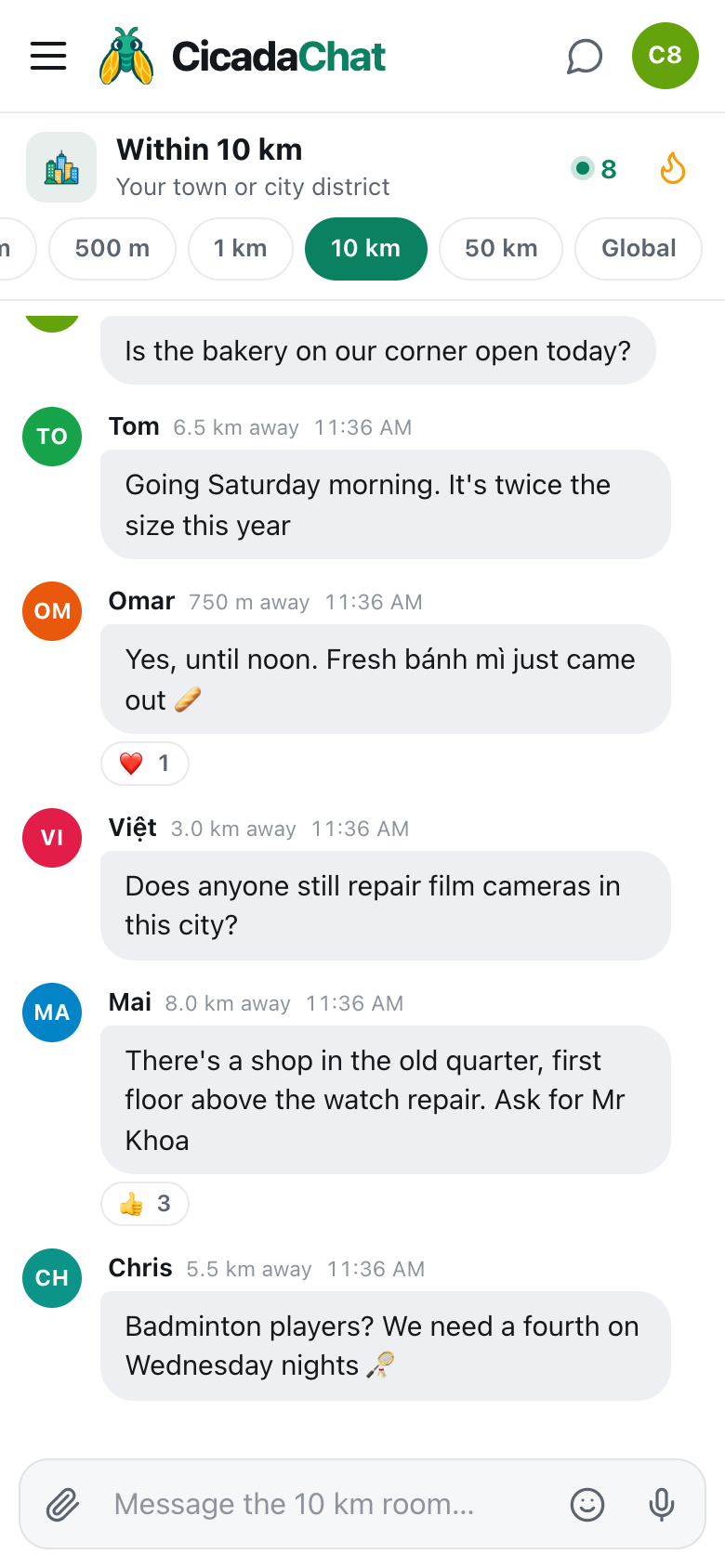
Here's what that looks like from one spot. Seven people posted within the last few minutes. Two of them live nearby and were chatting in the 1 km room about the bakery on the corner. The other five are spread across town, 3 to 8 km away, and were talking in the 10 km room about a book fair, a film camera repair shop and a badminton game.
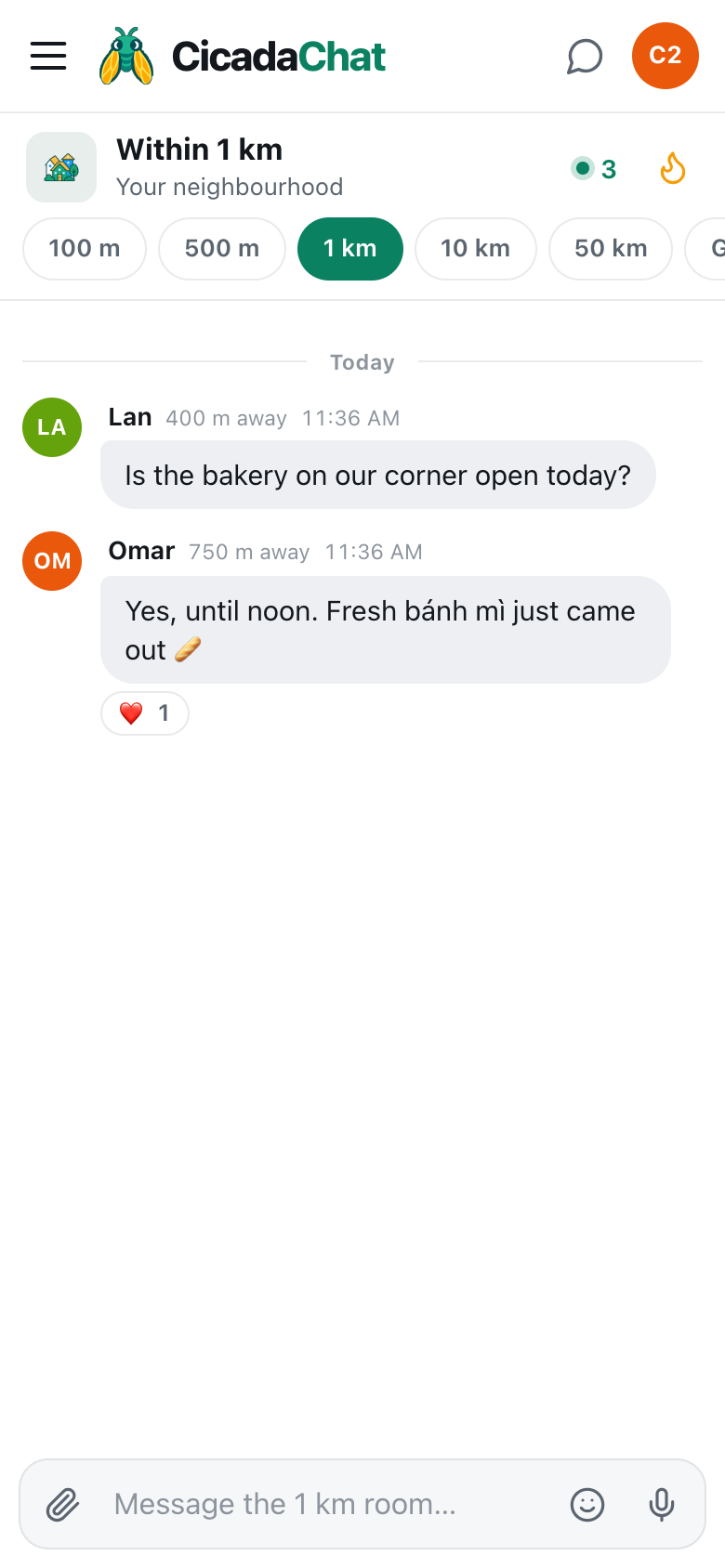
A screenshot of the 1 km room from one spot. Only the two neighbours, 400 m and 750 m away, are in it, and the header shows 3 people in range.
From that spot, the 1 km room shows two messages and three people in range, you included. Switch to the 10 km tab without moving and you see all seven messages, and eight people in range.
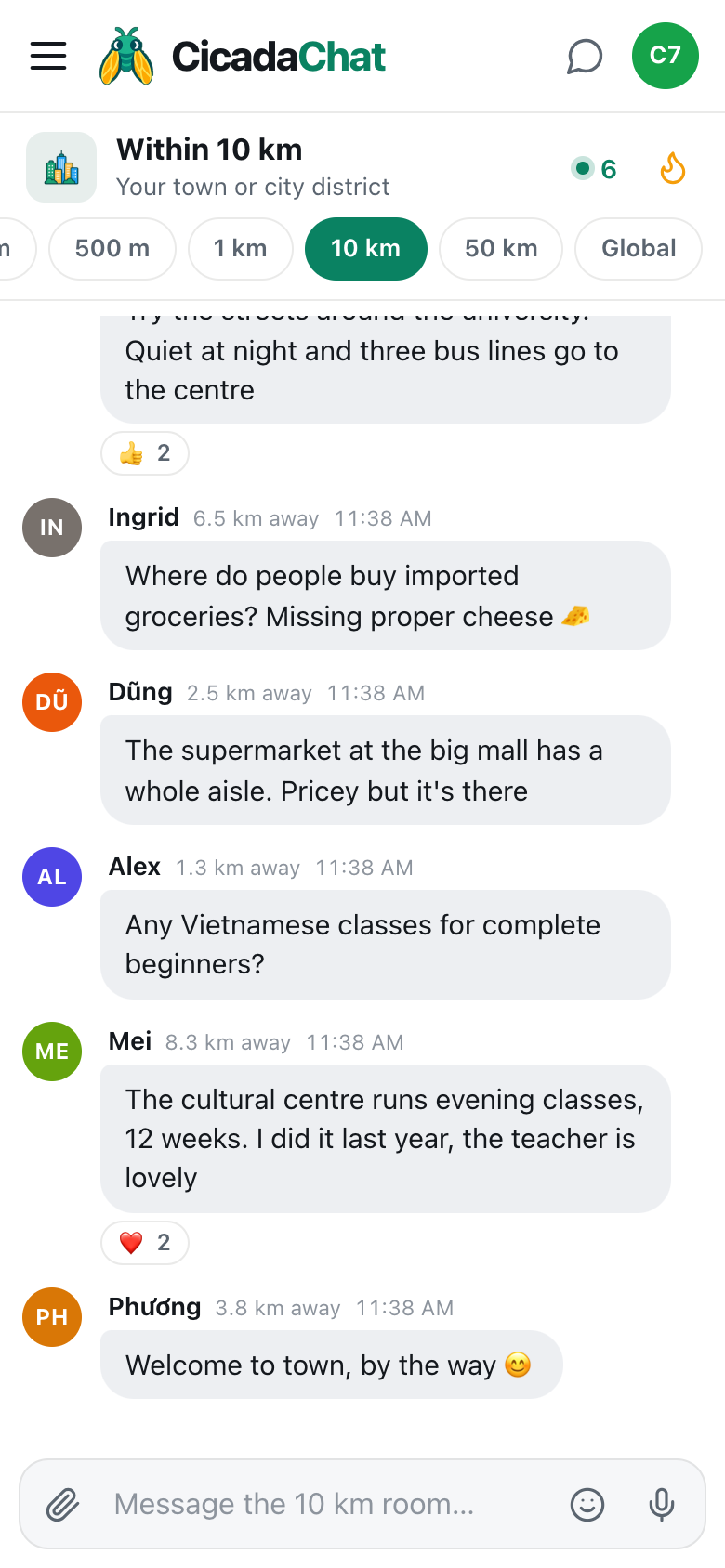
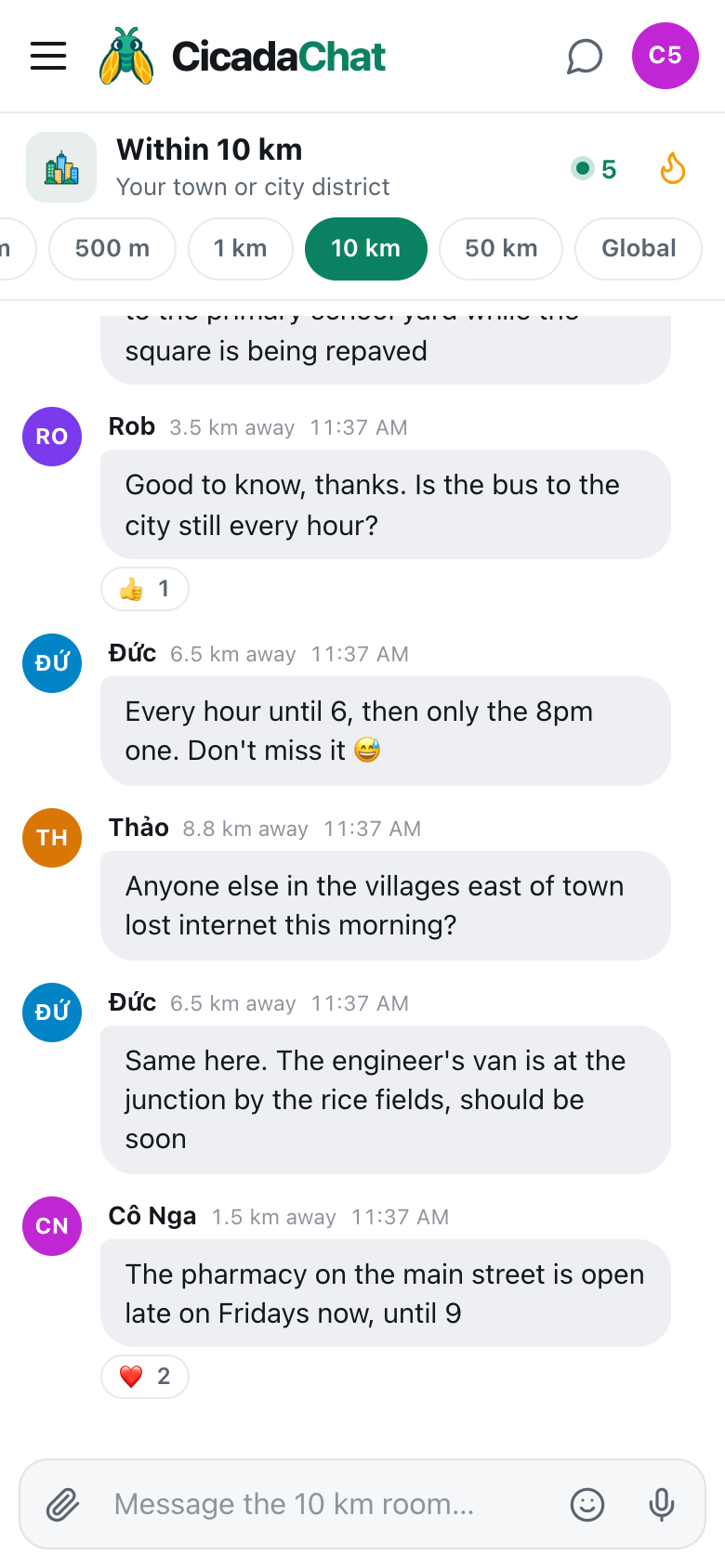
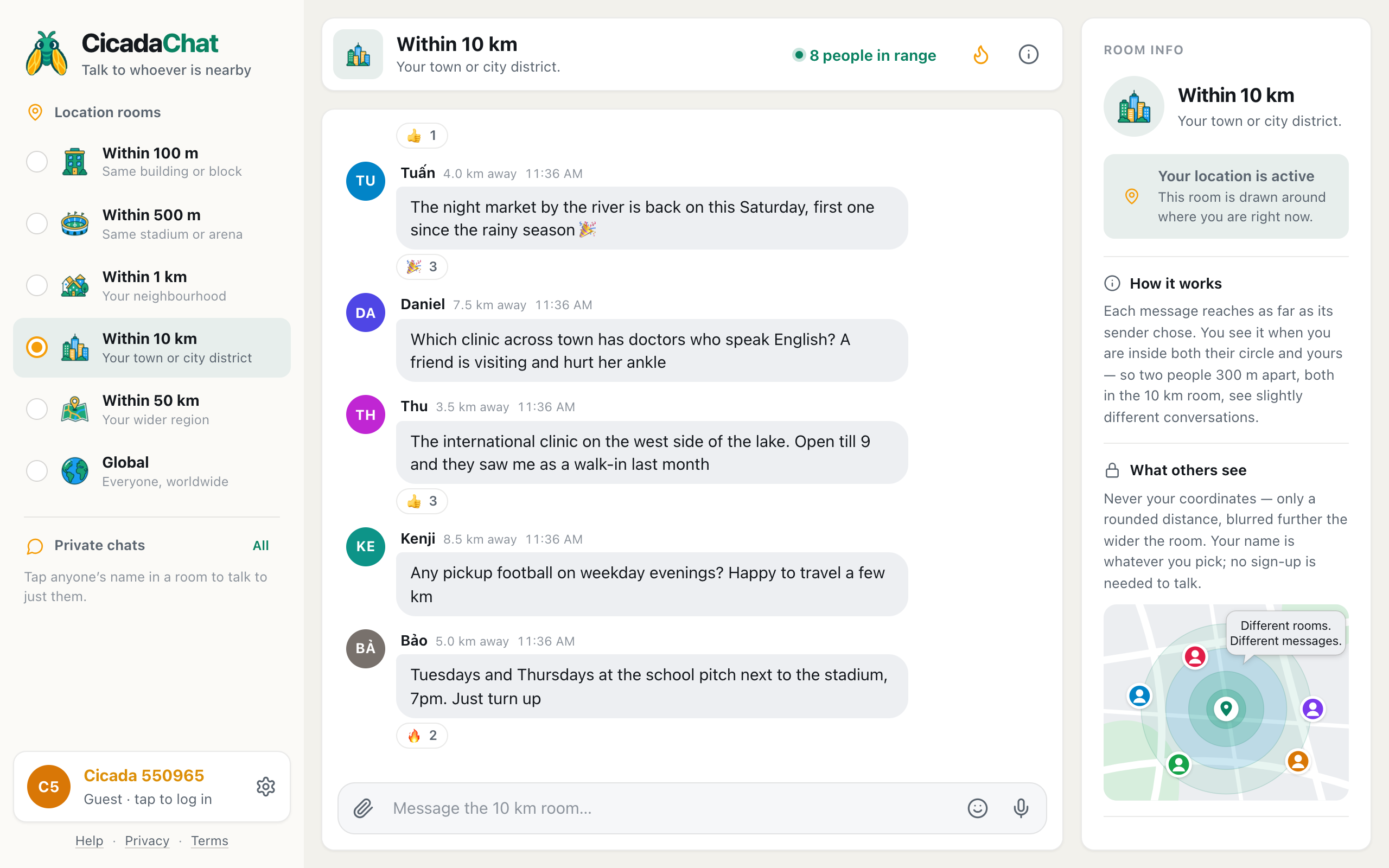
A screenshot of the 10 km room from the same spot. The bakery chat is still there, now mixed in with messages from 3 to 8 km away about a book fair, camera repairs and badminton.
Notice two things. First, the neighbourhood conversation doesn't disappear when you go wider. The 10 km room is a superset of your 1 km room: anything said within a kilometre of you, in any local room, still shows up. Second, the town-wide messages never reached the 1 km room. People sitting in the 1 km room chose to hear only what's said within a kilometre, and CicadaChat respects that.
How the rule works, in plain words
Every message carries the size of the room its sender was in. You see a message when the distance between you is no more than the smaller of the two rooms: the sender's and yours. That has a consequence people often miss:
- When you write in the 10 km room, your message reaches everyone within 10 km who is also in the 10 km or 50 km room, but only the people within 1 km of you who are sitting in the 1 km room. Someone 5 km away in their 1 km room won't see it.
- When you write in the 1 km room, your message reaches everyone within 1 km of you, whichever local room they're in, including the 10 km and 50 km rooms. It never goes further than 1 km, however wide the listener's room is.
So going wider is a choice about both listening and speaking. In the 10 km room you hear more, and you're heard further, but only by people who have also chosen to listen wide. There's a longer explanation in the 10 km room: chatting with your whole town or city district.
Signs it's time to go wider
The 1 km room is quiet
If the people in range number next to the room name is 1 or 2, and the newest messages are days old, there aren't many people nearby using CicadaChat right now. That's common in suburbs, small towns and quiet residential streets. The 10 km room pulls in the whole district, so there's usually someone there. The People in range list says as much when it's empty: Nobody else is in range right now. Try a wider room.
Your question is about the town, not the street
"Is the corner shop open?" is a 1 km question. "Which hospital has an English-speaking orthopaedic doctor?" is a 10 km question: the answer probably isn't within walking distance, and the people who know it probably don't live on your street. As a rule of thumb, if you'd be happy to travel twenty minutes to the answer, ask the 10 km room.
You're looking for people, not places
Hobbies, sports and language exchange need a certain number of people to work. There may be one other chess player within a kilometre of you. Within 10 km there are dozens. The same goes for parents of children with the same needs, people who speak your language, or anyone else you'd like to find a few of.
Something is happening on a scale bigger than your neighbourhood
A storm, a festival, a big match, a transport strike or a road closure on the ring road affects the whole district. The 1 km room tells you what it's like on your street. The 10 km room tells you what it's like across town, and whether the way you planned to get somewhere still works.
You're on the move
If you're driving or riding across a city, the 1 km room changes every few minutes as you go. The 10 km room stays mostly the same for the whole journey, so a conversation you start at one end is still in range at the other.
Signs it's time to come back
The room is about places you never go
If the 10 km room is busy with traffic on the other side of the city and events in districts you don't visit, it's working as intended, just not for you right now. Step down to 1 km and the conversation is about your streets again.
You're asking something only neighbours can answer
"Is the water off on our street?" "Did anyone else hear that bang?" "Which of the three cafés on the square has seats free?" Questions like these need people who can look out of the window. In the 10 km room they get buried under town-wide chatter and answered by people 7 km away who can't see what you mean.
You want to be heard by the whole neighbourhood
This one surprises people. A message sent in the 10 km room doesn't reach neighbours who are sitting in the 1 km room, unless they're within a kilometre of you. That's everyone in your 1 km room, so if you want to be sure your neighbours see a message, send it from the 1 km room. People listening wider will still see it, because the 10 km and 50 km rooms include what's said within a kilometre of them.
You're sharing something personal
The 10 km room is a lot of people. A location, a photo of your street, or a detail that narrows down where you live is seen by everyone within 10 km. If it only matters to neighbours, share it in the 1 km room, or better, in a private chat.
A quick way to decide
| If you want to… | Use |
|---|---|
| Ask about your street, your block or a shop you can walk to | 1 km |
| Hear what's happening right around you | 1 km |
| Find a service, specialist or shop anywhere in town | 10 km |
| Check a commute, a road or a bus route | 10 km |
| Find people who share a hobby or a language | 10 km |
| Hear about events across the district | 10 km |
| Chat when the neighbourhood is quiet | 10 km, or 50 km in the countryside |
The 100 m and 500 m rooms sit below 1 km for your building and for a stadium or campus. The help article choosing a room: 100 m, 500 m, 1 km, 10 km, 50 km or Global compares all six.
Switching is free, and often
You don't lose anything by switching rooms. Messages stay where they were sent, and every room loads its own history from where you are. Many people keep the 1 km room open by default and hop to the 10 km room when they have a town-sized question, or check both morning and evening. On a phone, the room tabs are right under the header: tap 1 km or 10 km. On a computer, click Within 1 km or Within 10 km in the Location rooms list.
CicadaChat remembers the last room you chose on each device. If you find yourself living in the 10 km room, the app opens there next time. If you'd rather it opened in your neighbourhood, just finish in the 1 km room.
Asking in the 1 km room first
If you're not sure, start small. Ask in the 1 km room, and if nobody answers in a while, ask the same question in the 10 km room with a little more detail about where you are ("near the university", "on the east side"). The answers from further away are often just as useful, and the people who reply from 6 km away are people who might have the thing you need, whether it's a camera repair or a fourth for badminton. It's the same approach the 500 m room articles recommend for stadiums and campuses, in 100 m, 500 m or 1 km? How to tell when the 500 m room is the right size.
What stays the same in both rooms
- Nobody sees your coordinates, only a rounded distance. In the 1 km room, it's rounded to the nearest 50 m. In the 10 km room, it's rounded to the nearest 250 m and usually shown in kilometres.
- The room is drawn around where you are right now and moves with you.
- You can tap anyone's name to start a private chat with them, from either room.
- Reactions, photos, documents, voice notes and location sharing work the same way, and Hot shows each room's most-reacted messages from the past week.
- Everything works as a guest. A free account adds friends and private rooms.
No comments yet. Start the conversation.