
Finding your people across town: sport, hobbies and language exchange in the 10 km room
A whole district has enough people for almost any hobby. How to ask or invite in the 10 km room, find a language exchange partner, pick a place across town and turn strangers into regulars.
There might be one other chess player on your street, and no one at all who wants to practise Japanese. Across a whole town there are dozens of each. The trouble has always been finding them: hobby groups live on scattered pages and forums, half of them abandoned, and the other half for a different city. CicadaChat's 10 km room puts everyone within a short ride of you in one conversation, which makes it one of the easiest ways to find people for sport, hobbies and language exchange. This article covers how to ask, how to invite, how to turn replies into a first meetup, and how a one-off game becomes a regular group.
Why hobbies need a 10 km room
Most hobbies need a few people who share them, and most neighbourhoods don't have enough. The 1 km room is the right size for a coffee or a dog walk, but a badminton doubles game needs four players at the same level on the same night, and a language exchange needs someone who speaks exactly the language you're learning and wants yours in return.
The 10 km room, Within 10 km, Your town or city district, is a circle twenty kilometres across, with a hundred times the area of the 1 km room. In a city, that's usually enough people for almost any interest, and they're all close enough to meet on a weekday evening. A message you send there reaches everyone within 10 km of you who's listening in the 10 km or 50 km room.
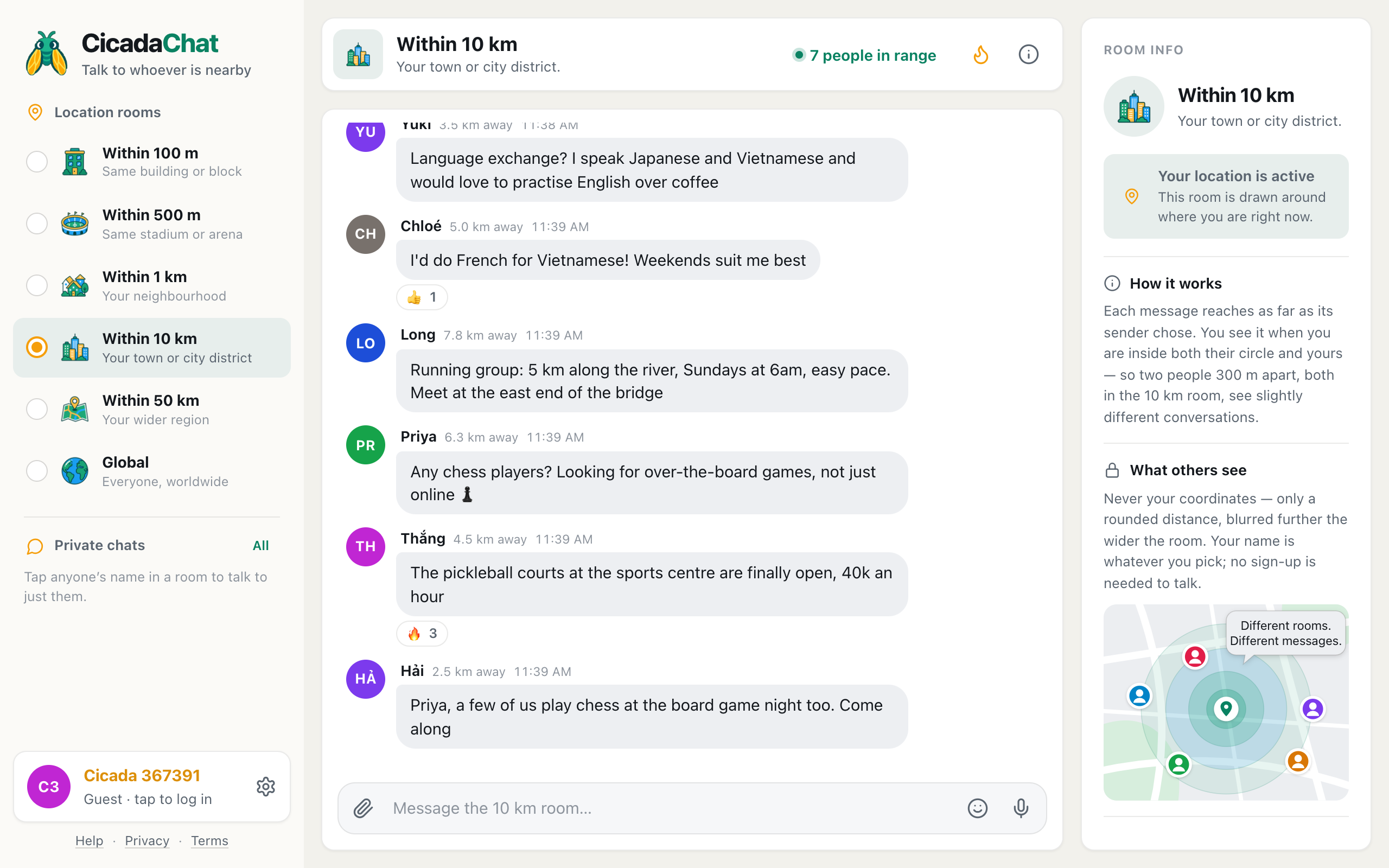
A screenshot of the 10 km room on a computer. People 2.5 to 7.8 km away are sharing a board game night, a language exchange, a Sunday running group and new pickleball courts, and a chess player gets an invitation.
Two ways to start: ask or invite
Ask
If you're looking for something that might already exist, ask. Be specific about what you want, your level, and when you're free:
- "Any chess players? Looking for over-the-board games, not just online."
- "Is there pickup football on weekday evenings? Happy to travel a few km."
- "Any climbing gyms with a beginners' evening?"
Often someone already runs exactly what you're looking for, or knows someone who does. In the screenshot, the chess player's question got an answer from the board game night's organiser within minutes: a few of them play chess there too.
Invite
If nothing exists, start it. An invitation needs a little more detail, because people decide from one read whether it's for them:
- What: "Running group", "Board game night", "Badminton doubles".
- Level: "easy pace", "beginners welcome", "intermediate players".
- When: "Sundays at 6am", "every Thursday at 7".
- Where, with a landmark everyone knows: "the east end of the bridge", "the café near the university".
- Cost, if any: "40k an hour for the court, split between us".
"Running group: 5 km along the river, Sundays at 6am, easy pace. Meet at the east end of the bridge." says everything in one line. People can react with 🔥 or 👍 to show interest, reply to ask questions, or just turn up.
Language exchange
Language exchange is made for the 10 km room. A city has people learning every combination of languages, and a good exchange partner is worth crossing town for. Post what you speak and what you're learning:
- "Language exchange? I speak Japanese and Vietnamese and would love to practise English over coffee."
- "I'd do French for Vietnamese! Weekends suit me best."
Say how you'd like to meet (coffee, a walk, a video call), how often, and your level. When someone replies, tap their name to start a private chat and arrange the details: only the two of you can read it, and it doesn't show either of your distances. The help article private chats: how to message someone one to one explains how.
A tip: write your post in both languages. It shows people you're serious, and it's already a little practice.
Sport
Team sports have a numbers problem. Five-a-side needs ten players, doubles needs four, and someone always drops out on the day. The 10 km room is where you find the missing player: "Badminton players? We need a fourth on Wednesday nights" is exactly the kind of message it's good at.
It's also where you hear about places to play: new courts at the sports centre, which pitch has pickup games on Tuesdays and Thursdays, which pool has a lane for serious swimmers in the morning. These messages collect reactions, which means they turn up in the room's Hot view, the flame button in the header, for a week. Newcomers to the room find them without having to ask.
Picking a place across town
In a 20 km circle, "near me" means something different to everyone. A few habits help:
- Pick somewhere central or easy to reach, like a landmark on a main bus route, or somewhere with parking.
- Use the distances as a rough guide. Each message shows how far away its sender was, rounded to the nearest 250 m, like 4.5 km away. If everyone replying is on the same side of you, it might make sense to meet on that side.
- Rotate if the group is spread out. This week near the university, next week by the river.
- Share a meeting point, not your home. To show people exactly where to meet, share a location from the paperclip button. CicadaChat warns that Everyone within 10 km will see this exact spot, which is fine for the east end of a bridge and not for your front door.
When nobody answers
Sometimes a question sits there with no replies. That doesn't necessarily mean nobody shares your hobby. A few things to try:
- Ask at a busier time. Evenings and weekend mornings are when most people open the app. A post at 3pm on a Tuesday is seen by far fewer people than the same post at 8pm.
- Check the number in range. The green number beside the room name is how many people are online now and would hear you, you included. If it's low, try again later, or step up to the 50 km room for something rare.
- Make it easier to say yes. "Anyone into chess?" is easy to ignore. "Playing chess at the café by the university on Thursday at 7, come along" gives people something concrete to react to.
- Just go. If you've posted an invitation, turn up anyway. The first session of many groups is two people, and the photo from it is what brings the third.
And look at the room's Hot view. Groups that already exist often have a message there from the last few days.
The first meetup
- Meet in public, somewhere with other people around: a café, a park, a sports centre.
- Tell someone where you're going, especially when meeting one person.
- Arrange details in private chats, not the room. Phone numbers and exact times can wait until you know who's coming.
- Post afterwards. "Great first run this morning, six of us, same time next week" tells the room the group is real, and brings more people next time.
From strangers to regulars
After a couple of meetups, you'll start to recognise names. That's the time to stay in touch in a way that doesn't depend on being in range. A guest account works for everything in the room, but a free registered account adds two things that groups find useful:
- Friends. Tap someone's name and use Add friend. The button shows Requested while you wait, and Friends once they accept. Friends see when each other is online, but never where. The help article friend requests: adding, accepting, declining and removing friends covers the details.
- Private rooms. Invite-only group chats that work wherever each of you is. Only the room's owner can add people, and only their friends, so nobody gets pulled in by a stranger.
A running group or board game night with its own private room can plan the next session, swap photos and cancel for rain without filling the 10 km room with it. From the 10 km room to a private room: organising a club or meetup across town walks through setting one up.
Keep posting in the 10 km room too, though. It's where the next member will find you.
Ideas that do well in a town-wide room
- Games: board games, chess, go, card games, quiz teams.
- Sport: running, cycling, football, badminton, pickleball, swimming, climbing, yoga in the park.
- Languages: exchanges, conversation clubs, study partners for an exam.
- Making things: photography walks, sketching, knitting, woodwork, film camera repairs.
- Music: a band looking for a drummer, a choir, jam sessions.
- Learning: coding meetups, book clubs, history walks.
- Helping: clean-ups, food banks, animal shelters looking for dog walkers.
Keeping the room friendly
- Welcome beginners. "Beginners welcome" in an invitation brings more people than you'd expect.
- Don't flood the room. Post your group once or twice a week, not every hour. CicadaChat limits how fast anyone can send messages, and people stop reading a room that's full of the same post.
- Answer questions. A quick reply to "what level is it?" is often the difference between someone coming and not.
- Be clear about costs. Court fees, gym passes and café minimums are all fine, as long as people know before they come.
Open CicadaChat, tap 10 km, and ask who else plays.
No comments yet. Start the conversation.