
Talking to the whole world: good manners in the Global room
The habits that make CicadaChat's Global room friendly: writing for a worldwide audience, being generous with second languages, reacting instead of repeating, and when to take it private.
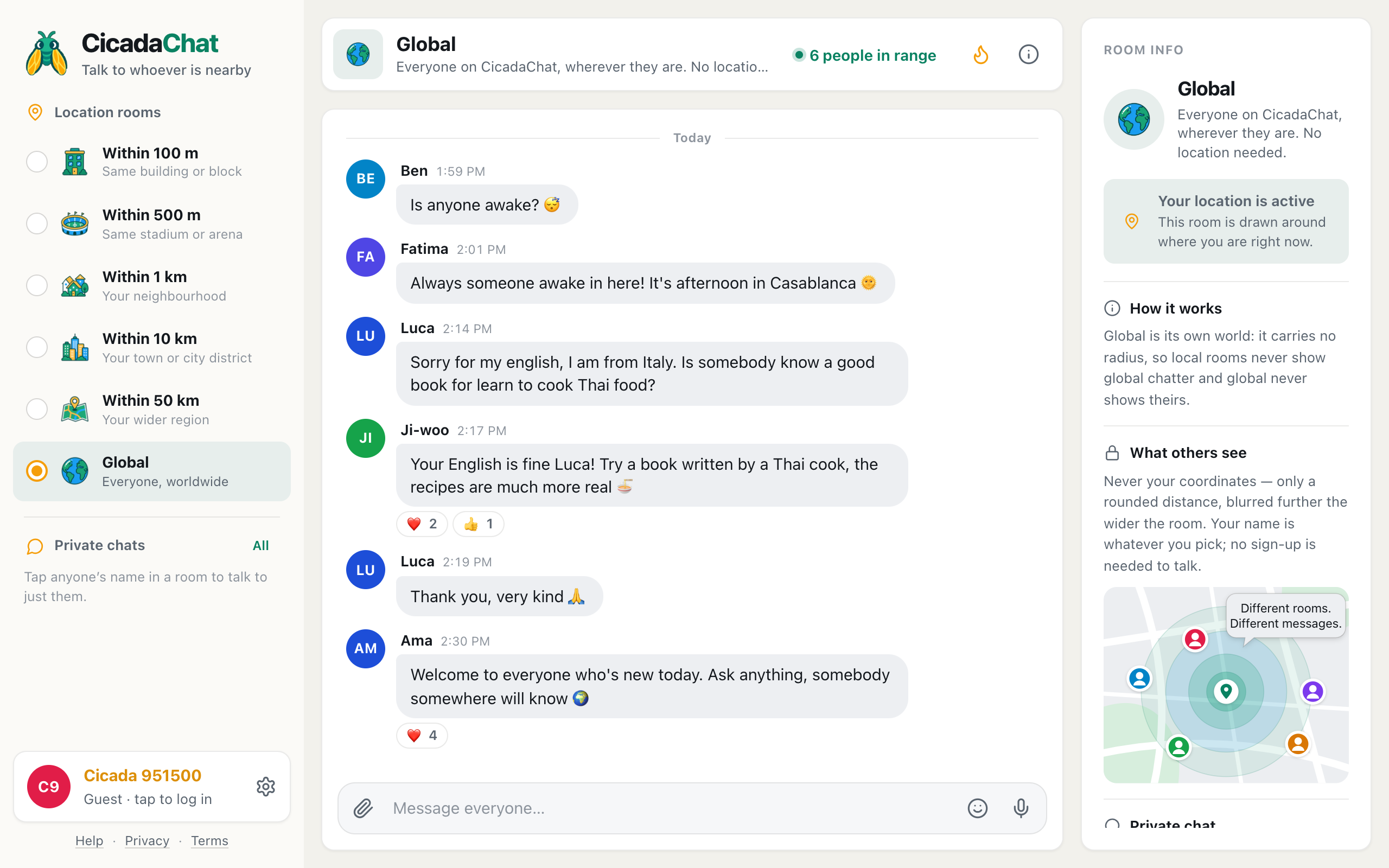
The Global room is the one place on CicadaChat where you're talking to everyone at once: people of every age, in every time zone, writing in their first, second or third language. That's what makes it special, and it's also why manners matter more there than anywhere else. Good manners in the Global room aren't about rules. They're a handful of habits that make a room of strangers from forty countries feel friendly. This article goes through them: how to write for a worldwide audience, how to be kind to people writing in a second language, when to take a conversation private, and what to do when things go wrong.
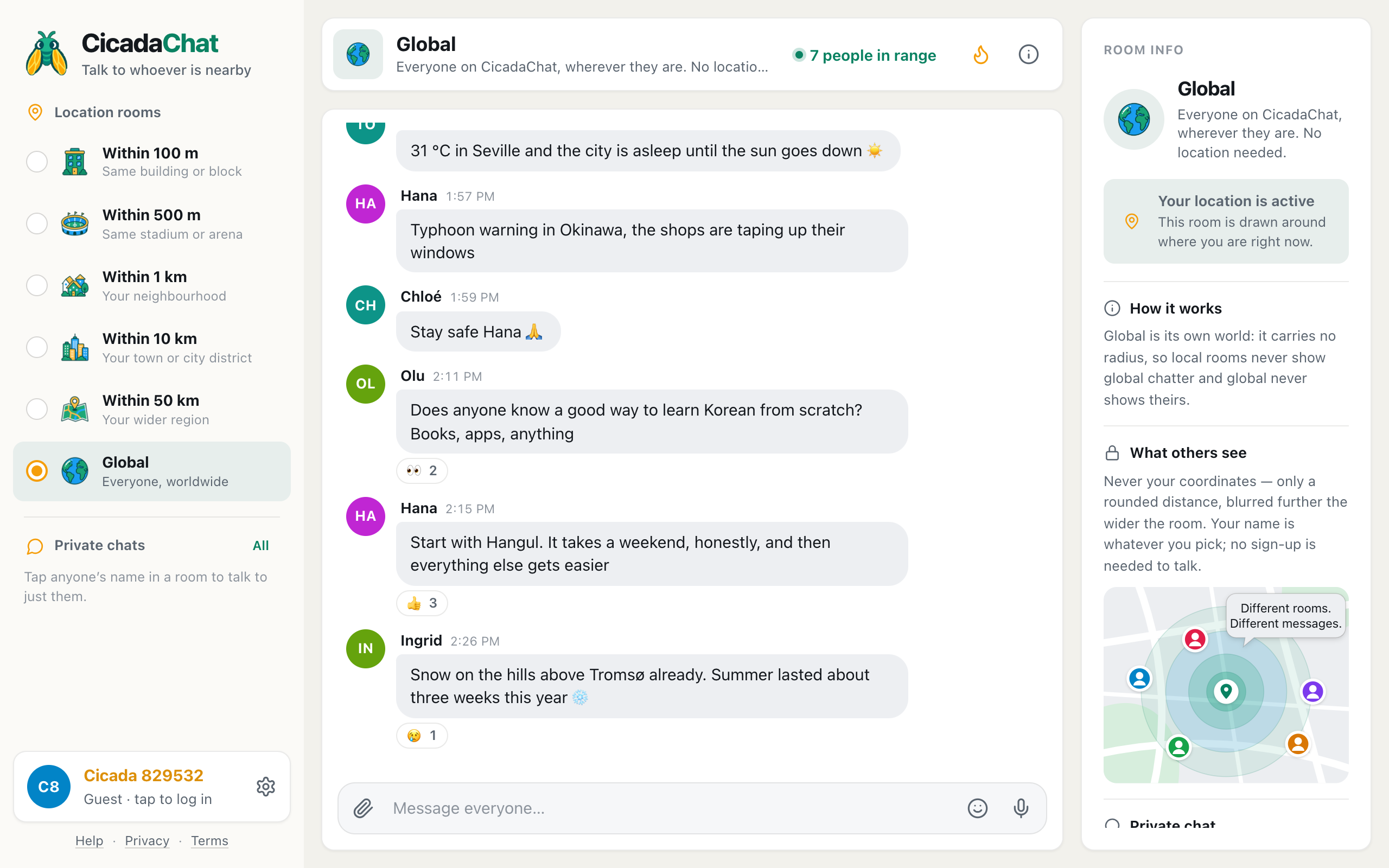
A screenshot of the Global room on a computer. Someone apologises for their English, gets a warm, useful answer, and a welcome message collects four hearts.
Remember who's reading
In a local room, the people reading your message live near you. They share your weather, your news, your slang and usually your language. In Global, none of that is true. When you write, picture the room as it really is:
- Different countries. A joke about your local football team or a politician in your country may mean nothing, or something very different, somewhere else.
- Different languages. Most people in Global write in English because it's the most widely shared language, but for many of them it isn't their first.
- Different times of day. Your evening is someone's morning and someone else's night shift. The times next to messages are shown in each reader's own time zone, so say "it's late here" rather than "see you at 9".
- Different ages and situations. Students, parents, retired people, night workers, travellers. Write as if anyone could be reading, because they are.
Writing for a worldwide room
A few small habits make your messages easier for everyone to read:
- Plain words over slang. "That's great" travels further than a phrase only your city uses. If you do use an expression, you might add what it means.
- One idea per message. Short, clear messages are easier to follow in a busy room and easier to understand in a second language. Messages can be up to 2,000 characters, but most good Global messages are one or two sentences.
- Context for questions. "Does anyone know a good book for learning Thai cooking?" can be answered by anyone. "Does anyone know the one I mean?" can't.
- Emoji help. A 😄 after a joke makes it clear it's a joke, in any language. That's especially useful when tone is hard to read.
- Check before sending. Messages can't be edited or deleted once they're sent. A second look saves a lot of "sorry, I meant…".
Be generous with second languages
This is the most important habit in Global. Many people there are brave enough to write in a language they're still learning, and how the room responds decides whether they come back.
When someone writes "Sorry for my english, I am from Italy. Is somebody know a good book for learn to cook Thai food?", the right response is the one in the picture above: "Your English is fine Luca! Try a book written by a Thai cook, the recipes are much more real 🍜". Answer the question. Reassure them if they apologised. Don't correct their grammar unless they've asked for help with it.
If you're the one writing in a second language, don't apologise too much. Everyone in Global is used to it, and people understand far more than you'd think. If you're learning and would like corrections, say so: "please correct my English!" invites friendly help.
CicadaChat doesn't translate messages, so they appear exactly as written. If you write in a language most of the room won't read, that's fine, but a few words in a more widely shared language help people join in.
Welcome the newcomers
Global is where many people meet CicadaChat for the first time, especially people who chose not to share their location. Their first message is often something like "Is anyone awake? 😴" or "First time in the Global room 👋". A quick friendly reply, like "Always someone awake in here! It's afternoon in Casablanca 🌞", is the difference between someone staying and someone closing the app.
Messages like "Welcome to everyone who's new today. Ask anything, somebody somewhere will know 🌍" are part of what makes Global feel like a room rather than a feed.
React more, repeat less
Reactions are the quiet way to take part. Hover over a message on a computer, or tap it on a phone, and choose 👍, ❤️, 😂, 😮, 😢, 🔥, 🎉 or 👀. They're a good fit for Global because:
- They work in every language. A ❤️ needs no translation.
- They keep the room readable. If ten people agree with an answer, ten 👍 on it are easier to read than ten "yes, this" messages.
- They're anonymous. A reaction shows as a count, not a name, so reacting is an easy way to say thanks without being in the spotlight.
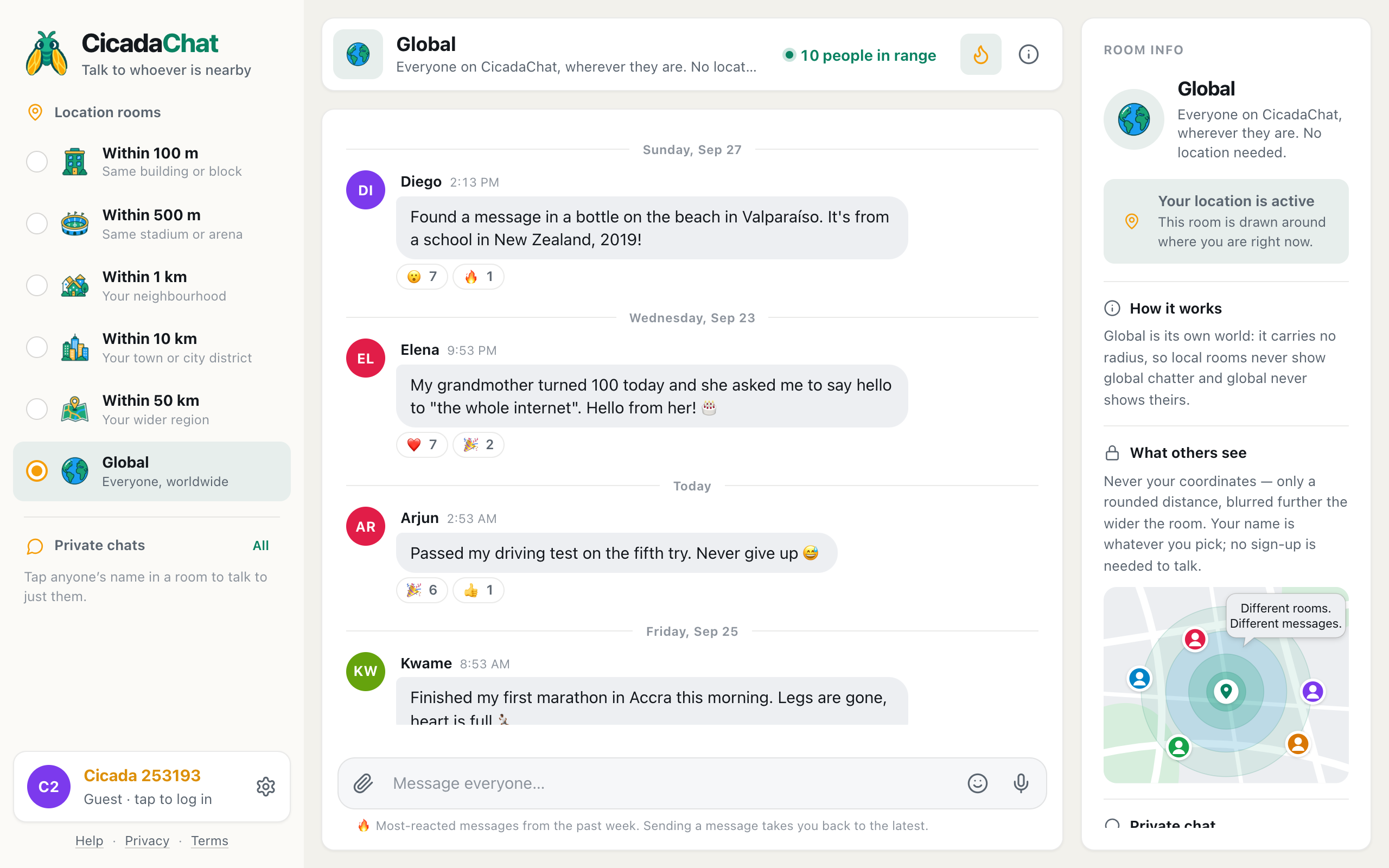
- They lift the best messages. The Hot view (the flame button in the header) ranks the week's messages by how many people reacted. Reacting to kind, helpful and funny messages is how they end up there.
For how reactions work in detail, see sending messages, emoji and reactions in CicadaChat.
Know when to take it private
Global is a shared space, and some conversations are better one to one. Tap someone's name on any of their messages to open a private chat that only the two of you can read. Take a conversation private when:
- It's become a long back-and-forth between two people. The rest of the room can't follow it and can't get a word in.
- It's personal. Anything you wouldn't say in front of a crowd of strangers.
- It's a disagreement. Arguments in public tend to grow. In private they tend to calm down, or at least end quickly.
- You want to share details. A phone number, a guide, a photo of something personal.
Private chats: how to message someone one to one explains how they work.
Respect people's privacy
CicadaChat never shows anyone's location or distance in Global. Keep it that way in conversation too:
- Don't ask strangers where exactly they live. "Which country are you in?" is friendly. "Which street?" isn't.
- Don't post other people's photos, names or details without their permission.
- Don't share an exact location in Global unless you truly mean everyone to see it. The warning when you attach one says so: Everyone in the global room will see this exact spot.
Privacy in the Global room: what everyone on CicadaChat can and can't see goes into more detail.
Don't advertise at people
It's fine to say what you do, and a question about your field is a great chance to help. What doesn't work in Global is posting promotions: the same offer again and again, links in reply to unrelated messages, or "check out my shop" as a greeting. People scroll past it, and it makes the room worse for everyone. If you run a business or make things, being helpful is the best advert, and a business card on a registered account lets people who are interested find out more in a private chat.
Phrases that travel well
Some messages work in any culture and any language level. They're good to have ready:
- "Good morning from…" / "Evening here in…" Says hello and gives context without giving away more than a city.
- "Welcome!" The kindest word you can send to someone's first message.
- "Your English is fine." Often the thing someone apologising for their English most needs to hear.
- "What's it like where you are?" Opens a conversation with anyone, anywhere.
- "Thank you, very kind 🙏" Closes a helpful exchange warmly.
- "Sorry, I misunderstood." Ends a misunderstanding before it becomes an argument.
None of these need perfect grammar, and all of them work just as well in your own language as in English. If you only remember one habit from this article, make it this: reply to people the way you'd want a stranger on the other side of the world to reply to you.
When things go wrong
Most of the time, Global is friendly. When it isn't:
- Don't feed an argument. A calm reply or no reply at all usually ends it faster than a clever comeback.
- Don't pile on. If someone said something unkind, one person pointing it out is enough. Ten people doing it turns a mistake into a spectacle.
- You never have to reply. Not in the room, and not in a private chat. If a conversation makes you uncomfortable, stop answering.
- Change room for a while. Your local rooms and the Global room are separate conversations. Stepping into your 1 km room, or closing the app for an hour, is a perfectly good way to leave a bad moment behind.
- Apologise if it was you. Everyone misreads a joke across cultures sometimes. "Sorry, that came out wrong" is always welcome.
In short
Write as if the whole world were reading, because it is: plain words, one idea at a time, context for your questions. Be generous with people writing in a second language, welcome newcomers, react instead of repeating, and take long, personal or heated conversations private. Respect privacy, don't advertise, and don't feed arguments. The Global room is only as friendly as the people in it, and that includes you.
No comments yet. Start the conversation.