
Farms, villages and islands: when the 50 km room is the one that's awake
In the countryside, the small rooms can be empty for days. The 50 km room gathers farms, villages, towns and islands into one conversation that's awake.
In a city, the 1 km room can be busy at midnight. On a farm, in a hill village or on a small island, it might be you and the chickens. That's not a flaw in the countryside. It's just arithmetic: fewer people live in each square kilometre, so a small circle holds fewer of them. The 50 km room fixes the arithmetic. It gathers the villages, farms, market towns and islands around you into one conversation that's big enough to be awake. This article is about using the 50 km room in the countryside and other quiet places: why it works, what people talk about there, and how to get a quiet room going.
Why the small rooms are quiet outside the city
Every CicadaChat room is a circle drawn around you. In a dense city neighbourhood, a 1 km circle can hold tens of thousands of people. In farmland, the same circle might hold a few dozen, and only some of them will have CicadaChat open at any moment. The 10 km room does better, and around a market town it's often enough, which is the idea behind small towns, suburbs and villages: when the 10 km room is your local room. But in truly rural areas, on islands and in the mountains, even a town-sized room can go quiet for days.
The 50 km room is a circle a hundred kilometres across. In the countryside, that's typically a couple of market towns, dozens of villages, the district hospital, the bus station and the main road to the city. It's the area people already think of as "round here" when they live far from anywhere. And it has enough people in it for somebody to answer.
What a rural 50 km room looks like
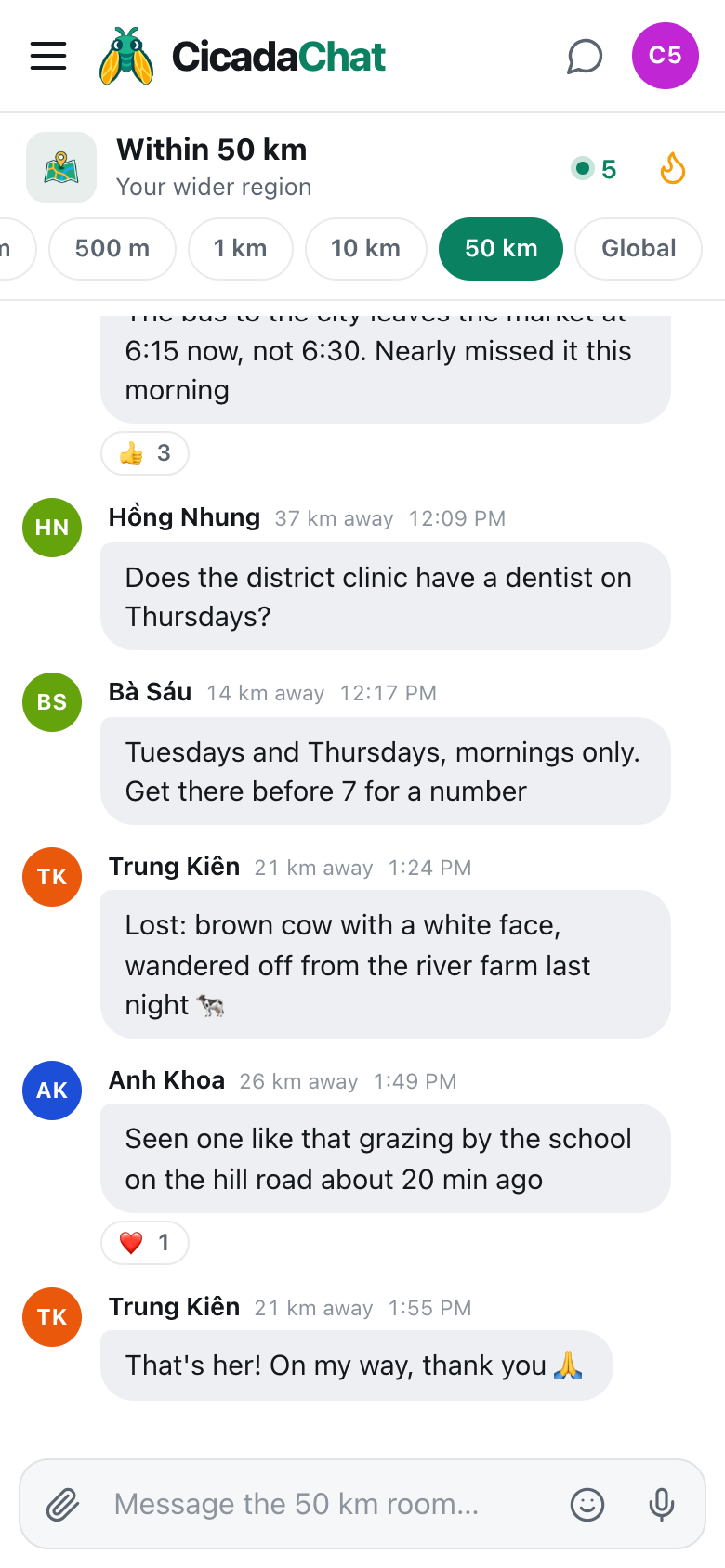
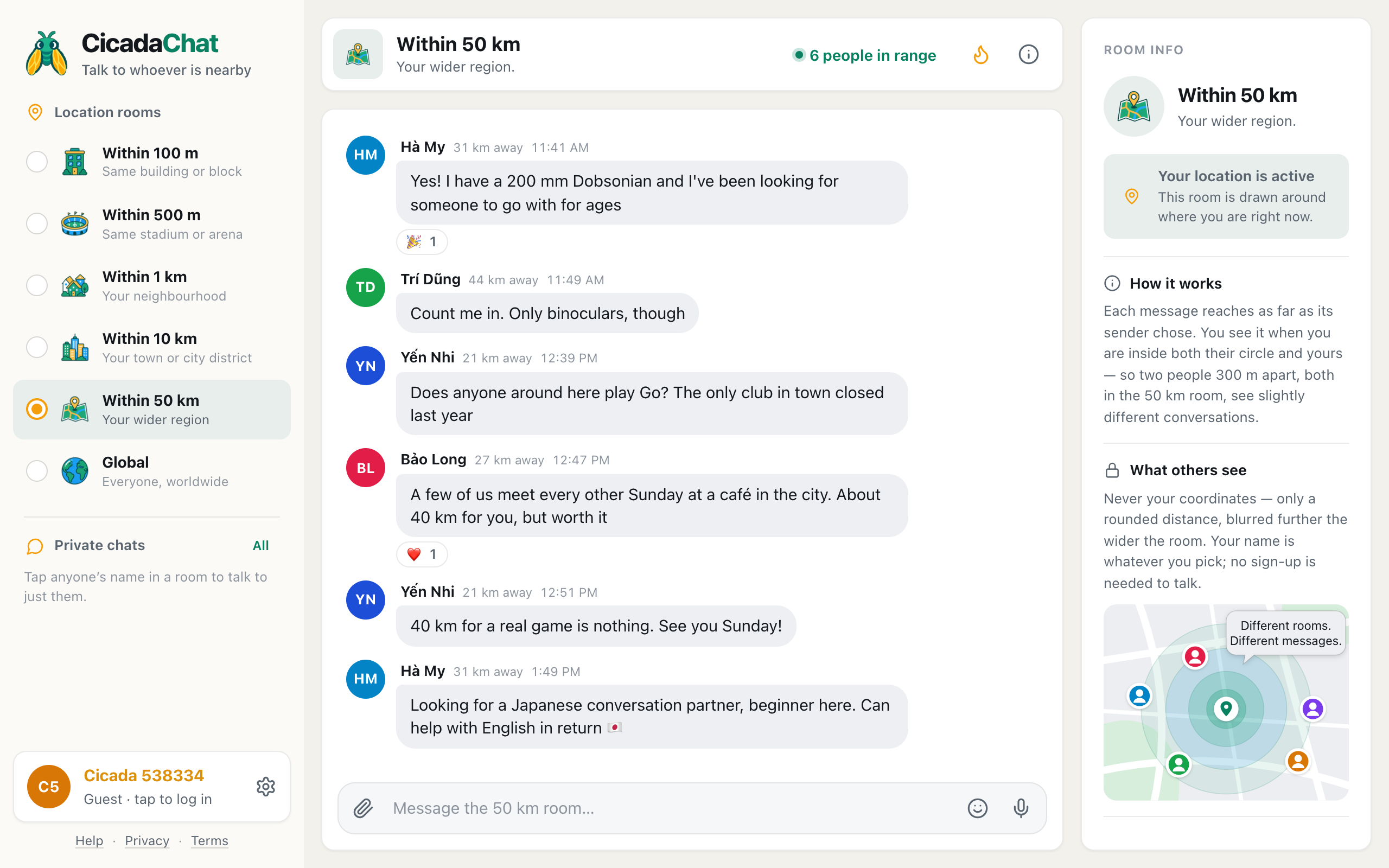
Here's a 50 km room in farming country. Five people are in range, and the nearest of them is 14 km away. A new bus time gets three 👍. Someone asks whether the district clinic has a dentist on Thursdays and gets an answer eight minutes later. A cow that wandered off in the night is spotted by the school on the hill road and found within half an hour.
A screenshot of a rural 50 km room on a phone. Five people in range, 14 to 37 km apart, share a new bus time, the clinic's dentist days and a lost cow that's found within half an hour.
None of it would work in a 1 km room, because nobody else would be in it. At 50 km, the person who knows the answer is usually in range, even if they live half an hour's drive away.
What people talk about in the countryside
Services that come to you
Vets who visit farms, mechanics who fix tractors in the field, the man with the rice harvester who comes through once a season, the mobile library, the dentist who's in the district town on Tuesdays and Thursdays. In the country, many services cover a whole district, and knowing when they're coming matters.
Buses, boats and roads
A changed bus time, a ferry cancelled for wind, a landslide on the mountain road, the level crossing that's closed for repairs. When there's one bus a day, finding out it leaves fifteen minutes earlier is worth a lot.
Weather and water
Rain in the hills reaches the valley hours later. Someone upstream telling you the river is rising gives you time to move animals and equipment. When the weather crosses the region covers storms, floods, smoke and snow in the 50 km room.
Animals, lost and found
Cows, goats, buffalo and dogs don't respect fences. A lost animal can cover a lot of ground, and in a room that reaches every farm around, someone has usually seen it.
Buying, selling and swapping
Seedlings, eggs, a used water pump, a spare load of firewood, a litter of puppies that need homes. Remember that CicadaChat is a chat, not a marketplace: agree details in a private chat, and meet somewhere public.
Markets and festivals
Which town has its market on which day, when the harvest festival is, whether the fair is on despite the rain. In the country, events rotate between towns, and the whole region goes.
Islands and coasts
On an island, a 50 km circle often includes the mainland port, the ferry route and the neighbouring islands. That makes it the room for the questions island life turns on: is the boat running, is the supermarket on the mainland open, does anyone have space in their van for the crossing? The circle doesn't care about water. A message from the harbour on the mainland reaches you on the island as long as you're within range of each other.
The same goes for coasts and lakes. A long bay or a reservoir can split a region into two sides that are close on the map and an hour apart by road. The 50 km room puts both sides in the same conversation, which is useful when someone on the far side can see the weather coming before you can.
Mountains and valleys
In the hills, distance on the map isn't distance on the road. A village 15 km away across a ridge might be an hour's drive round. The 50 km room shows distances as the crow flies, rounded to the nearest kilometre, so "15 km away" tells you how far someone is, not how long it takes to get there. Use it the way mountain people always have: to find out what's happening on the other side of the ridge before you set out.
How to get a quiet room going
Even a 50 km room can be quiet at first, especially where CicadaChat is new. A few things help:
- Ask something useful. "When is the next market in town?" or "Is the pass open?" gets answers. "Anyone here?" usually doesn't.
- Answer when you can. A room becomes worth checking when questions get answered. If you know the bus times, share them.
- Post at the busy times. Early morning, lunchtime and evening are when most people have a moment.
- React. A 👍 costs nothing, tells the poster they were heard, and lifts useful messages into the room's Hot view for the week.
- Tell people. At the market, the school gate, the cooperative meeting. Anyone with a phone can join without signing up.
- Add it to your phone. Adding CicadaChat to your home screen makes it one tap away, like an app.
Patchy signal
Rural areas often have weak or intermittent mobile data. CicadaChat needs a connection to send and receive messages, so a few habits help:
- Text travels better than photos. Photos are resized on your phone before sending, but a short message still gets through far more easily on one bar of signal.
- Check it went. If a message doesn't go through, wait until you have signal and send it again.
- Refresh after a dead zone. When your signal comes back after a long gap, reopening the room or reloading the page brings in what was said while you were away.
- Post before you lose signal. If you know the valley road has no coverage, ask about it at the top, not halfway down.
The seasons of a rural room
A city room is busy all year. A country room follows the calendar, and it helps to know its rhythm:
- Planting and harvest. The busiest weeks for questions about machinery, labour, seed, weather and prices. Also the weeks when nobody has time to chat, so keep messages short and practical.
- The rainy season or winter. Roads, rivers, power and supplies. This is when the 50 km room proves its worth, because the news you need comes from the hills and the next valley, not your own lane.
- Holidays. When people who've moved to the city come home for the holidays, the room fills up. Old neighbours find each other, and questions about buses back to the city multiply.
- Festival season. Fairs, temple festivals and sports days rotate between towns. The whole region goes, and the room is where you find out when and where.
If the room is quiet in a slow month, don't give up on it. The same people will be back when there's something to talk about.
Privacy in a small community
In a village, people know each other. "The farm with the blue gate" identifies you as surely as an address. CicadaChat never shows anyone your coordinates, only a distance rounded to the nearest kilometre, but in a place with a handful of houses, the details you write matter more than the distance. Talk about places and events freely, keep family matters for private chats, and remember that the 50 km room reaches the next town too.
The same goes for photos. CicadaChat strips the hidden location data from photos before they're sent, but a picture of your field with the church tower behind it tells locals exactly where you are.
From a quiet room to a community
Rural rooms rarely get busy overnight. They grow the way village life does: a question answered, a lost cow found, a lift offered to the city. Over a few weeks, the same names start appearing, and people start to check the room before they drive into town.
When a group forms around something, like a farmers' cooperative, a football team or parents from the district school, registered accounts can make a private room: an invite-only chat that isn't tied to location, so members stay together however spread out they are. It's how a regional conversation becomes a regional community. The 50 km room: chatting with your whole region has the basics of the room itself, from how to get there to what you can send.
No comments yet. Start the conversation.