
Rare hobbies need a bigger circle: finding your niche within 50 km
If your hobby is rare, your town may not be enough. How to find astronomers, Go players, language partners and more within 50 km, and turn replies into a group.
Some hobbies find you company on every street: football, running, coffee. Others are rarer. If you're into astronomy, the board game Go, beekeeping, restoring old motorbikes, or practising a language few people speak where you live, you might be the only one in your neighbourhood, and one of a handful in your town. Across a whole region, though, there are usually enough of you to start something. This article is about finding your niche in the 50 km room: why a bigger circle helps rare interests, how to ask so the right people answer, and how to turn a few replies into a group that meets.
The arithmetic of rare interests
Say one person in two thousand plays Go. In a 1 km circle in a medium-sized town, there might be ten thousand people, so five Go players, most of whom aren't on CicadaChat at the moment you ask. In a 10 km circle there might be a few dozen. A 50 km circle covers twenty-five times the area of a 10 km one. Around a city, it can hold millions of people, and even in the countryside it takes in several towns. Somewhere in there are enough Go players for a regular game.
That's the idea behind the 50 km room: a circle a hundred kilometres across, drawn around you. It's the widest room that's still local, where the people who answer are close enough to meet. For hobbies that a town can support on its own, like pickup football or running groups, the 10 km room is usually enough. Finding your people across town: sport, hobbies and language exchange in the 10 km room covers those. This article is for when your town isn't enough.
What it looks like
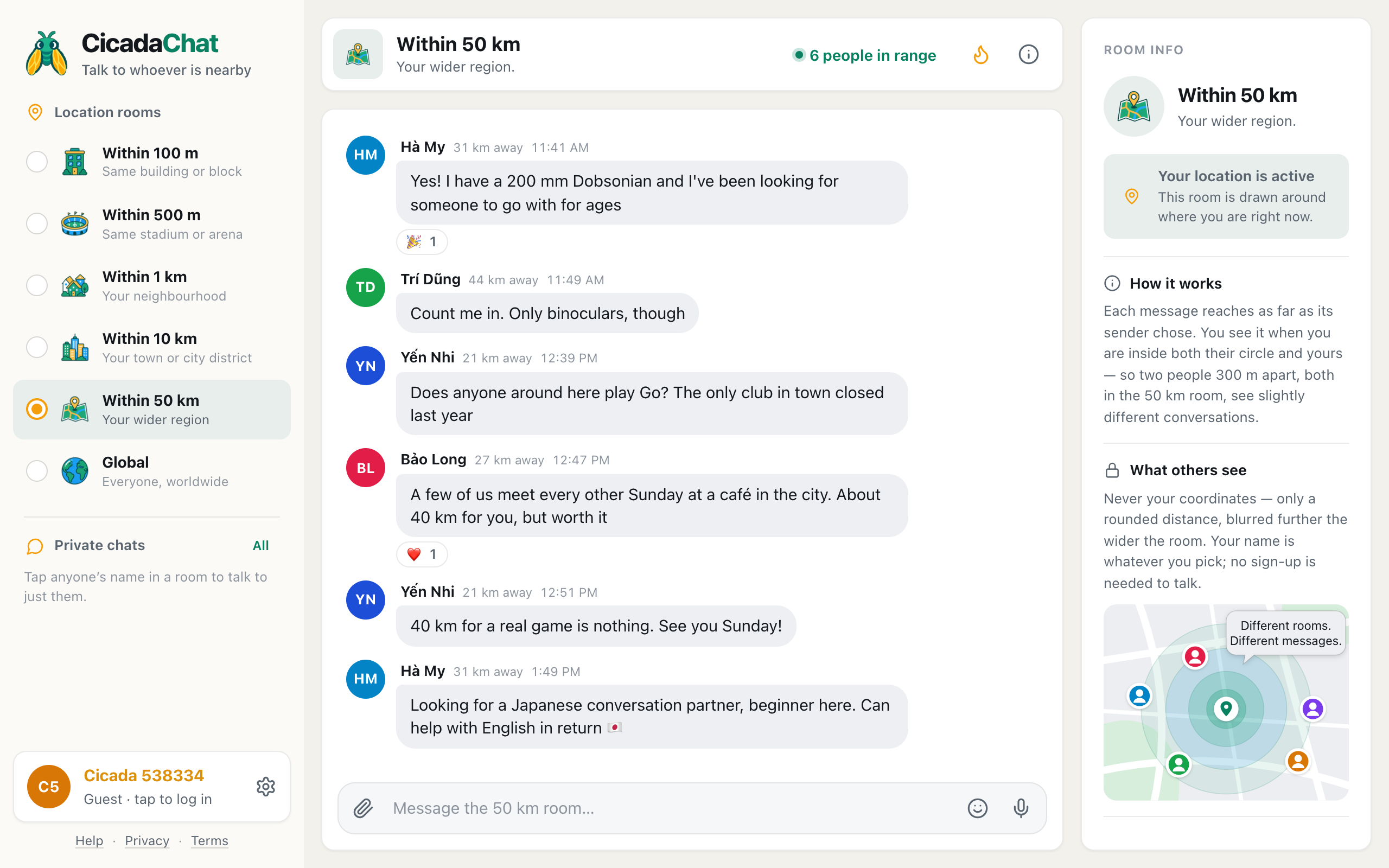
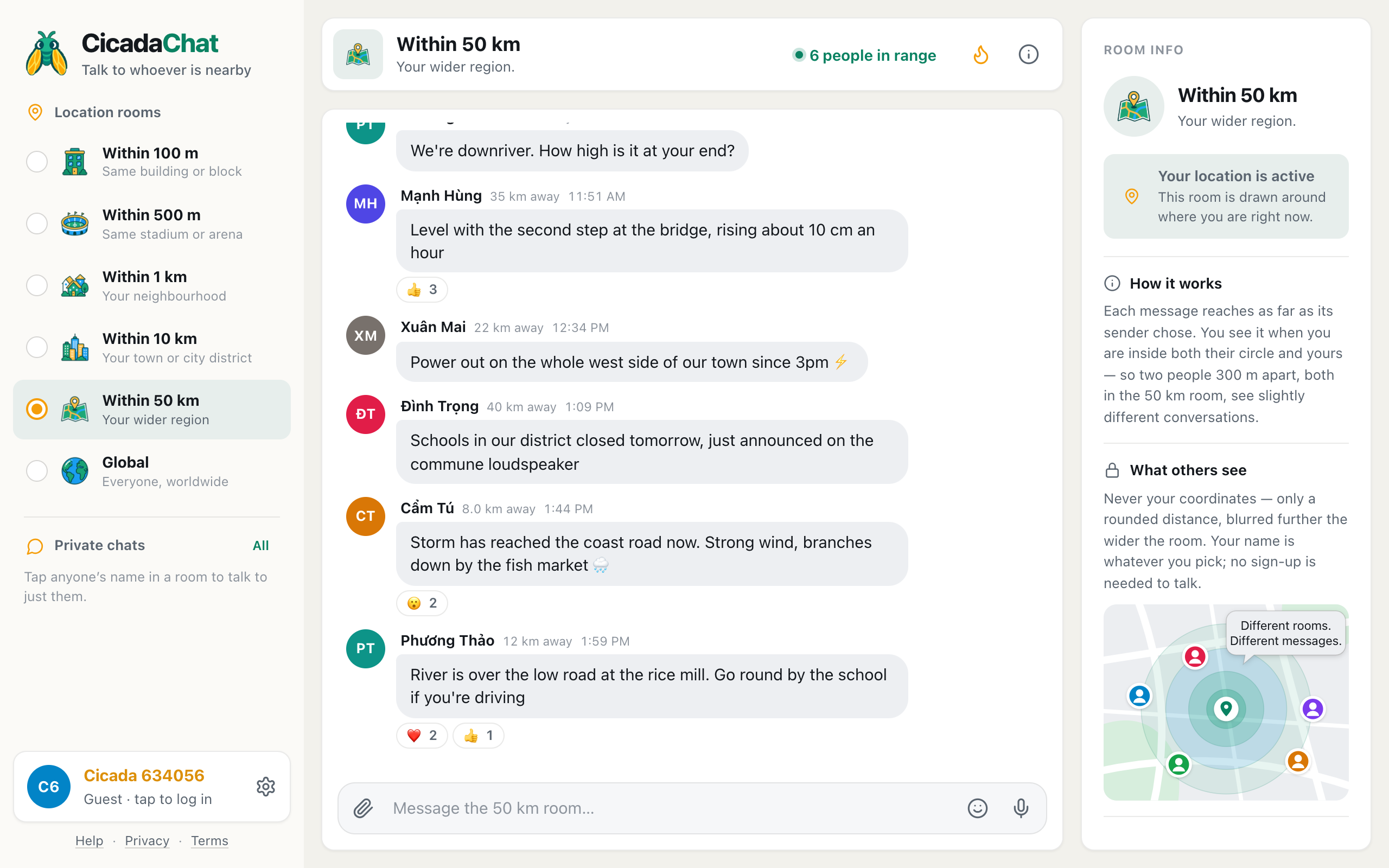
A screenshot of hobbies finding people in the 50 km room. A stargazing trip, a Go group in the city and a language exchange all get replies from 21 to 44 km away.
Here's a 50 km room on an ordinary day. Someone asks whether any amateur astronomers are around, because clear skies are forecast for Friday. Someone 31 km away replies straight away: they have a 200 mm Dobsonian telescope and have been looking for someone to go with for ages. Someone 44 km away is in, with binoculars. Later, someone asks whether anyone plays Go, since the only club in town closed last year. Someone 27 km away says a few of them meet every other Sunday at a café in the city, about 40 km away, but worth it. The answer: "40 km for a real game is nothing. See you Sunday!" And a request for a Japanese conversation partner, with English offered in return, is waiting for its first reply.
Hobbies that suit the regional room
- Sky and nature: astronomy, birdwatching, butterfly counting, foraging, orchid growing. Many need dark or wild places outside the towns.
- Games: Go, chess, bridge, tabletop role-playing, war games, rare card games.
- Making and fixing: woodworking, restoring old motorbikes or radios, pottery with a kiln, blacksmithing, model railways.
- Animals: beekeeping, rare breeds, pigeon racing, dog sports.
- Sport on a big scale: trail running, mountain biking, paragliding, open-water swimming, climbing. These need terrain that's spread across a region.
- Languages: finding speakers of a language that's rare where you live, for practice or just for company.
- Music: finding a bass player for a band, a choir that sings a particular style, other players of a traditional instrument.
- Collecting: stamps, coins, vinyl, old maps, anything that's more fun with someone to swap with.
How to ask so the right people answer
Open CicadaChat, tap 50 km in the row of room tabs on a phone, or Within 50 km in the Location rooms list on a computer, and write a message that makes it easy to say yes:
- Name the hobby clearly. "Any amateur astronomers around?" is better than "Anyone into space?"
- Give a reason to reply now. "Clear skies forecast Friday, thinking of taking the telescope up to the ridge" turns an idea into a plan.
- Say your level. "Beginner here" or "played for twenty years" helps people judge whether it's for them.
- Offer something. "Can help with English in return" or "happy to lend my spare gear" makes it a swap, not a favour.
- Use an emoji if it helps. 🔭, ♟️ or 🐝 catch the eye of the right person scrolling past.
You can write in any language. If your hobby comes with a language, like a Japanese conversation group, writing a line in it is a good way to find the people who read it.
Be patient
A rare interest means the right person might not be online when you ask. Every message stays in the room, and anyone who opens the 50 km room later can scroll up and read it. Popular messages also collect in Hot, the flame button, which shows the room's most-reacted messages from the past week. A 🔥 or 🎉 from someone who's interested but shy also helps: reactions lift a message into Hot, where more people see it.
If nothing comes back after a day or two, ask again at a different time. Evenings and weekend mornings are when most people have time for hobbies. And remember that each person sees their own 50 km circle. When you ask from home and again from work, a different slice of the region sees it.
Joining an existing group, or starting a new one
Before starting something, ask whether it already exists. In the example above, the person asking about Go didn't need to start a club: one was already meeting in the city, and the room connected them to it. That's often the case with rare hobbies. A group of five meets somewhere in the region, and nobody outside it knows. "Is there a Go club anywhere within reach?" finds them.
If nothing exists, you're the founder. Start small. Two astronomers on a ridge on a clear night is already a club. Pick a date, a place and a simple plan, and invite the people who replied. Once it has happened once, it's much easier to invite others to the next one: "Five of us went stargazing on the ridge last Friday, next trip at the new moon."
Judging distance
Every message shows how far away its sender was when they sent it, rounded to the nearest kilometre: 21 km away, 44 km away. It's a straight-line distance, not a road distance, and it doesn't say which direction. Still, it tells you straight away whether a weekly meet-up is realistic or whether you're looking at a monthly trip. In the regional room, many groups meet in the middle, or take turns hosting in different towns.
From replies to a real group
Once a few people have replied, the room has done its job. The next steps happen elsewhere:
- Talk one to one. Tap someone's name, on their message or in the People in range list, to start a private chat. Only the two of you can read it.
- Create accounts. Friends and private rooms are for registered accounts. It's free, and anything you said as a guest is kept.
- Become friends. Send a friend request from their chat. Friends see when each other is online, but never where each other is. The help article friend requests: adding, accepting, declining and removing friends has the details.
- Make a private room. An invite-only chat for the group, which isn't tied to location. Every member sees every message, however far apart they live. That matters in a regional group, where two members can be 80 km from each other and outside each other's 50 km rooms. From the 50 km room to a private room: organising a regional club, league or community goes through it step by step.
Meeting up
When a hobby turns into a meeting, choose somewhere public for the first time: a café, a club room, a park, a library. For outdoor hobbies like stargazing or birdwatching, meet at a public car park and travel together from there. Tell someone where you're going.
If you share a meeting point in the 50 km room with the paperclip's Location option, CicadaChat warns you first: Everyone within 50 km will see this exact spot. For a public place that's fine. For anything else, share it in a private chat or a private room.
Keeping the door open
A small group has a tendency to close up once it's formed. Try not to let it. Post in the 50 km room now and then: "Go group meets every other Sunday in the city, all levels welcome, message me." People move to the region, pick up new hobbies, or just didn't see your first message. A rare interest stays rare, and every new member makes the group more likely to last.
Hobbies and privacy
Hobbies can say a lot about you. Some are harmless to mention, like chess. Others, like valuable collections or expensive equipment, are better discussed carefully. "I have a 200 mm telescope" is fine. "I keep my coin collection at home, which is the house by the lake" isn't. Keep valuables, addresses and schedules for private chats with people you've got to know.
People in the room see your name, your picture or initials, and a distance rounded to the nearest kilometre. Never your coordinates.
No comments yet. Start the conversation.