
Day trips and weekends away: asking the region about lakes, hikes and waterfalls before you go
Is it worth the drive? How to plan day trips and weekends away with the 50 km room: asking about conditions, crowds and opening times, and giving tips back.
A free Saturday, a full tank and a whole region to explore. The question is always the same: is it worth the drive? Guidebooks don't know whether the waterfall trail is slippery after this week's rain. Review sites don't know that the campsite is full because of a festival. The people who've just been there do, and they're within 50 km of you. This article is about planning day trips and weekends away with the 50 km room: what to ask before you go, how to read the answers, and how to give something back when you're there.
Why the 50 km room is the day-trip room
A day trip is usually an hour or so from home: the lake, the hills, the coast, the old town, the tea plantations, the national park. That's the scale of the 50 km room: a circle a hundred kilometres across, drawn around you. Your town's 10 km room is great for what's on in town this weekend, as what's on this weekend? Finding events, markets and things to do within 10 km explains. The 50 km room is where you ask about the places you'd drive to.
And because the room is drawn around each person, it includes the people who live near those places: the family by the lake, the guide in the hill village, the café owner at the top of the pass. They know how things are today.
Before you go: ask
Open CicadaChat, tap 50 km in the row of room tabs on a phone, or Within 50 km in the Location rooms list on a computer, and ask something specific. Good questions name the place and what you need to know:
- "Planning a day out on Saturday. Is the waterfall trail open after all the rain?"
- "Is it worth driving up to the tea hills for sunrise?"
- "Is the beach on the south cove busy on Sundays, or is it quiet?"
- "Is the road to the lake paved all the way, or do I need something higher than a small car?"
- "Anywhere near the reservoir to eat that's good with kids?"
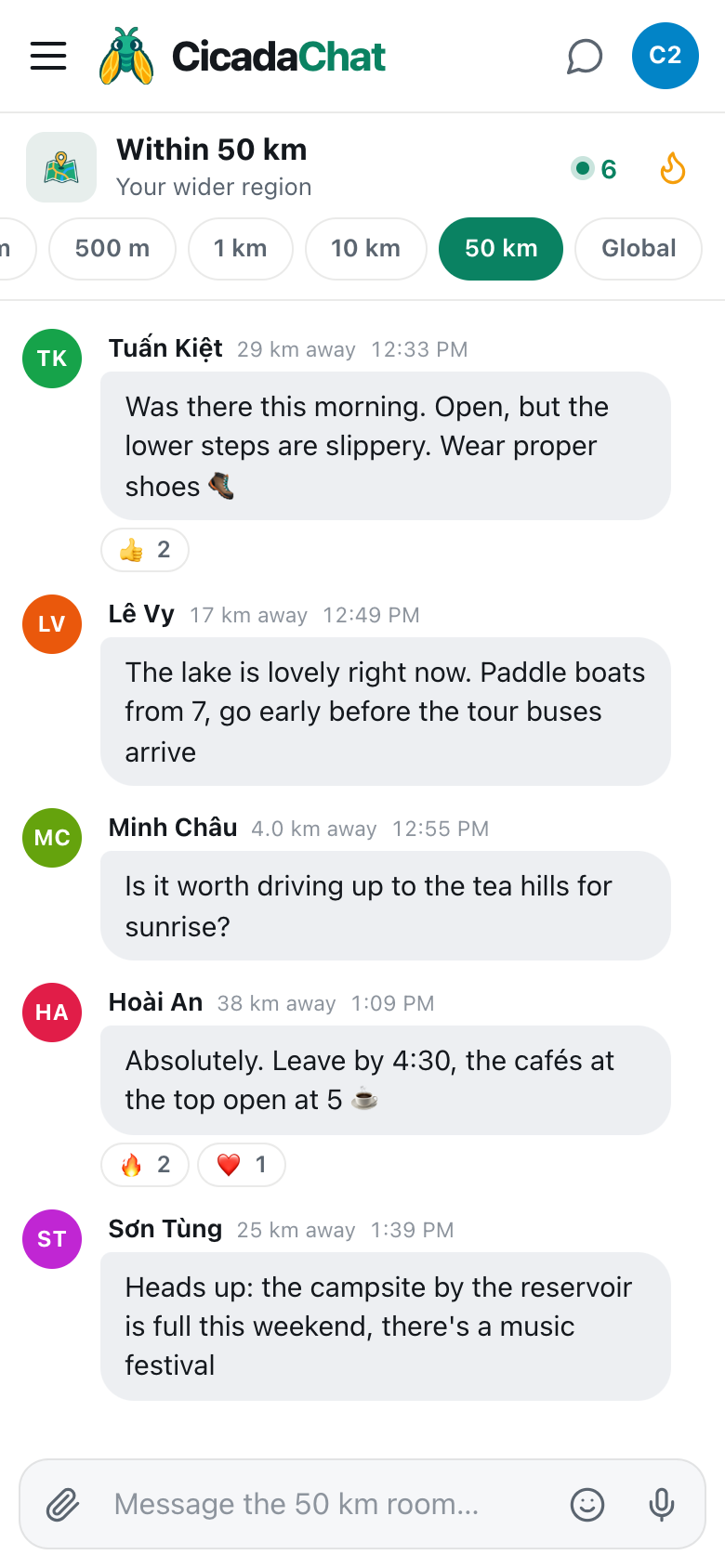
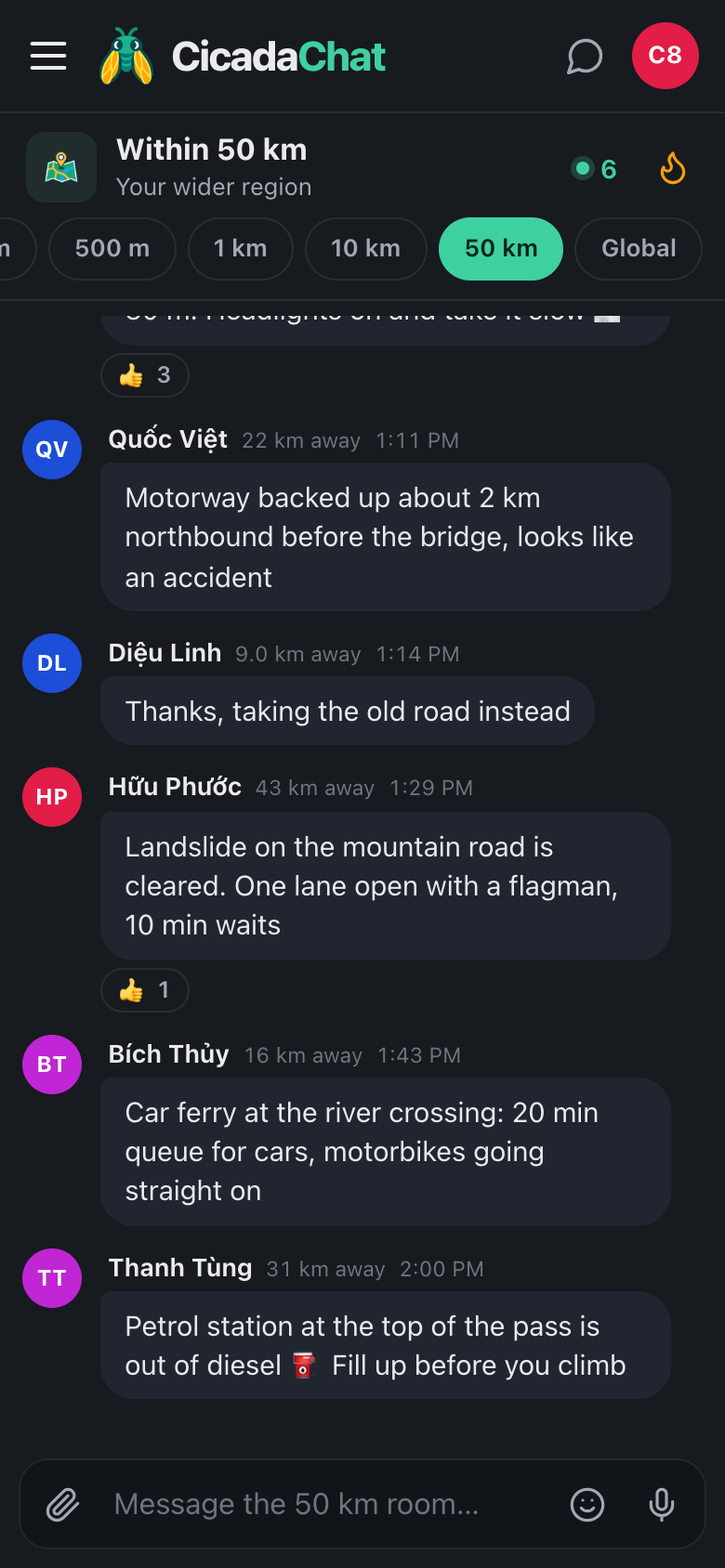
A screenshot of day trip planning in the 50 km room on a phone. People 17 to 38 km away answer questions about the waterfall trail, the lake and sunrise in the tea hills.
Here's how that goes on a normal morning. Someone who walked the waterfall trail that morning says it's open but slippery on the lower steps. Someone 17 km away says the lake is lovely right now and to go early, before the tour buses. Someone 38 km away, out by the tea hills, answers the sunrise question with exactly what you need: leave by 4:30, the cafés at the top open at 5. And someone 25 km away adds a warning nobody asked for but everybody needed: the campsite by the reservoir is full this weekend because of a festival.
What to ask about
Conditions
Trails after rain, river levels for swimming, whether a road is passable, how cold it is at the top. Conditions change by the day, and the room is where they're current.
Crowds
Is it busy? When do the tour buses come? Is there a festival on? A place that's lovely at 7am can be packed by 10.
Opening times and prices
Seasonal places keep their own hours. Whether the paddle boats are running, what the park charges, whether the café takes cards. Locals know.
Getting there
The best road, where to park, whether there's a bus, whether the last stretch is a steep track. For the ride itself, the regional room is also where you'll find people offering lifts. Lifts and carpools: sharing a ride to the airport, the city or a big event within 50 km covers that side.
Hidden places
"Anywhere quiet to swim near the hill town?" Locals sometimes share the spots that aren't in the guidebooks. Treat them kindly, and don't be surprised if some people would rather keep theirs quiet.
Reading the answers
Every message shows the sender's name, how far away they were when they sent it, rounded to the nearest kilometre, and the time. Those three things help you judge an answer:
- The time. "Trail open" from this morning is worth more than "trail open" from last week.
- The distance. Someone 38 km away in the direction of the tea hills probably lives near them. Distances don't have a direction, but you usually know where the place is.
- Reactions. When others add 👍 or 🔥 to a tip, they agree with it. Popular tips also collect in Hot, the flame button, which shows the room's most-reacted messages from the past week. Before a weekend, it's a handy summary of what the region has been recommending.
If an answer needs more detail, tap the person's name to start a private chat. Only the two of you can read it.
While you're there: give something back
The room works because people share what they see. When you're out on your trip, a quick update helps the next person:
- "Waterfall trail: lower steps dry now, upper viewpoint closed for repairs."
- "Lake car park full at 10, overflow parking by the temple."
- "Sunrise at the tea hills was worth it ☕ Road up is fine for small cars."
Remember that the room moves with you. When you're at the lake, 40 km from home, your 50 km room is centred on the lake. That's ideal for asking questions on the spot, like "where's good for lunch near here?", because the people who answer are local to where you are now.
Photos
A picture of the view, the trail or the queue says more than words. Tap the paperclip and choose Photo. CicadaChat resizes and re-encodes photos on your phone before they're sent, which strips the hidden location data many cameras add. The help article how to send photos and documents in a chat walks through it.
Be thoughtful about people in your photos. A crowded beach is fine. A close-up of a stranger isn't.
Sharing a meeting point
If you're meeting people you've chatted with, like a group heading for the same hike, you can share an exact spot from the paperclip's Location option. Before you send it, CicadaChat warns you: Everyone within 50 km will see this exact spot. A trailhead car park or a café is fine to share with the region. For anything more personal, share it in a private chat instead.
Weekends away
Staying the night? Ask about the accommodation before you book: "Anyone stayed at the homestays in the hill village? Is it quiet at night?" Once you arrive, the room around your weekend spot is a new region, full of people who know it. Your 10 km room there tells you about the town. Your 50 km room tells you what else is worth the drive.
If you're the local, answer the visitors. A good tip given to a stranger is how a region earns its reputation.
The best time to go
Regional places have seasons of their own, and locals know them better than any website. It's worth asking not just "is it good?" but "when is it good?":
- Waterfalls are at their best a few days after rain, and at their most dangerous during it.
- Flower fields, orchards and fruit farms have short seasons. A message like "strawberry picking is open again at the farms past the lake" is a signal to go this week, not next month.
- Beaches and lakes are quiet early on weekday mornings and packed on holiday afternoons.
- Mountains are often clearest at sunrise and cloudy by midday. Ask what time the fog usually lifts.
- Festivals fill roads, car parks and campsites for miles around. Wonderful if you're going to the festival, a nuisance if you aren't.
If you ask a week or two ahead, say so: "Thinking of the lake in two weeks, is that a good time?" Then check again the day before, because conditions change.
Trips with children or older relatives
A trip that suits a fit hiker can be too much for a six-year-old or a grandparent. Say who's coming when you ask: "Is the waterfall trail OK for a seven-year-old?" or "Is there a way to see the view without the steep steps?" Locals will tell you about the easier path, the toilets, the shady picnic spot and the café that has high chairs. Those are details no map will give you.
Staying safe on day trips
- Tell someone where you're going, especially for hikes and water.
- Check the weather and conditions, and turn back if they're worse than you expected.
- Don't post "leaving the house empty all weekend" to the region.
- Meet new people in public places.
- If a tip sounds too good, like "you can swim at the top of the falls", ask someone else before trying it.
A day-trip checklist
- Open the 50 km room and look at Hot for what the region has been recommending.
- Ask about conditions, crowds and opening times at the place you're thinking of.
- Check the time and distance on each answer.
- Take a spare seat or offer one if you're driving.
- Post an update when you get there.
- React to the tips that turned out right.
No comments yet. Start the conversation.