
Motorways, mountain passes and ferries: the 50 km room for long drives and commutes
Long drives cross more than a town. How to use the 50 km room to ask about passes, motorways and ferries, report conditions well and stay safe on the road.
A long drive crosses more than a town. Between home and wherever you're going there might be a motorway junction that jams every Friday, a mountain pass that fills with fog, a river crossing with a ferry queue and a petrol station at the top of the hill that sometimes runs dry. The people who know what those places are like right now are already on the road, and most of them are within 50 km of you. This article is about using the 50 km room for long drives and commutes: asking before you set off, reporting well, reading the room on the move, and staying safe while you do.
Why the 50 km room fits the road
The 10 km room is made for getting around town: the ring road, the school run, the underpass that floods. It's covered in rush hour, rain and closed roads: getting around town with the 10 km room. But a commute from a satellite town, a drive over the hills or a run down to the coast doesn't fit in a 20 km circle. The 50 km room does. It's a circle a hundred kilometres across, drawn around you, so it covers the whole of most regional journeys in one conversation.
It also moves with you. As you drive, CicadaChat keeps your position up to date, and new messages reach you based on where you are now. The part of the region ahead of you comes into range and the part behind drops away. On a long trip, the 50 km room is a rolling window over the road ahead.
Before you set off: ask
The best time to use the room is before you're behind the wheel. Open CicadaChat, tap 50 km in the row of room tabs on a phone, or Within 50 km in the Location rooms list on a computer, and ask something specific:
- "Is the pass road open this morning? Heard there was a landslide."
- "How long is the car ferry queue at the river crossing right now?"
- "Motorway north toward the city: moving, or should I take the old road?"
- "Is the fuel station at the top of the pass open? Want to fill up there."
Scroll up first. Someone may already have said what you need, and the flame button, Hot, shows the room's most-reacted messages from the past week, which is where long-running news like a bridge closed for repairs tends to collect.
When you see something: report it well
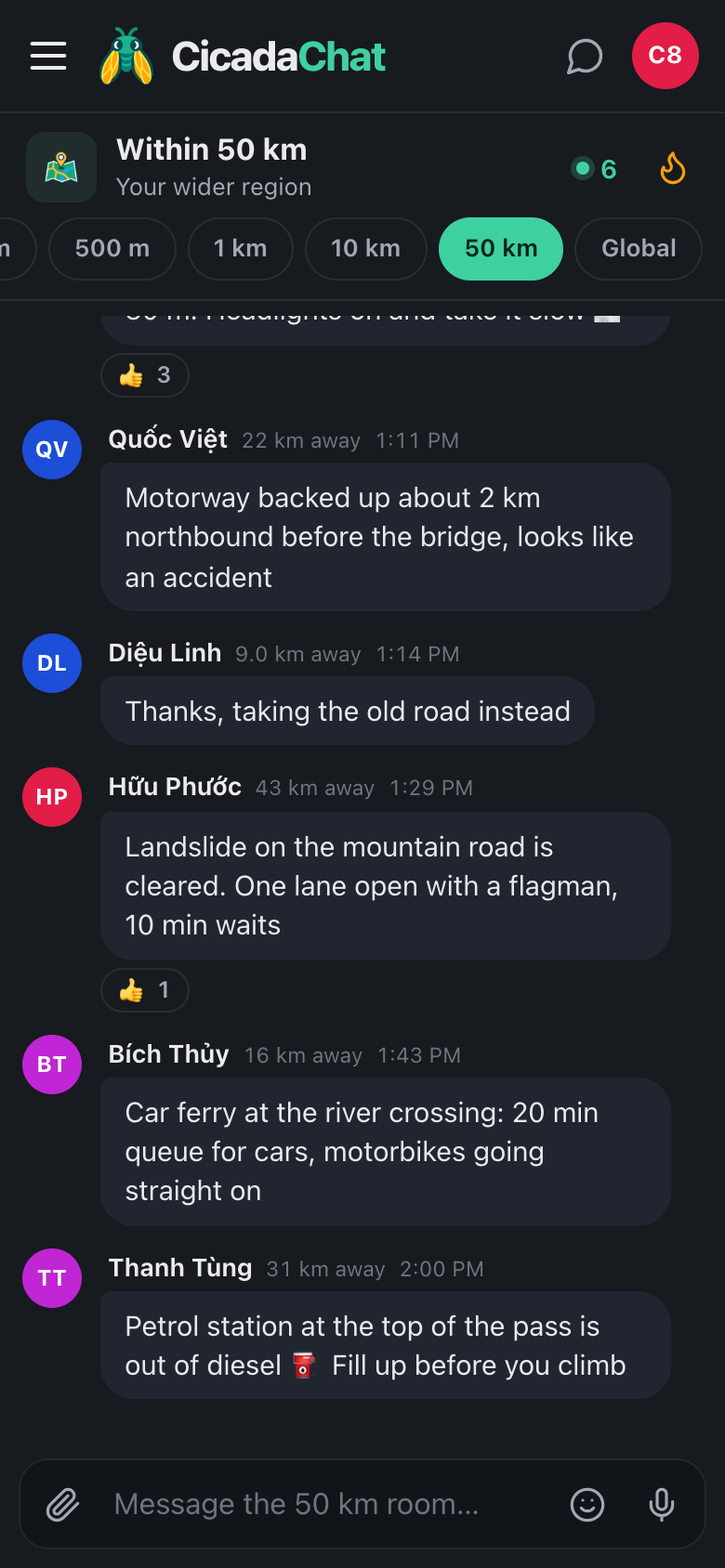
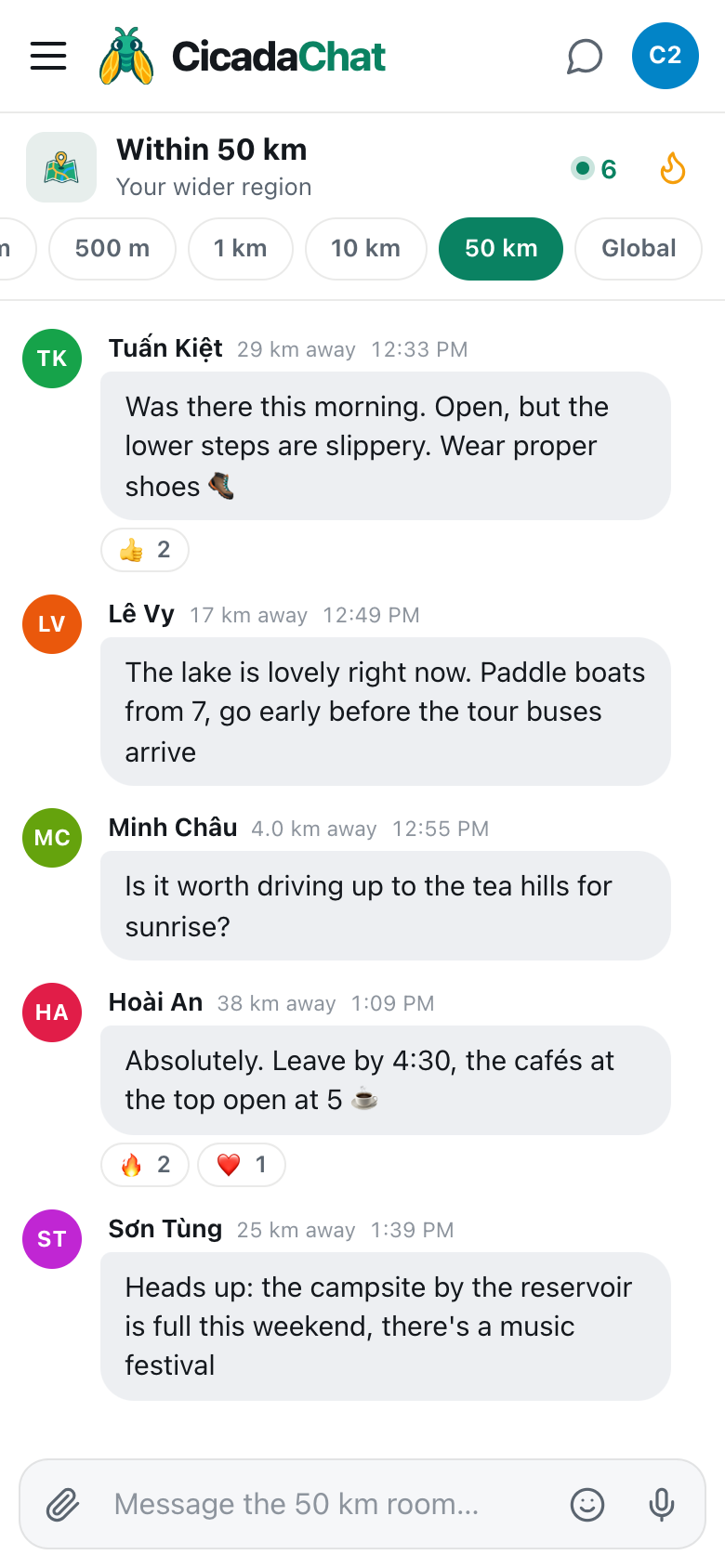
A screenshot of the 50 km room on a phone in the dark theme. Drivers 9 to 43 km away report a motorway jam, a cleared landslide, the ferry queue and a petrol station out of diesel.
A good road report is short and answers four questions: where, which way, what, and when. Compare these two:
- "Traffic's bad."
- "Motorway backed up about 2 km northbound before the bridge, looks like an accident. 1:10pm."
The second tells a stranger 40 km away whether it affects them. Some tips:
- Name the road and the landmark. "The hairpins below the pass", "the toll plaza on the motorway", "the ferry at the river crossing". In a regional room, "the bridge" could be one of twenty.
- Give the direction. A jam northbound is irrelevant to someone going south.
- Say what's changed. When the landslide is cleared or the fog lifts, say so. A message that says "clear now" is as useful as the warning.
- Add a photo if it helps. A picture of the fog or the queue explains more than a sentence. CicadaChat strips the hidden location data from photos before they're sent. Just make sure nobody's number plate or face is the subject.
- Use a voice note when you've stopped. The microphone button records a short message. It's quicker than typing at a rest stop.
Safety first
No chat is worth a crash. Never read or type while driving. Let a passenger do it, or wait until you've stopped somewhere safe: a lay-by, a petrol station, the ferry queue. Every report in the room was written by someone who had a moment to spare, and you can do the same.
If you see an accident or an emergency, call the emergency services first. The room is for letting other drivers know, not for getting help.
Reading the room: which reports to trust
Every message shows how far away its sender was when they sent it, rounded to the nearest kilometre, and the time. Use both:
- The time. A fog report from two hours ago may be out of date. Look for the latest word on each place.
- The distance. Someone reporting on the pass from 31 km away, in the direction of the pass, is probably there. Someone 6.0 km away passing it on is probably not. Distances don't say which direction, but you usually know where the pass is.
- The reactions. A 👍 from other drivers is a confirmation. When several people react to the same report, it's likely right.
- Replies. "Came through 10 minutes ago, still one lane" is worth more than the original report.
Mountain passes
Passes are where the 50 km room shines. Weather at the top can be completely different from the valley: fog when it's sunny below, ice when it's merely cold, a landslide after a night of rain. The people up there are 20 or 30 km away from the towns on either side, outside any town's 10 km room, but well inside the 50 km room.
Before a pass, ask about visibility, the road surface and whether any stretch is down to one lane. After you cross, a quick "top of the pass clear, fog below the first hairpin on the east side" helps everyone coming the other way.
Ferries and river crossings
Ferries run to timetables that weather and tides can ruin. A message from someone in the queue, "car ferry: 20 min wait, motorbikes going straight on", tells you whether to leave now or have lunch first. For island ferries, ask about cancellations early in the day, and say when the boats start running again. That message will get a lot of reactions.
Motorways and toll roads
A motorway covers a lot of ground quickly, so the 50 km room is the right scale for it. Jams on a motorway can stretch for kilometres, and the useful report says where the tail is, not just where the cause is. If there's a sensible alternative, like the old road that runs alongside, someone in the room will know whether it's moving.
Fuel, food and rest stops
On rural roads, the next fuel station can be a long way off. "Petrol station at the top of the pass is out of diesel, fill up before you climb" can save someone a very long walk. The same goes for a closed restaurant, a rest stop with no water, or a good roadside stall that's open late.
Commuting from out of town
If you commute from a satellite town to the city, or from the city to an industrial park, your journey probably runs across the whole 50 km room. Many regular commuters make it a morning routine: check the room before leaving, post one line on arrival. After a few weeks you'll recognise the other regulars by name, and their reports become the ones you trust.
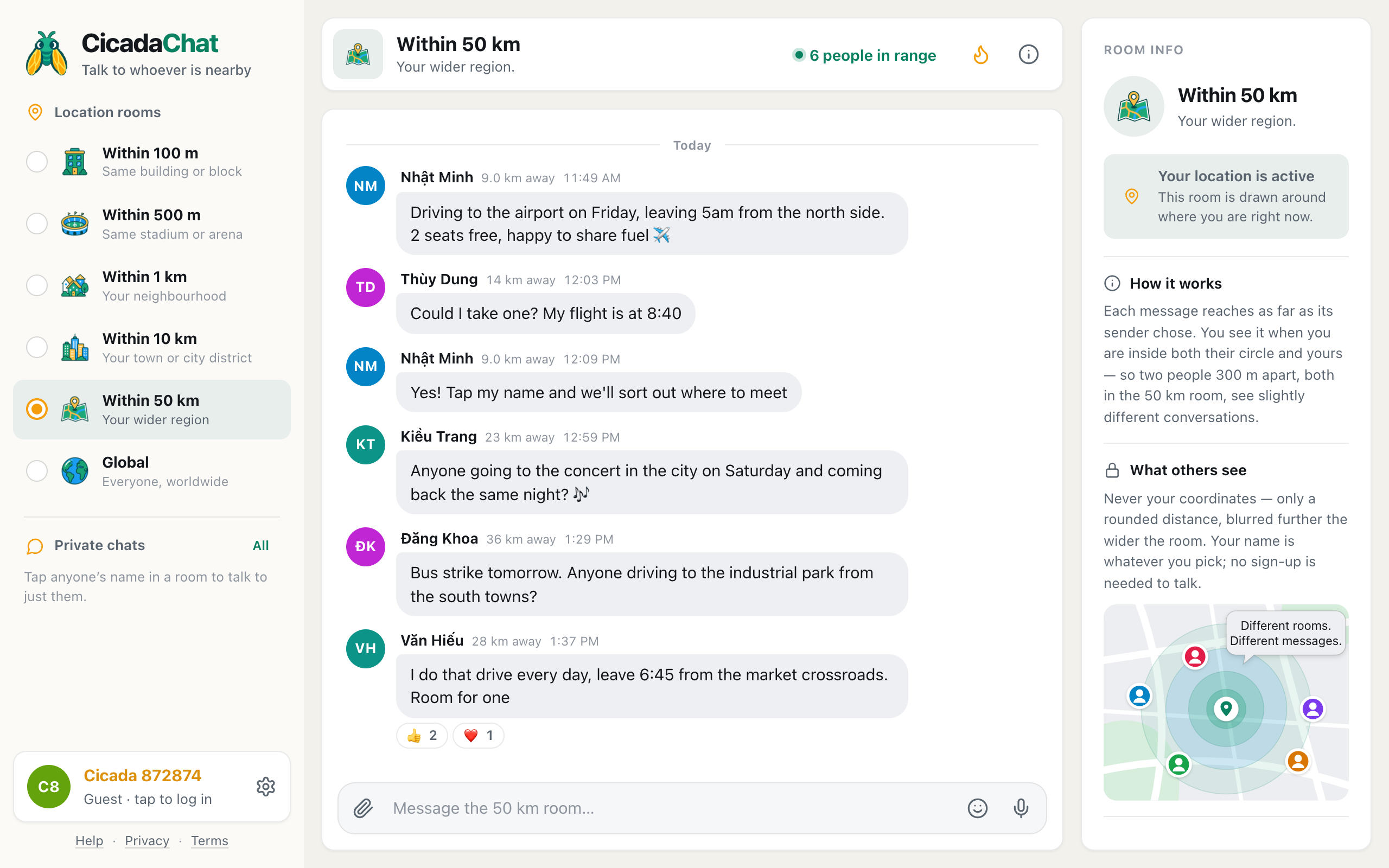
Commuters also share lifts. A spare seat on a daily run is useful to someone every day of the week. Sharing lifts across the region is a big enough topic to have its own article in this category.
Night driving and the dark theme
Checking a bright screen at night hurts your eyes. CicadaChat has a dark theme. Open Settings from the gear button beside your name and, under Theme, choose Dark, or System to follow your device. It's easier on your eyes, and on the eyes of anyone else in the car.
On a phone
Most road reports come from phones. To make CicadaChat quick to open, add it to your home screen so it opens like an app, in one tap. The help article using CicadaChat on your phone: add it to your home screen shows how on each kind of phone.
On a phone, the rooms are a row of tabs under the header: 100 m, 500 m, 1 km, 10 km, 50 km and Global. CicadaChat remembers the room you picked, so if you set it to 50 km before a trip, it opens there next time.
When the weather's the problem
Fog, storms, floods and snow cause most of the worst days on regional roads. The road reports in the 50 km room often turn into weather reports, and the other way round. For more on following the weather across a region, see when the weather crosses the region: storms, floods, smoke and snow in the 50 km room.
A few habits that make the road room better
- Ask before you leave, not while you drive.
- Report where, which way, what and when.
- Say "clear now" when it's clear.
- React to reports that turned out right.
- Keep the talk about roads and places, not about other drivers.
- Share a meeting point, never your home, if you use the Location option. The warning reminds you: Everyone within 50 km will see this exact spot.
No comments yet. Start the conversation.