
Ask the neighbourhood: finding a plumber, a dentist or the best noodle stall within 1 km
How to ask CicadaChat's 1 km room for local recommendations so people answer, how to judge the replies, how Hot keeps the best ones, and how to recommend well yourself.
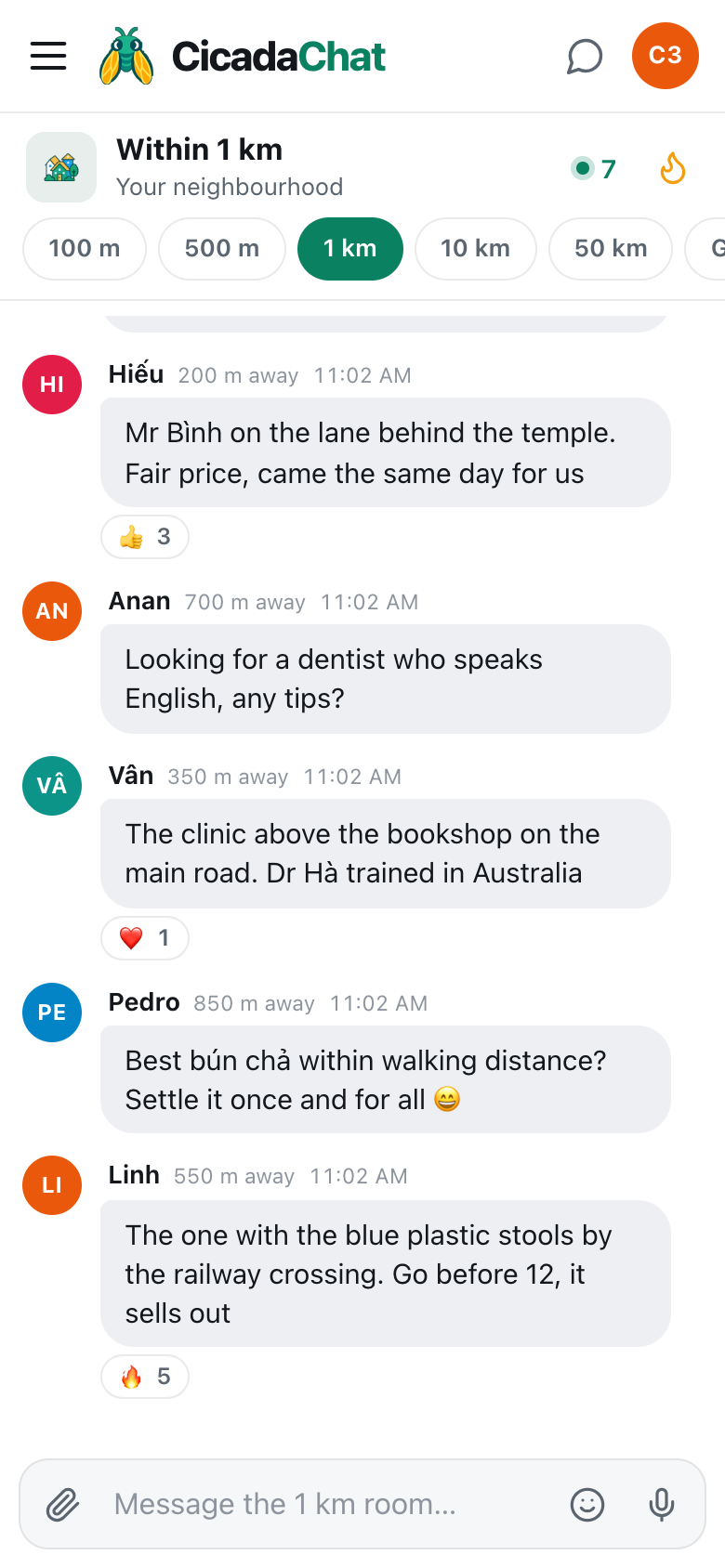
A review site will tell you which dentist has the most stars across the whole city. It won't tell you which one is a ten minute walk away, speaks English and fitted in your neighbour's cracked tooth the same afternoon. For that, you ask the neighbourhood. CicadaChat's 1 km room is the neighbourhood, in one conversation: everyone within a kilometre of you, most of whom have already found a plumber, a dentist and a favourite noodle stall. This article is about asking for local recommendations within 1 km: how to ask so people answer, how to judge the answers, how to find the best ones later, and how to give good recommendations yourself.
Why ask the 1 km room
A recommendation is only useful if you can get there. The 1 km room reaches everyone within a kilometre of where you're standing, a circle two kilometres across, which is about the distance most people will walk for bread, a haircut or lunch. So the answers you get are, almost by definition, places near you.
Every answer also comes with a distance. When someone recommends a plumber from 200 m away, they live round the corner from you and probably used him last month. That's a different kind of recommendation from an anonymous star rating.
And the people answering aren't paid to. Nobody in the 1 km room is there to sell you anything, except the shops who say so, and the room tends to notice quickly who's giving honest advice.
How to ask so people answer
The best questions in the 1 km room are specific, short and easy to answer from memory. Compare:
- "Any good dentists?" gets a few replies, most of them names without reasons.
- "Looking for a dentist who speaks English, any tips?" gets exactly the people who've needed the same thing.
A few things make a question work:
Say what matters to you
"Fair price", "can come today", "speaks English", "good with nervous children", "open on Sundays". One or two conditions help people pick the right answer out of the several they know.
Say roughly where, without an address
Your neighbours see how far away you are, but not in which direction. "Near the temple" or "on the canal side" helps them suggest somewhere that's actually close to you.
Say when you need it
"Leak under the kitchen sink and our landlord is away" tells people it's urgent. "Need a suit taken in by Saturday" tells them there's a deadline. Urgency changes the answer.
Ask one thing at a time
Three questions in one message tend to get three half-answers. Send them separately, and each gets its own replies and reactions.
A screenshot of the 1 km room answering requests for a plumber, a dentist and the best bún chả. Each answer shows how far away the person giving it was.
Where you ask from changes who answers
A message in the 1 km room reaches 1 km around the spot where you sent it, and it stays there. That's worth thinking about before you ask:
- Want a dentist near home? Ask from home. If you ask from your office across town, the answers will be about dentists near your office, because that's where your neighbours-for-the-moment are.
- Want lunch near work? Ask from work, for the same reason.
- Want the best in the whole area? For something you'd happily travel for, like a specialist doctor or a wedding tailor, try the 10 km room, which reaches a whole district. You'll get more answers, but some will be a bus ride away.
Your circle also moves with you. If you ask at home and then walk to the market, the room shifts too. New messages reach you based on where you are now, and when you open the room at the market, it loads what's been said within 1 km of the market, with distances measured from there. Replies sent near home may not be in it if home is more than a kilometre away, and they'll be back when you open the room at home.
A worked example
Say your kitchen tap starts leaking on a Sunday evening. Here's how the 1 km room might help:
- Post from home: "Can anyone recommend a plumber? Leak under the kitchen sink and our landlord is away."
- Within a few minutes, a neighbour 200 m away names a plumber on the lane behind the temple who came the same day for them. Three other people add a 👍.
- Tap the neighbour's name and ask, in a private chat, whether they have his number.
- Once the leak is fixed, go back to the room and add your own 👍, or a line saying how it went. The next person with a leak will find it in Hot all week.
How to judge the answers
Not every answer is equally useful. A few signs help:
- Reasons beat names. "Mr Bình on the lane behind the temple. Fair price, came the same day for us" tells you why, and that they've used him. A bare name tells you much less.
- Reactions are votes. When three people add a 👍 to an answer, three more neighbours agree with it. People only see how many reacted, not who, so a reaction is an easy, low-key way to back a recommendation. See sending messages, emoji and reactions in CicadaChat for how reactions work.
- Distance tells you something. An answer from 200 m away is probably someone who lives near you and goes there often. One from 900 m away might be from the far side of the neighbourhood, where "near" means something else.
- Several independent answers are best. If two people who don't seem to know each other name the same bún chả stall, it's probably good.
Follow up in private
Sometimes you need more than a one-line answer: a phone number, what they paid, whether the dentist is good with children. Tap the person's name on their message to open a private chat with just them. It's more polite than a long public back-and-forth, and it keeps things like phone numbers and prices out of a room of hundreds.
A private chat also keeps working when you're not in the neighbourhood, so you can thank them a week later from work.
Finding the best answers later: Hot
Good recommendations scroll away as the room moves on. The flame button in the header, Hot, brings them back. It shows the room's most-reacted messages from the past week, with the one most people reacted to first. In a neighbourhood room, the best recommendations tend to rise to the top.
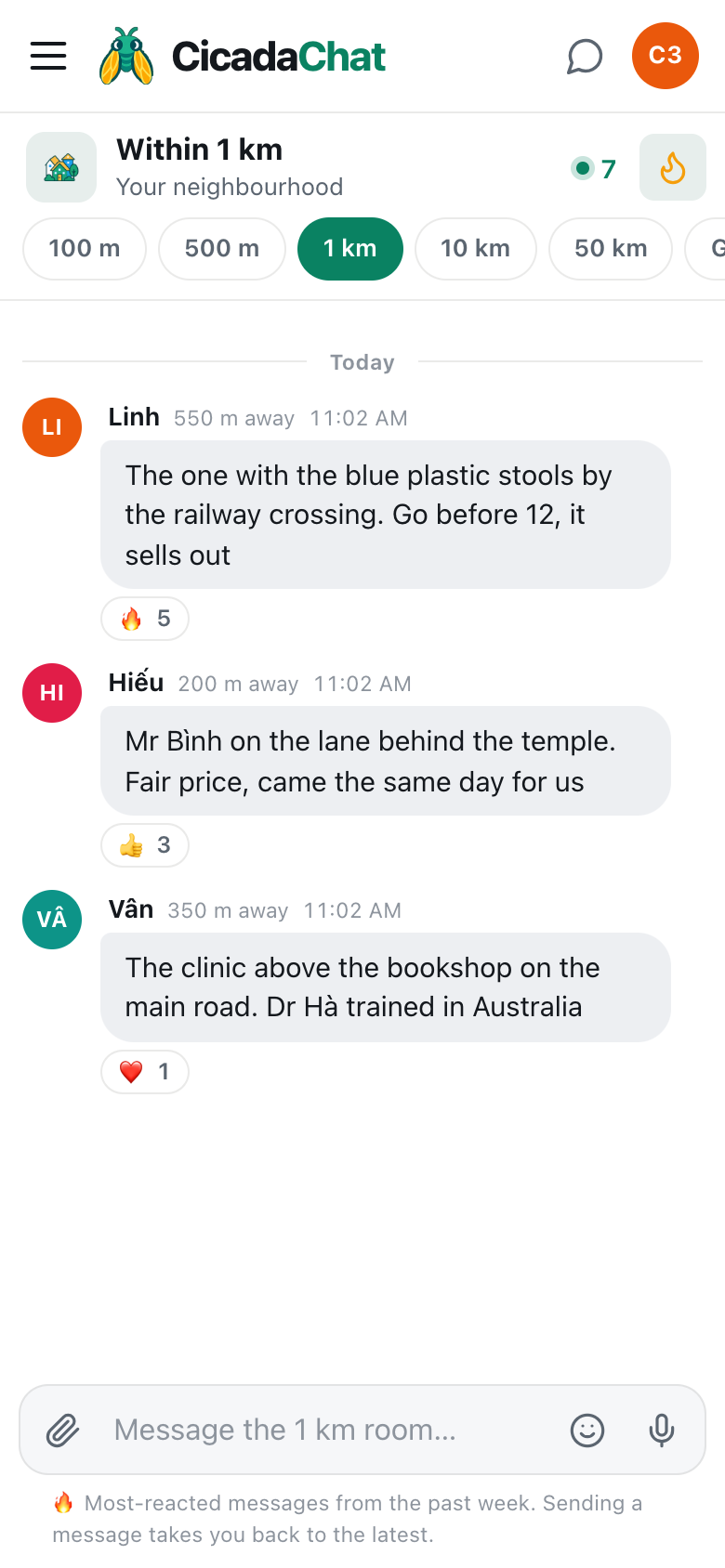
A screenshot of Hot in the 1 km room. The tip five people reacted to is at the top, and the note at the bottom explains what Hot shows.
Under the message box, a note explains: 🔥 Most-reacted messages from the past week. Sending a message takes you back to the latest. Tap the flame again to return to the conversation. Hot only looks back one week, so a tip from a month ago won't be there. If you're looking for something older, scroll up in the latest messages and press Load older messages, or simply ask again. The help article the Hot view: finding a room's best messages from the past week has more.
What people ask the 1 km room for
Trades and repairs
Plumbers, electricians, locksmiths, air-conditioning repair, someone to fix a bike, a phone screen or a sewing machine. This is where a neighbour's recommendation matters most, because a bad tradesperson costs you money and a good one is hard to find.
Health
Family doctors, dentists, pharmacies open late, a physiotherapist, a vet. People often ask for someone who speaks a particular language, or who's good with children or animals.
Food
The best bún chả, the bakery worth queuing for, a place for a birthday dinner, a stall that does vegetarian food, somewhere open after midnight. Food questions are the most fun and get the most answers. They're also where arguments break out, gently. "Settle it once and for all" rarely settles anything.
Everyday services
A tailor, a hairdresser, a key cutter, a printer, a laundry, a tutor, a piano teacher. Things you need a couple of times a year and never remember who to use.
When a business answers
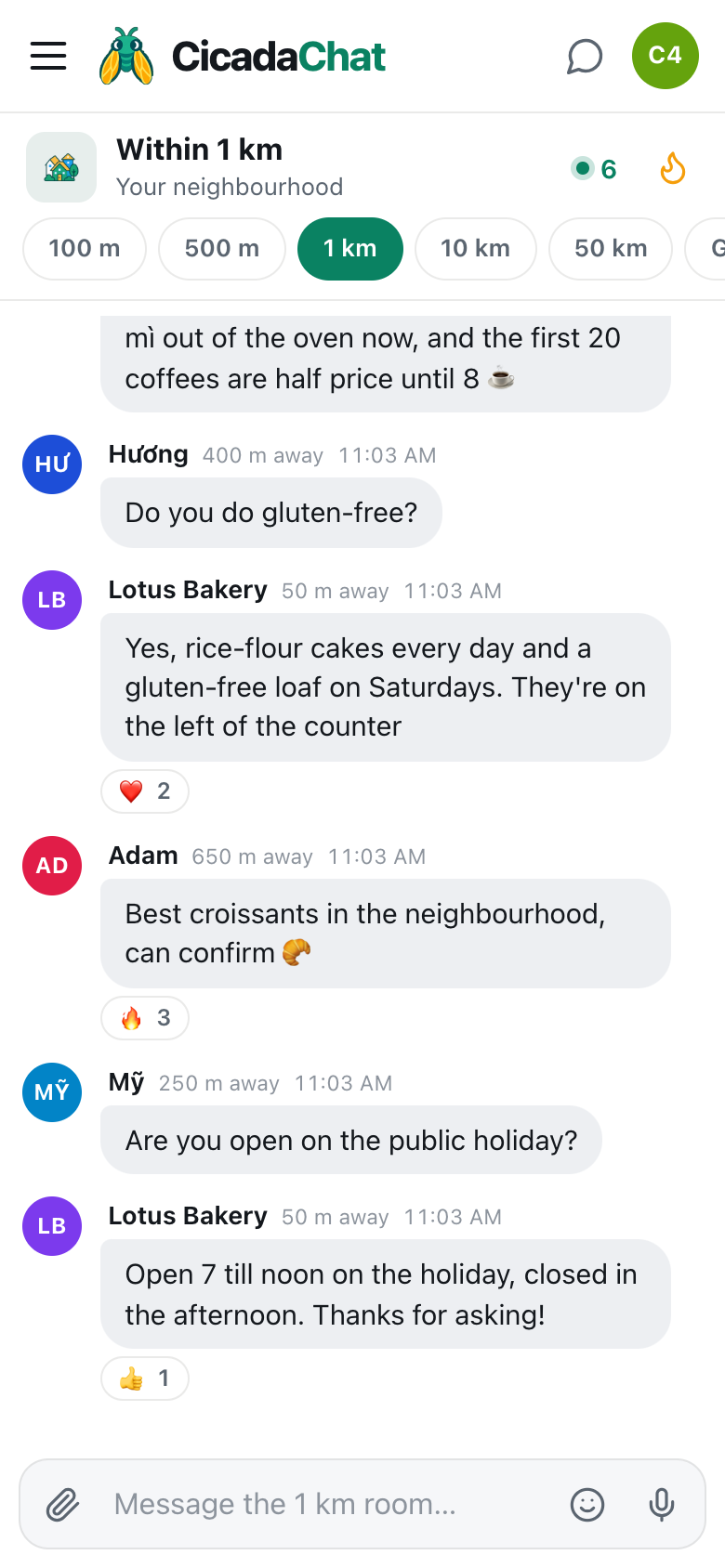
Local shops and services use the 1 km room too. A bakery might post when fresh bread comes out; a tailor might answer a question about alterations. That's welcome, as long as it's clear who's talking. A business posting under its own name, like "Lotus Bakery", tells you exactly who you're hearing from. If a business has added a business card to its registered account, opening a private chat with it shows its description, address and contact details beside the conversation.
If you run a local business yourself, for cafés, shops and restaurants: reaching the neighbourhood in the 1 km room explains how to take part without overdoing it.
Giving good recommendations
The room is only as useful as its answers. When someone asks something you know:
- Say where it is in a way anyone can find. "The clinic above the bookshop on the main road" is better than "the one near me".
- Say why. Price, speed, friendliness, language, quality. One reason is enough.
- Say if it's been a while. "Used them two years ago" is honest and useful.
- Be fair about bad experiences. Stick to what happened, not what you think of the person. And remember they might be reading: they're in the neighbourhood too.
- If someone already gave your answer, react instead. A 👍 on theirs does more good than a second copy of it.
Keep it neighbourly
- Don't post phone numbers of private people in the room. A plumber's business number on his van is one thing. Someone's personal number is another. Share those in a private chat.
- Don't advertise in disguise. Recommending your cousin's restaurant without saying so is the fastest way to lose the room's trust.
- Remember messages can't be deleted. There's no editing or deleting once a message is sent, so be sure before you post a bad review.
Asked well, the 1 km room is the best directory your neighbourhood has, written by the people who live in it.
No comments yet. Start the conversation.